
Fixed garden lighting sounds like a job for an electrician: digging trenches, laying 230 volt cable and having everything inspected. With the Garden Lights 12V system, none of that is necessary. You plug a transformer into an outdoor socket, lay a cable through the garden and click the lights onto it. In this guide you'll read how it works, which components you need, how many lights you can connect and how to install it yourself in an afternoon.
In short: you need three things: a transformer (24, 60 or 150 W), a main cable (fixed or flex) and the lights. Load the transformer with no more than 75% of its capacity, and you can always expand the system later.
Why 12V and not simply 230V?
The main difference lies in the voltage. A transformer converts the 230 volts from the socket into 12 volts of low voltage. This makes the cable in the garden safe, even if you accidentally put a spade through it, and means you're allowed to install everything yourself.
| 12V Garden Lights | 230V | |
|---|---|---|
| Who installs it? | You | Usually an installer |
| Connection | Plug into the socket | Permanently wired to the fuse box |
| Cable | Shallow or under mulch and gravel | Buried deep and protected |
| Adding lights | Click on to the cable | New connection needed |
| Moving a light | Unclip and relocate | Rewiring required |
| Safety | Low voltage, safe for children and pets | Mains voltage in the garden |
Advantages of the 12V system
- No electrician and no excavation work needed
- Expanding and moving lights is always possible, without cutting or soldering
- Energy-efficient LED lights from 0.2 to 12 W
- 5-year guarantee on all Garden Lights products
How does the Garden Lights system work?
Every Garden Lights system consists of three components that connect to each other:
Goes into the outdoor socket and converts 230 volts to 12 volts. The wattage determines how many lights you can connect.
Runs from the transformer through the garden. You connect all the lights to it with a click connection.
Spots, uplights, deck lights, wall lights, standing lights and ambient lighting. Each light has its own cable with a connector.
Because everything clicks together, you can start small. Buy a transformer, a cable and a few spotlights this year, and add wall lights or a string of lights to the same network next spring.
Which lights should you choose where?
Garden Lights has a dedicated type of light for every spot in the garden. Click on a category to see all the models.
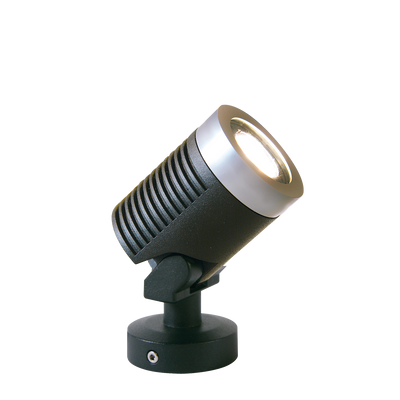
Spots
Trees and borders →
Uplights
In the ground →
Deck lights
Decking and patio →
Wall lights
Walls and fencing →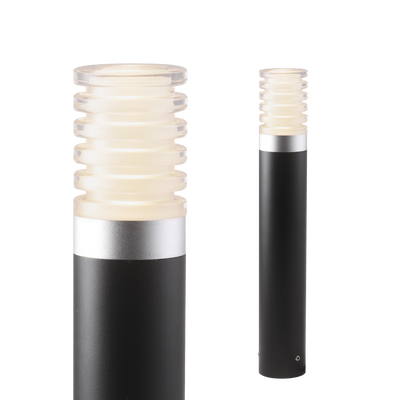
Standing lights
Paths and driveway →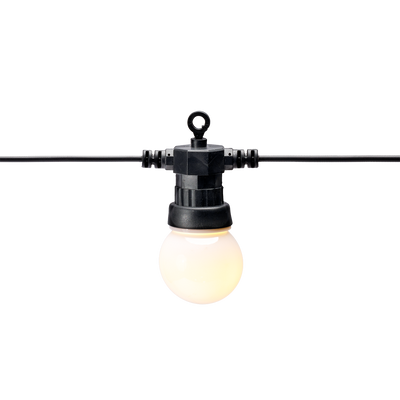
Ambient lighting
String lights →| Type | Where | For example |
|---|---|---|
| Spots | Lighting up trees and shrubs | Jona, 2.3 W |
| Uplights | Buried, invisible during the day | Rubum, 3.5 W |
| Deck lights | Set into decking or patio | Sirius, 1 W |
| Wall lights | Walls, pergola and fencing | Mauri, 6 W |
| Standing lights | Along paths and the driveway | Atila, 1.5 W |
| Ambient lighting | Above the patio | Partylights, 8 W |
Not sure yet what atmosphere you want? In 10 garden lighting ideas you can see how to combine the types.
Which transformer do you need?
The transformer is the heart of the system. Garden Lights offers three, and the rule of thumb is simple: load a transformer with no more than 75% of its capacity. This is also what Garden Lights itself recommends: the 60W transformer is intended for a maximum of 45 W of lights, the 150W for a maximum of 112.5 W.
| Transformer | Maximum lighting load | For example |
|---|---|---|
| 24 W | 18 W | 10 spots of 1.8 W |
| 60 W | 45 W | 25 spots of 1.8 W |
| 150 W | 112.5 W | 62 spots of 1.8 W |
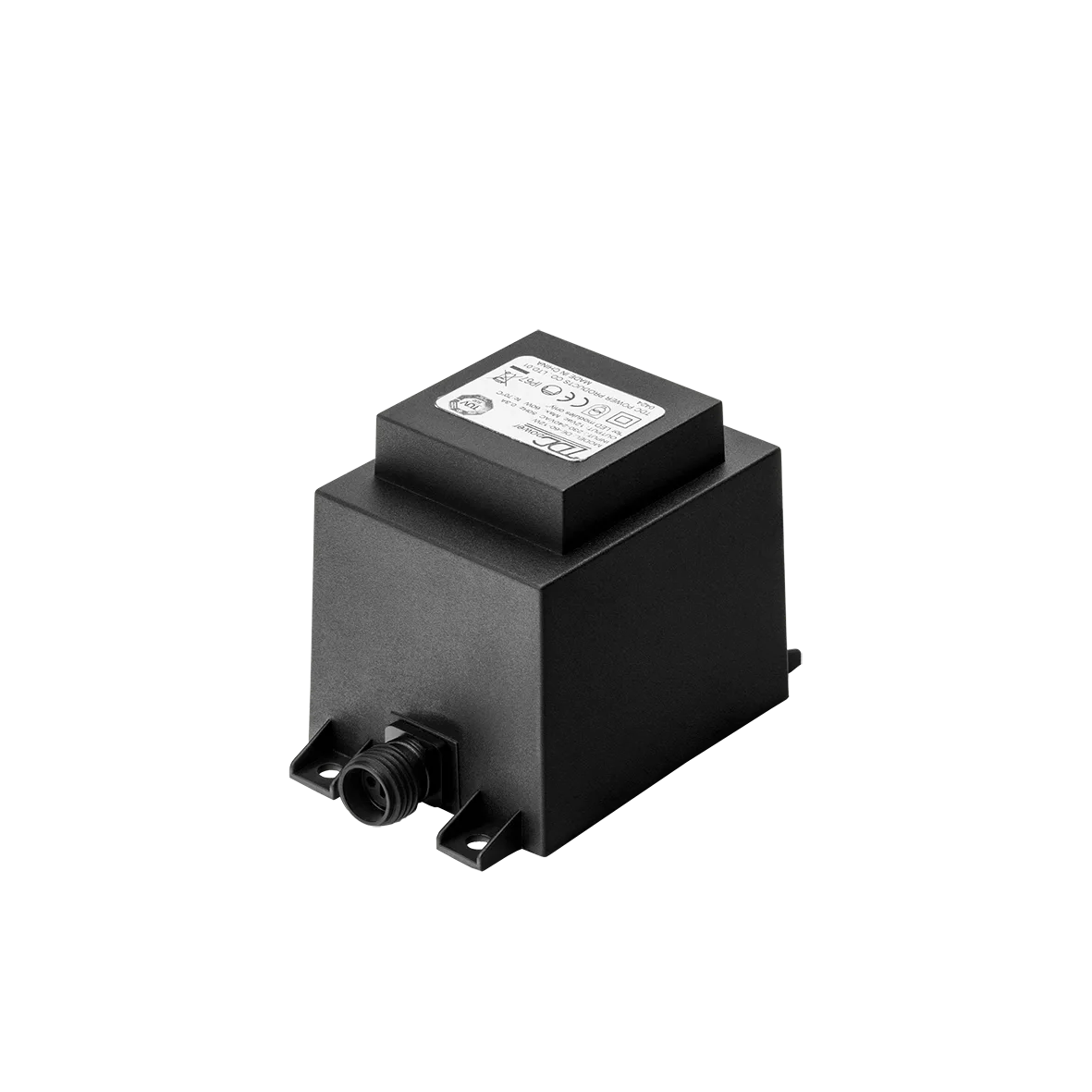
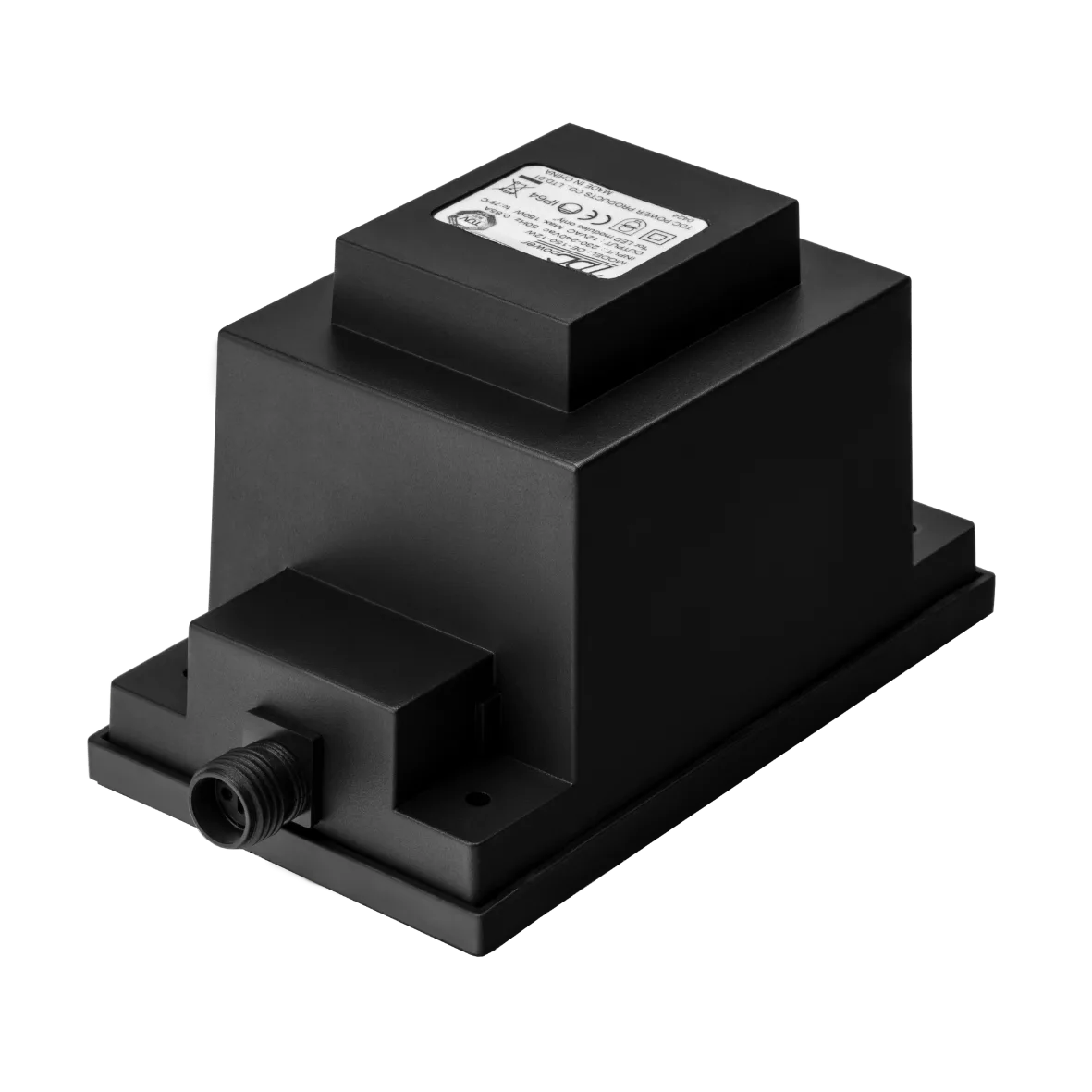
Torn between two sizes? Choose the larger one. That way you can add lights later without buying a second transformer.
Calculation examples: small, medium and large
Add up the wattage of all your lights and compare it with the table above. Here's what that looks like for three gardens, using real models from the range:
Small city garden: 9.2 W
4 × Lovi spot (1.8 W) and 2 × Palm wall light (1 W). A 24 W transformer is enough (maximum 18 W), or go for 60 W if you want to expand.
Family garden: 29.8 W
6 × Jona spot (2.3 W), 4 × Lunia path light (1 W) and 2 × Mauri wall light (6 W). Choose the 60 W transformer (maximum 45 W).
Large garden: 86 W
6 × Corvus spot (5 W), 2 × Rubum uplight (3.5 W), 6 × Atila path light (1.5 W), 4 × Sibus wall light (8 W) and a Partylights string (8 W). Choose the 150 W transformer (maximum 112.5 W).
Write the wattage of each light on your garden sketch. Then you can see at a glance how much room is left if you want to expand later.
Fixed cable or flex cable?
The main cable is the backbone of your installation. Garden Lights offers two systems, and the difference lies in where you connect the lights:
| Fixed cable | Flex cable | |
|---|---|---|
| Length | 15 metres | 10, 25 or 50 metres |
| Connection points | 6, at fixed positions | Choose yourself, with flex connectors |
| Separate connectors needed? | No, ready straight away | Yes, a male or female flex connector per light |
| Ideal for | A straight strip along a path or border | Irregular gardens and lights in precise locations |
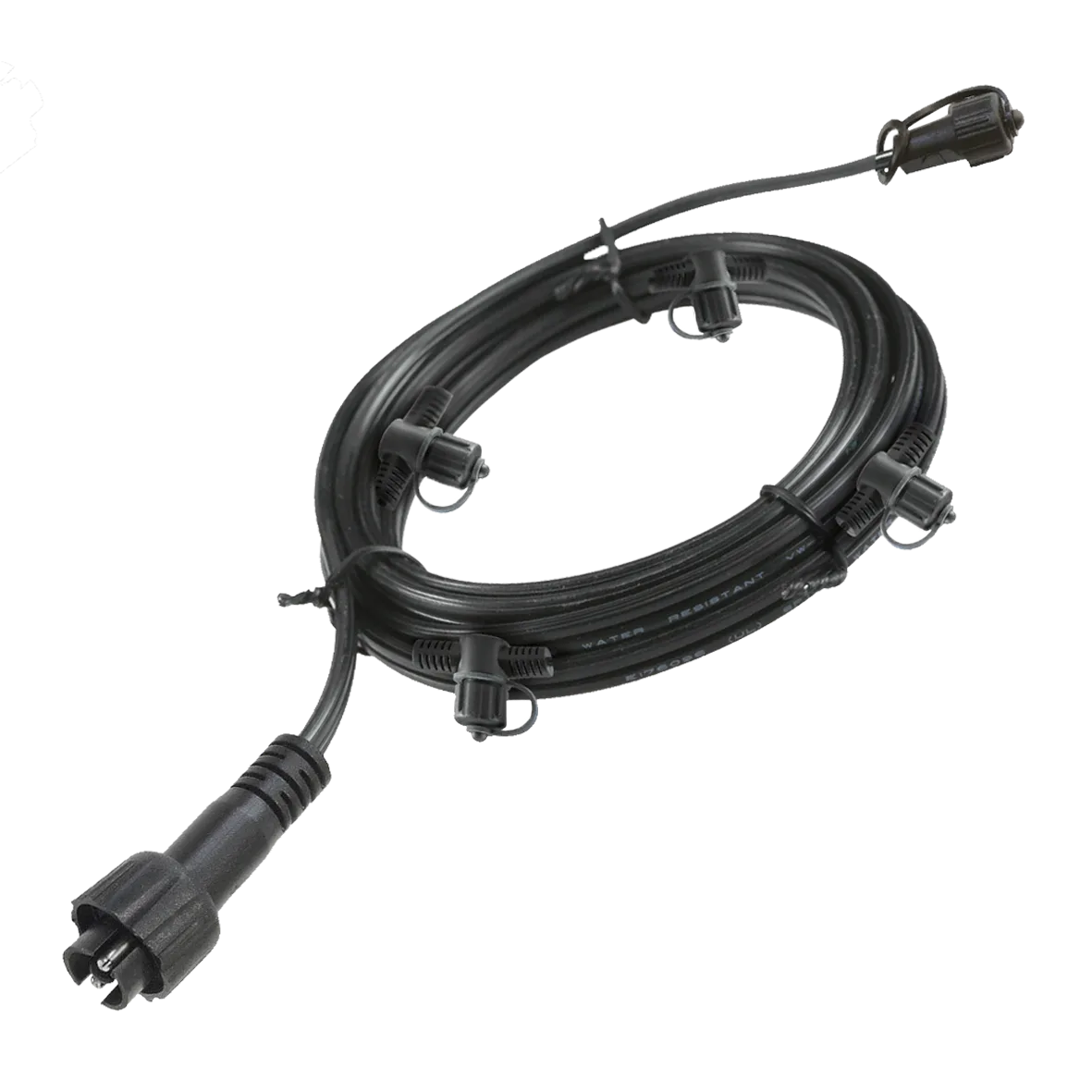
Main cable fixed 15 meter
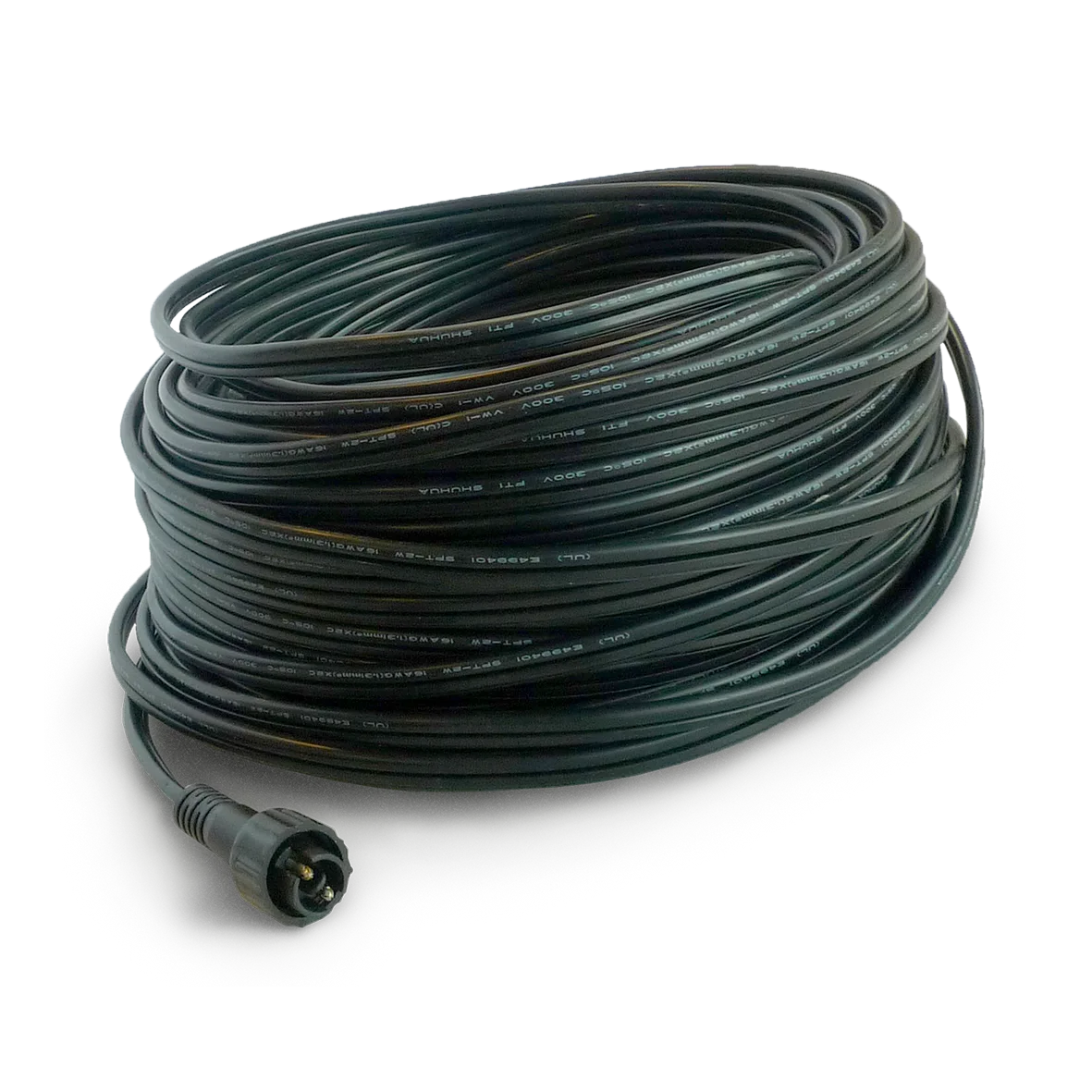
Flex main cable 25 meter
Falling just short, or want a branch running to the other side of the garden? Use an extension cable (30 cm, 2, 6 or 10 metres) or a cable splitter with three outputs. Several shorter branches often work better than one very long cable.
Installation step by step
With good preparation, you can light an average garden in an afternoon. Here's how to go about it:
Roughly draw the garden and mark where the outdoor socket is, where you want lights and which route the cable will follow. Measure the route and allow an extra 30 cm per light.
Note the wattage of each light on your sketch and choose a transformer that can handle the total with no more than 75% load.
First lay the main cable over the lawn or border, without burying it yet. Along a fence or hedge, secure it with cable clips.
Connect each light to a connection point or flex connector. You don't need any tools: the connection clicks into place. Push spots into the ground with the ground spike.
Plug the transformer into the socket and walk through the garden in the dark. Adjust spots and move lights until the light falls well.
Only once everything is right do you tidy the cable away: just below the surface or under mulch, bark or gravel. That way you can still move things easily later on.

5 common mistakes when installing
Choosing a transformer that's too small
A transformer running at 100% gets hot and won't last as long. Keep 75% as the maximum, and also factor in any lights you may want to add later.
Measuring the cable too short
Detours around the patio, pond and borders add up quickly. Measure the actual route and allow an extra 30 cm per light for the connection.
Burying first, testing afterwards
Only bury the cable once you've checked in the dark how the light falls. Otherwise you'll have to dig everything up again just to move a spot.
Everything lit equally brightly
A garden where everything is lit to the same brightness looks flat. Use stronger spots for one or two focal points and soft path lights for the rest.
The wrong IP rating for ground-level fittings
Lights that go in the ground or in decking must be able to withstand standing water. Choose at least IP67 there, as with deck lights and uplights.
Automatic on, remote control or via the app
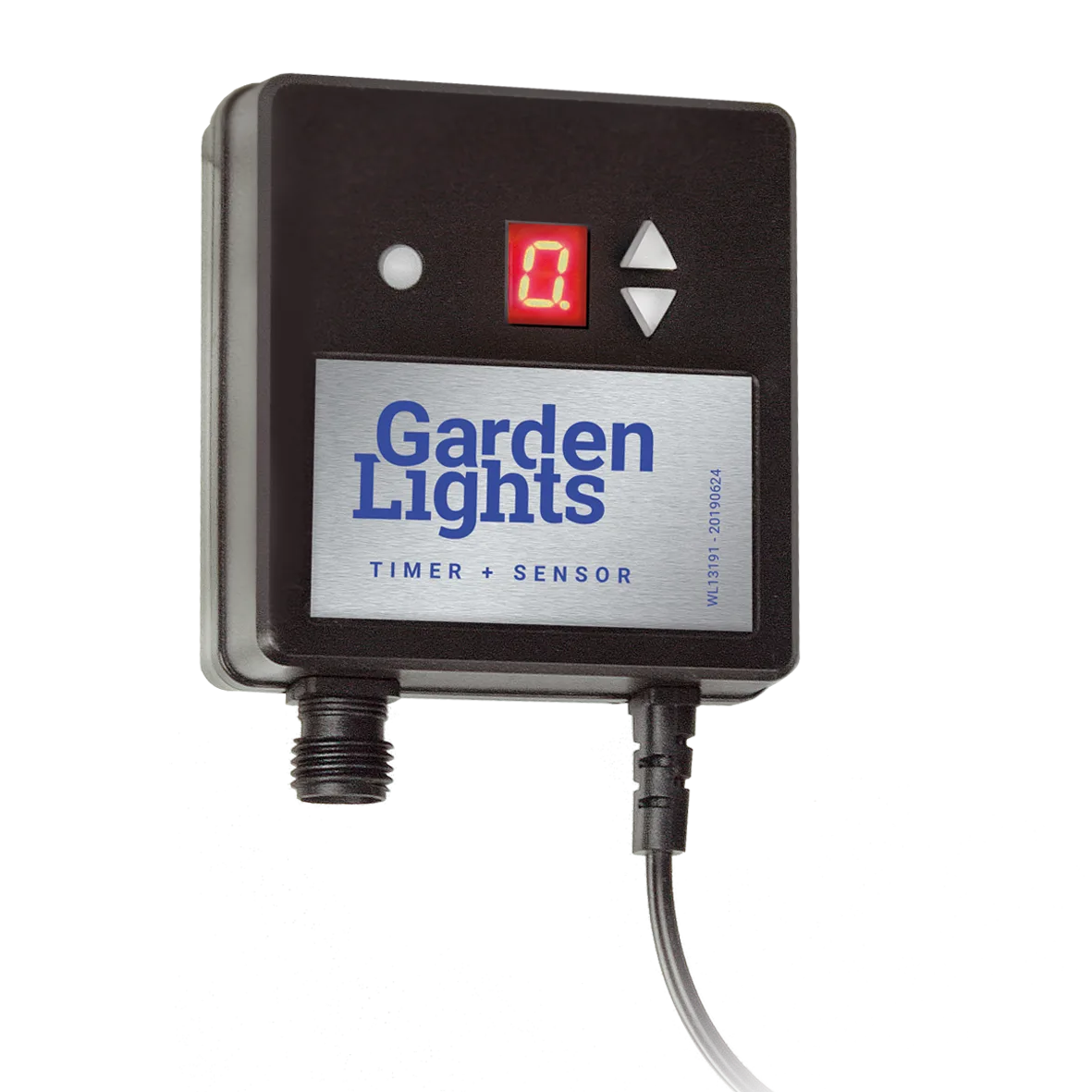
A transformer doesn't have a timer clock of its own. Would you like the lighting to switch on and off by itself, or would you rather control it from the patio? There are three options, all of which work on the same 12V system:
| Option | What it does | For whom |
|---|---|---|
| Timer + Dusk to Dawn Sensor | Switches on automatically at dusk, up to 150 W | Anyone who never wants to think about it |
| Remote + Receiver | Remote control for up to 9 receivers, range up to 40 m | Anyone who wants to switch groups of lights separately |
| Smart series | Dimming and colour selection via the app, with the Garden Lights Gateway | Anyone who wants to control their garden lighting smartly |
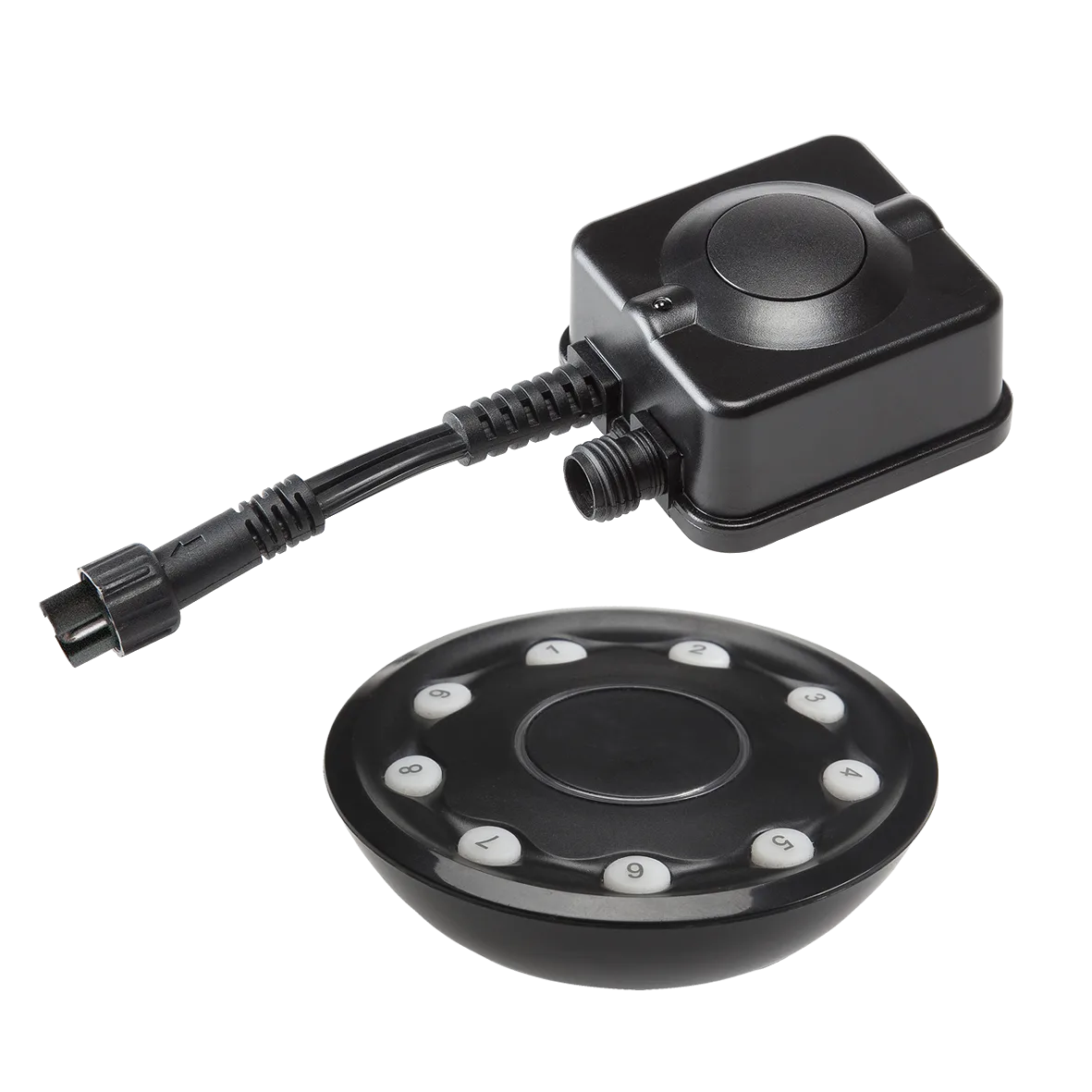
The lights from the Smart series (5 W) can produce anything from warm white to cool white light, and any RGB colour. They run on the same cable and transformer as the standard lights, so you can simply add to an existing system.
Which IP rating do you need?
The IP rating indicates how well a light is protected against water and dust. All Garden Lights fittings can stay outdoors all year round, but the location determines which rating you need:
| IP rating | Meaning | Suitable for |
|---|---|---|
| IP44 | Splash-proof | Spots on a ground spike, wall lights, standing lights |
| IP54 and IP65 | Additional protection against dust and water jets | Locations exposed to heavy rain, such as a free-standing wall |
| IP67 | Withstands temporary immersion | Deck lights and uplights in decking or the ground |
| IP68 | Withstands prolonged immersion | Very wet locations, such as the Lapis and Protego spots |
Warm white or cool white?
Most Garden Lights fittings give warm white light at 3000 K, which looks soft and cosy. Filament lamps at 2000 K are even warmer, while cool white at 6000 K is crisper and suits modern gardens. Choose one light colour for the whole garden and it will look calm.
Maintenance: twice a year
Wipe the lights down with a damp cloth in spring and autumn, and check that the connections are still secure. Nothing more is needed, and all Garden Lights products come with a 5-year guarantee.
Starting with a complete set
Would you rather not work everything out separately? A Garden Lights set contains everything you need to get started straight away: three lights, an 8-metre main cable and a 12 W transformer. Ideal for a path, a border or a first introduction to 12V garden lighting.
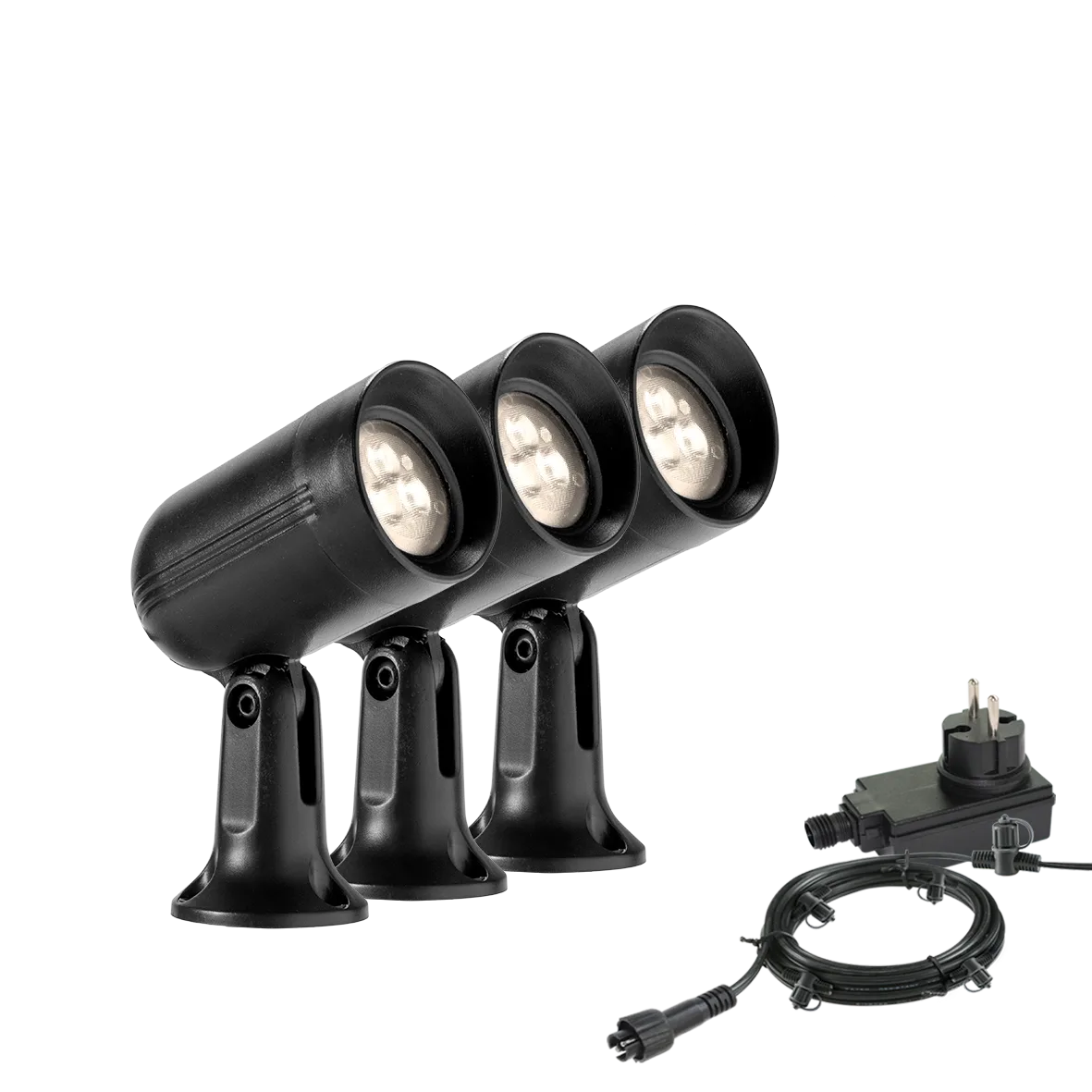
Xiro set: 3 ground spots
View set →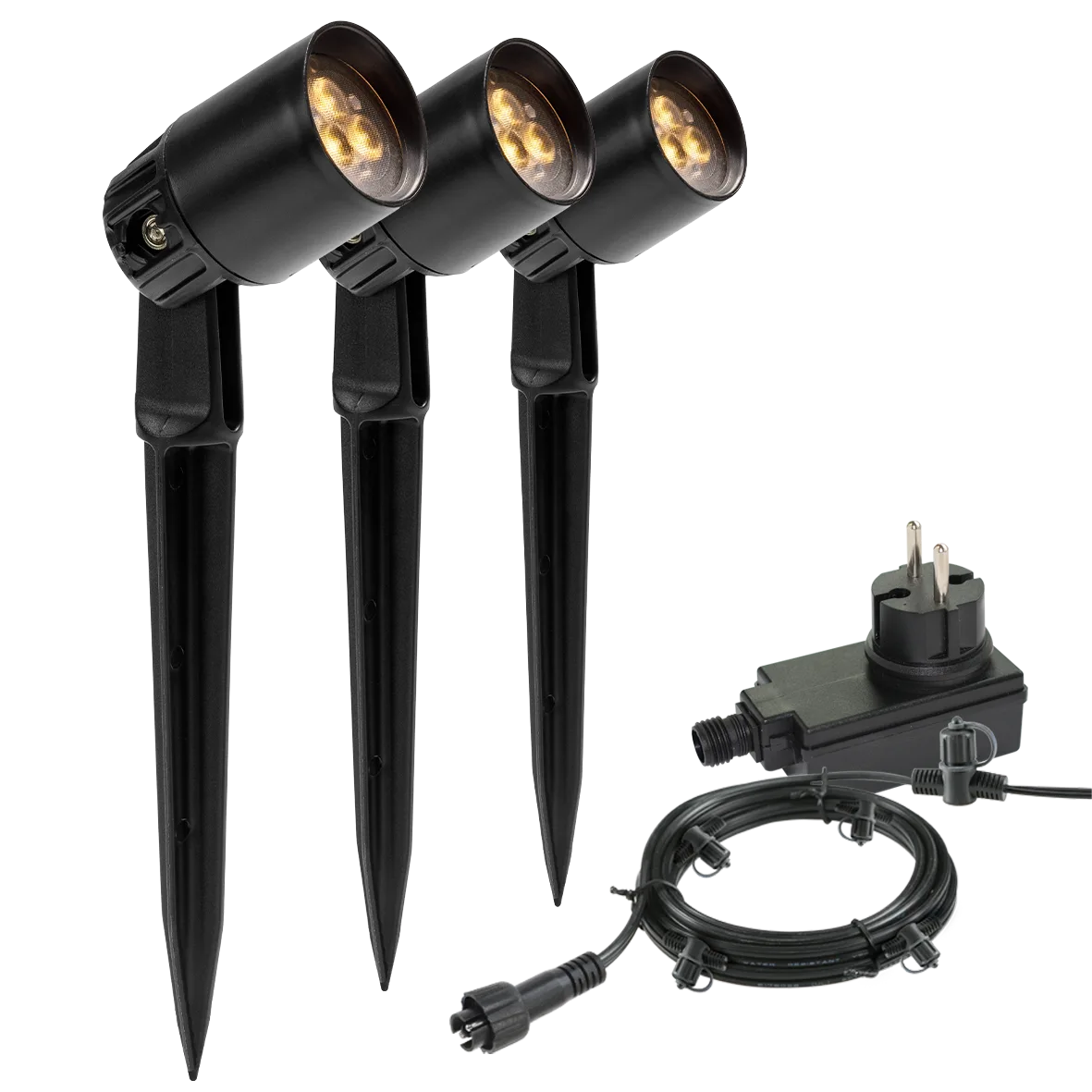
Neso set: 3 spots
View set →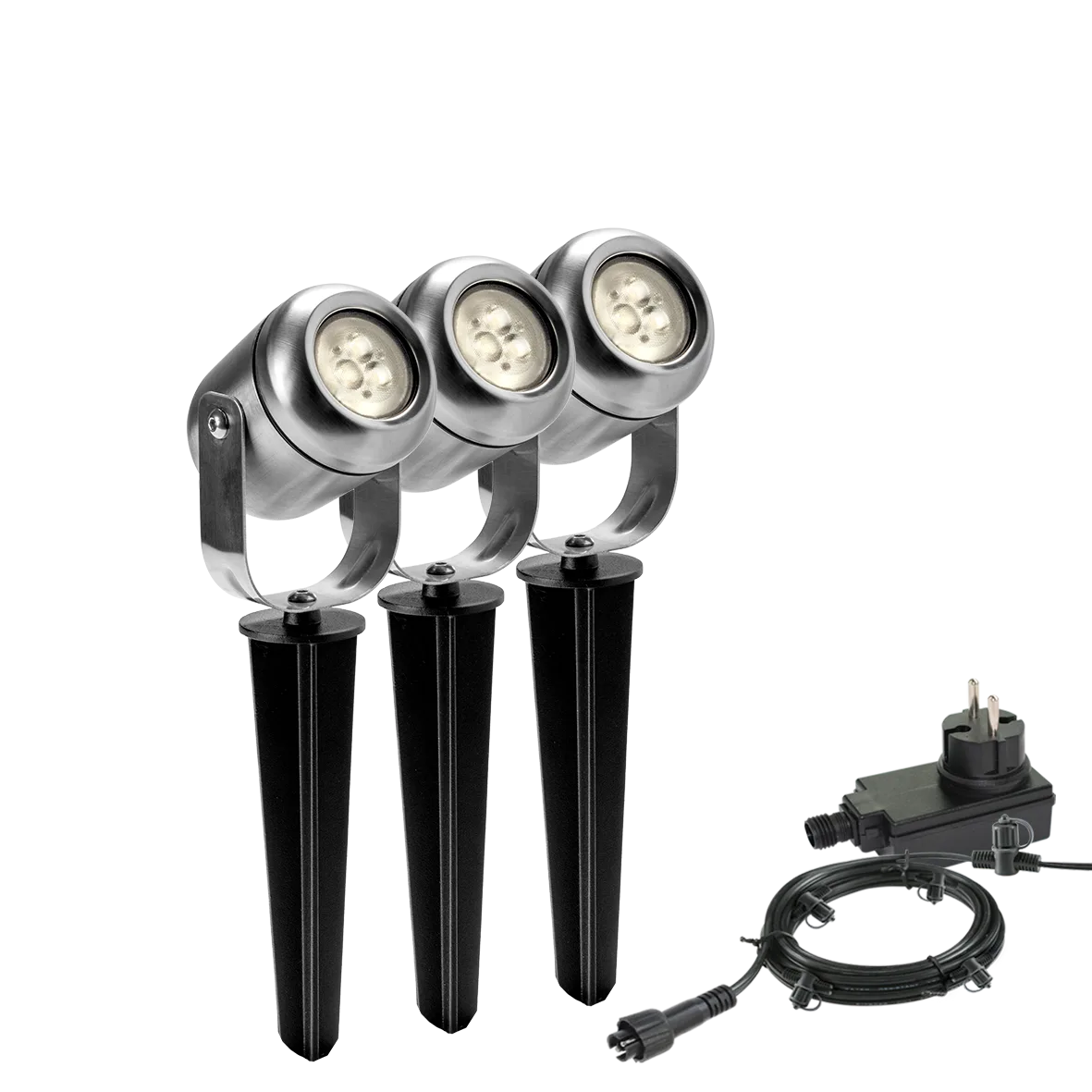
Jard set: 3 stainless steel spots
View set →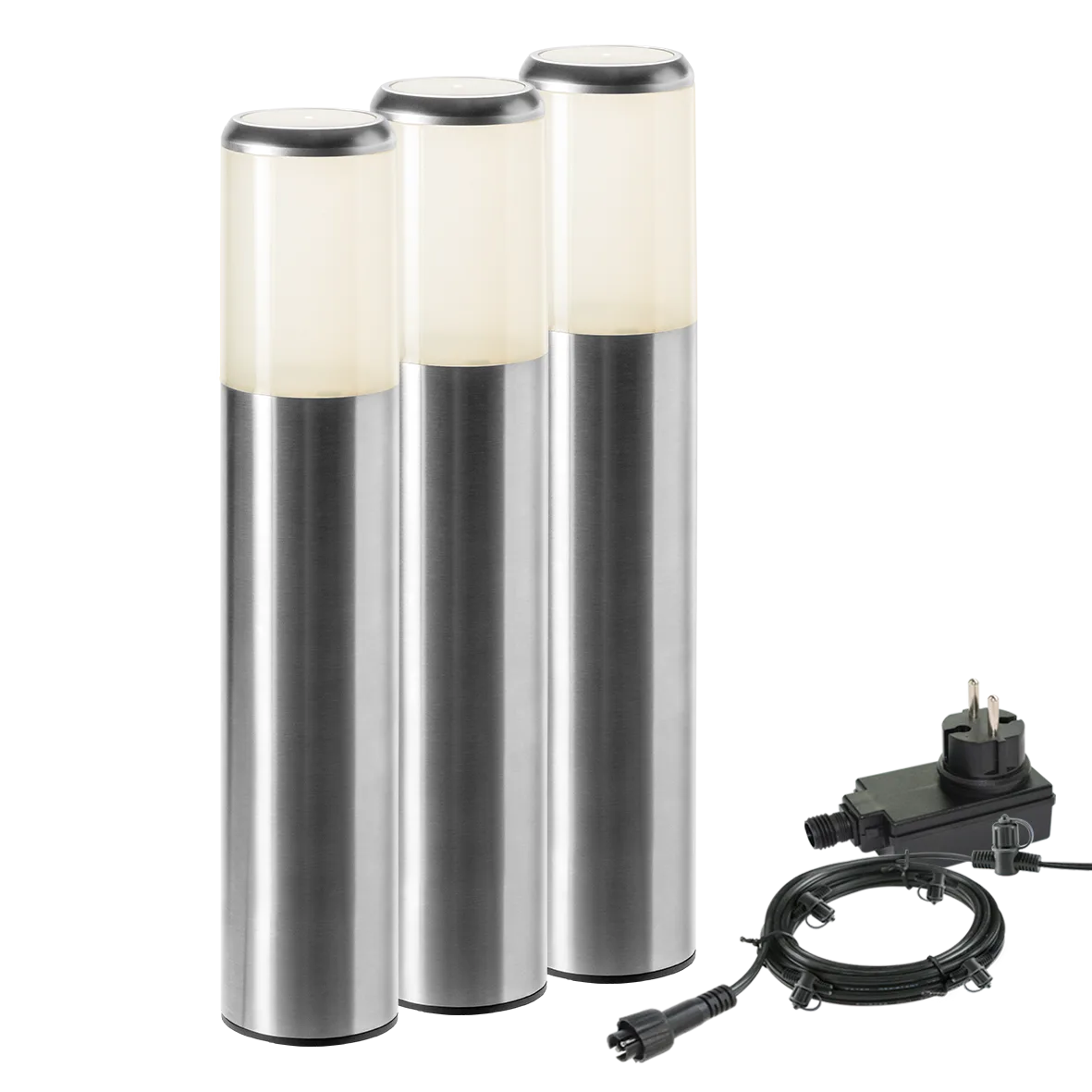
Novu set: 3 posts
View set →Want to connect more lights later than the set can handle? Then switch to a 60 or 150 W transformer and a longer main cable.
Garden Lights installation videos
Would you rather see how it works first? Garden Lights has official instructional videos. These three are the most useful for a first installation.
Explainer: the 12V system in a nutshell
Connecting with the fixed main cable
Connecting with the flex cable
Frequently asked questions
Do I need an electrician for Garden Lights garden lighting?
No. The transformer plugs into a standard outdoor socket and converts the mains voltage to safe 12 volts. You fit everything after that, from cable to lights, yourself and without any tools.
How many lights can I connect to one transformer?
Load a transformer to no more than 75% of its rated power: 45 W on the 60W transformer and 112.5 W on the 150W transformer. Add up the wattage of all your lights. With 1.8 W spotlights, you can therefore connect 25 spotlights to a 60W transformer.
What is the difference between the fixed cable and the flex cable?
The fixed 15-metre main cable has 6 connection points in fixed positions, so it is ready to use straight away, but your lights must be placed at those points. On the flex cable (10, 25 or 50 metres), you click flex connectors exactly where you want them, giving you more freedom when positioning your lights.
How deep does the cable need to go underground?
A 12V cable does not need to be buried deeply. Lay it just below the surface or hide it under mulch, bark or gravel, so you won't cut into it when digging. If you want to move lights later, a shallow cable is especially handy.
Can I have Garden Lights garden lighting switch on automatically?
Yes. With the Timer + Dusk to Dawn Sensor, the lighting switches on automatically at dusk, and with the Remote + Receiver you can control up to 9 receivers from a distance. The Smart range is controlled via the app with the Garden Lights Gateway.
How long do the LED lights last?
Most Garden Lights fittings have a rated lifespan of 25,000 hours, while some have 30,000. If your lighting is on for 5 hours every evening, that works out at well over 13 years. All Garden Lights products come with a 5-year warranty.