
What exactly is a ground spot?
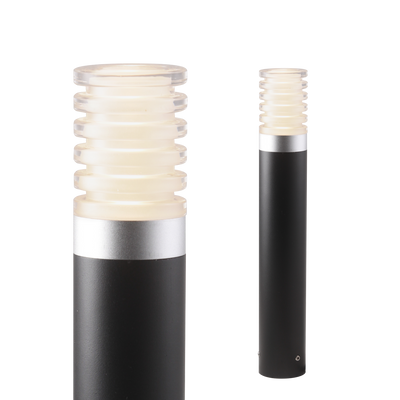
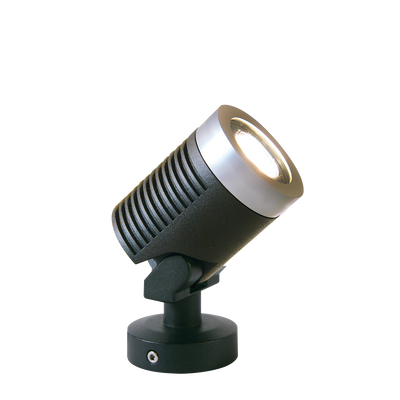
A ground spot is an outdoor lamp that, low to the ground — or in the ground — projects a concentrated beam of light upwards or to the side. They are used to dramatically illuminate trees, ornamental shrubs, masonry, sculptures or borders after sunset. During the day they are barely noticeable; in the evening they become the focal point of your garden.
The term 'ground spot' is used in practice for two types of lamps that look similar at first glance but are technically different: spike spots (which stand above ground on a spike) and recessed spots or uplights (which are mounted flush into the ground). We explain the difference below.
Spike spot or recessed uplight: what suits you?
Spike spot: flexible and visible
A spike spot or garden spot has a ground spike that you push into the soil. Advantages: easy to move, no digging or drilling, and you can adjust the direction freely. Disadvantage: the fitting is visible during the day. For most gardens this is not a problem — modern spike spots like those from Garden Lights have a sleek, minimalist stainless steel design that looks neat even during the day.
Recessed spot / uplight: invisible and permanent
An uplight or recessed ground spot is completely buried in the ground so that only the glass cover plate sits at ground level. During the day you see virtually nothing; in the evening the light shines straight upwards. Disadvantage: installation requires digging a hole and is less easy to relocate.
Rule of thumb: choose a spike spot if you want flexibility and the position of your lighting is not yet final. Choose an uplight if you want a permanent, completely invisible solution for a mature tree or fixed border.
IP rating: how waterproof does a ground spot need to be?
The IP rating (Ingress Protection) indicates how well a lamp is protected against dust and water. For garden lighting these are the most relevant ratings:
- IP44 — splash-proof. Suitable for normal garden conditions (rain, sprinklers). Not suitable for burying in the ground or placing in a pond.
- IP65 — dust-proof and water jet resistant. Good for places that get regularly wet, even from multiple directions.
- IP67 — fully dust-proof and temporarily submersible (up to 1 metre, 30 minutes). Recommended for uplights that are buried in the ground or stand in wet areas.
- IP68 — permanently submersible. Required for underwater lighting in a pond.
For spike spots that stand above ground, IP44 is sufficient. For uplights that are buried in the ground, choose a minimum of IP67.
Material: stainless steel, aluminium or plastic?
Stainless steel (SS)
The premium choice for outdoor lighting. Stainless steel does not rust, is resistant to salt (even for coastal areas), maintains its appearance for years and feels high quality. Garden Lights spots are mostly made from SS 304 or SS 316. Heavier than aluminium, but that also gives a solid, stable feel.
Aluminium (cast or sprayed)
Lighter than steel, also rust-proof and resistant to the elements. Aluminium with powder coating is the most common application for outdoor lamps; the coating protects the aluminium and determines the colour (usually black, anthracite or silver-grey). Slightly less premium than stainless steel but excellent for normal garden use.
Plastic
Inexpensive, light and corrosion-free, but less durable in the long term. UV radiation and temperature fluctuations can make plastic brittle and discoloured over time. Not recommended for permanent outdoor installations.
Advice: for garden spots that remain outside permanently, always choose stainless steel or high-quality aluminium with powder coating. The investment is higher, but the lifespan is many times longer.
Wattage and lumens: how much light do you need?
Many people look at wattage when buying an outdoor lamp, but lumens is the better measure: lumens indicates how much light a lamp actually produces, wattage only tells you about energy consumption.
- 100–200 lumens: subtle accent lighting for small shrubs and low borders. Not dazzling, pleasant for the eyes.
- 200–400 lumens: good for medium-sized shrubs, borders and path lighting.
- 400–800 lumens: for mature trees and larger accents where you need more light reach.
Garden Lights spots typically range from 1.8W to 5W — with LED already sufficient for impressive lighting effects. Do not choose too much wattage: too bright a spot looks intrusive and dazzles when looked at directly.
Light colour: warm white or cold white?
The colour temperature of light is expressed in Kelvin (K) and greatly influences the atmosphere:
- 2700–3000K (warm white): golden yellow, comparable to an incandescent bulb or candle. The cosiest and most atmospheric light for a garden. Choose this for 95% of situations.
- 4000K (neutral white): bright, white light. Good for functional lighting (driveway, work area), less suitable for atmospheric accents.
- 6000K+ (cold/daylight): bluish, clinical. Rarely desired in a home garden.
Garden Lights spots are in most cases available in warm white (3000K), which immediately provides the warmest and most atmospheric result in an average garden.
12V or 230V: what suits your garden?
Most quality ground spots for garden use are available in 12V or 230V. Both have advantages and disadvantages:
| 12V (low voltage) | 230V (mains power) |
|---|---|
| ✓ Can be installed yourself | ✗ Electrician required |
| ✓ Safe (no risk from contact) | ✗ Cable must be buried at least 60 cm deep |
| ✓ Easy to extend | ✓ No power limitation per cable |
| ✓ Flexible to relocate | ✗ Less flexible |
| ✗ Maximum power per transformer | ✓ Higher light output possible |
For most residential gardens 12V is the most sensible choice: cheaper to install, safer and sufficient for all decorative and atmospheric lighting. Only for large projects with many powerful lamps over long distances is 230V a serious consideration.
Installation tips for the best lighting result
- Angle is everything: do not aim a spike spot straight upwards but at an angle of 30–45 degrees at the object. This creates more depth, shadow and drama.
- Distance to the object: maintain a minimum distance of 50–80 cm for a tree or large shrub. Too close creates an uneven light patch; more distance creates a softer, broader lit image.
- Avoid glare: position the spot so that you do not look directly at the lamp when sitting on your terrace. Glare is the biggest aesthetic problem with poorly placed garden lighting.
- Test at night: do the first trial setup in the evening before you lay cables permanently. What looks logical during the day can look very different in the evening.
Which Garden Lights ground spot suits your situation?
The Garden Lights spots range offers a suitable lamp for every application:
- Small borders and paths: compact spots such as the Nano (1.8W) or Minus (2W) — subtle light, barely visible during the day.
- Medium-sized shrubs and borders: Corvus or Arcus (5W) — more powerful light beam, still warm and more atmospheric than functional.
- Large trees and accents: Flood 12 (12W) — for when you want a truly impressive lighting effect on a mature tree or large façade.
- Completely invisible in the ground: see the uplights for a recessed alternative.
All Garden Lights spots work on the 12V system and are easy to install yourself. View the complete garden lighting range or read more about how the system works in our article on installing garden lighting.
See the Garden Lights Jona in action
Curious to see what a ground spot looks like in practice? Watch the Garden Lights Jona LED spot in the video below.
Garden Lights Jona — LED spot