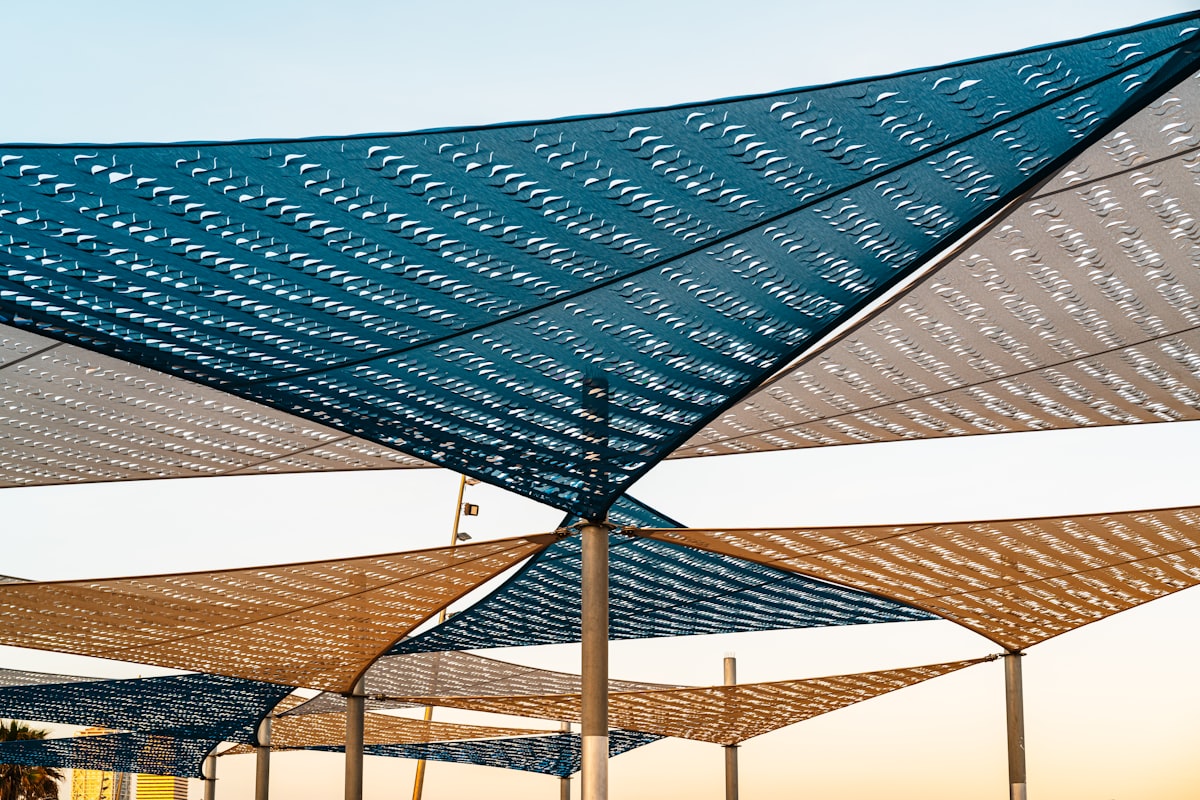

A shade sail (also called a sun sail) is a stylish and modern alternative to a parasol. Instead of a base and mast, you use attachment points on walls, poles or trees. The result: a sleek, architectural shaded area that gives your terrace or garden a completely different look.
Hanging a shade sail is a job you can complete with two people in an afternoon. In this guide, we explain step by step how to tackle it.
What do you need?
- A shade sail (triangular, square or rectangular)
- Mounting materials: wall eyes, carabiners or shade sail mounting kit
- Optionally: wooden or steel poles (if you don't have walls)
- Tensioners or straps to pull the sail taut
- Drill with masonry bit (for wall mounting)
- Spirit level and measuring tape
- Fischer plugs suitable for your wall type (concrete, brick, etc.)
Step 1: Determine the position and height
Think about where you want shade and at what time of day. Take the sun's position into account:
- Morning sun from the east — hang the sail higher on the east side.
- Midday sun from the south — the sail must cover the south side.
- Evening sun from the west — the west side needs the most shade.
Tip: don't hang the shade sail completely horizontally. Give it a slope of at least 20-30 degrees so rainwater can drain off. A flat sail creates a water pocket that can tear or pull the mounting loose.
Step 2: Choose your attachment points
A shade sail needs a minimum of 3 (triangle) or 4 (square/rectangle) attachment points. You have three options:
Option A: Wall mounting
The most stable option. Drill a hole in the wall, insert a heavy Fischer plug (minimum 10 mm) and screw a galvanised or stainless steel wall eye into it. Always use stainless steel or galvanised materials — ordinary steel rusts within a season.
Option B: Pole mounting
No wall available? Use wooden poles (minimum 9×9 cm, preferably 12×12 cm) or steel tube poles. The pole must be at least 60-80 cm deep in the ground, preferably in a concrete foundation. Expect a pole length of 3 metres for an attachment height of 2.2 metres.
Option C: Tree mounting
A sturdy tree with a trunk of at least 30 cm in diameter can serve as an attachment point. Use a tree strap (a wide, soft band that doesn't damage the bark) in combination with a carabiner. Note: trees move in the wind, so always use a tensioner to adjust the tension.
Step 3: Install the attachment points
Install the wall eyes, pole hooks or tree straps at the chosen positions. Check each point:
- Is the point strong enough? A shade sail exerts considerable forces in wind (up to 100+ kg per point).
- Is the plug secure? Give it a tug before hanging the sail.
- Are the heights correct? The lowest point determines where the water drains.
Step 4: Hang the shade sail
- Attach the sail first at the highest point — this is usually the wall side.
- Then hang the remaining corners loosely at the attachment points with carabiners.
- Use tensioners (ratchet or screw tensioner) to pull the sail taut. Start at the point that is furthest from the highest point.
- Tighten all corners evenly. The sail must be taut but not rock hard — a slight curve is normal and even desirable.
Important: don't let the sail hang slack. A slack sail flaps in the wind, wears faster and can come loose. The tension must be evenly distributed across all corners.
Step 5: Check and adjust
After a few days of use:
- Check all attachment points for looseness.
- Tighten the sail if necessary — fabric always stretches slightly after first tensioning.
- After the first rain, check that water drains properly via the lowest point.
Maintenance and seasonal tips
- Cleaning: rinse the sail a few times per season with water. Remove stubborn dirt with a soft brush and mild soapy water.
- Winter: always bring the sail indoors in winter. Snow and ice are too heavy and damage both the sail and the mounting.
- Storm: if wind speed is force 6 or higher, it's wise to unhook the sail. Many shade sails are easy to unhook thanks to the carabiners.
Which shade sail do you need?
Shade sails come in two main types:
- HDPE (breathable) — allows air and a small amount of rain through. Ideal as a sun screen, cooler due to air permeability. Not 100% waterproof.
- Polyester (water-repellent) — keeps rain out but is less breathable. Suitable if you also want to stay dry in a shower.
Browse our range of shade sails or compare with our parasols if you're unsure between the two. Need help choosing? Get in touch via WhatsApp or telephone — we're happy to help you decide.