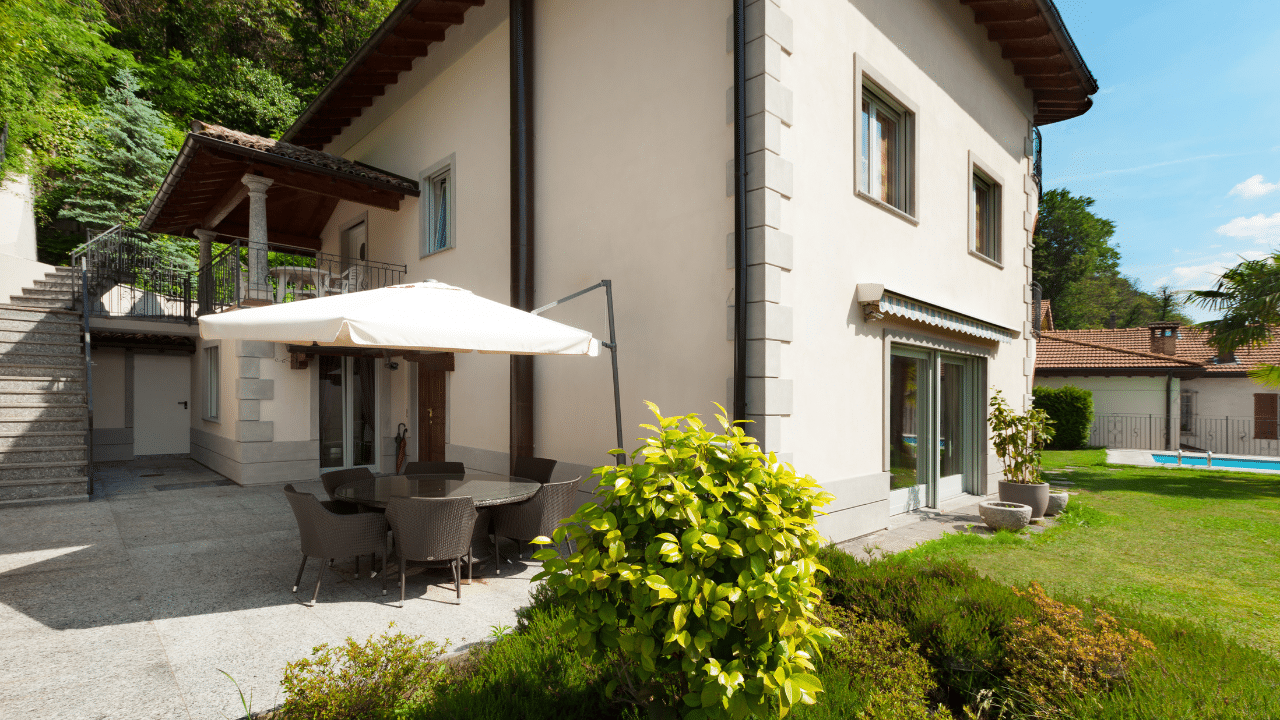

A cantilever parasol isn't something you buy every year. It's a big item with a heavy base, and if it disappoints, you'll notice all summer: the canopy is too small for your table, the shade moves away as the sun sinks, or the base turns out not to fit under the pole. Fortunately, you can rule out most of those mistakes in advance if you know what to look for in the product information.
In this buying guide we go through the eight buying criteria: location, size and shape, tilting and rotating, the canopy, the pole, the base, the operation and, finally, the cover and warranty. You'll find a comparison of available cantilever parasols on those criteria, four examples showing what you pay for, a short choice test and a checklist to run through before you order. New to this type of parasol? Read first what is a cantilever parasol?
In brief: measure your space first, including next to the seating area, because that's where the pole and the base go. Choose a canopy that covers your entire seating area; 300x300 cm suits most patios. If you sit outside late in the day, choose a model that tilts sideways and backwards. And always check whether the base is included, how heavy it needs to be and whether it fits. Before you order, run through the checklist.
The 8 buying criteria in one table
In photos, cantilever parasols look very similar. The differences are in the specifications. This table shows what to look for and where you'll find it.
| Criterion | What to look for | In the product info |
|---|---|---|
| Location | Room for pole and base | Base dimensions |
| Size and shape | Does the canopy cover your seating area? | Canopy dimensions |
| Tilting and rotating | Does it also tilt sideways? | Tilt direction |
| Canopy | Fabric, weight, UV | Canopy material |
| Pole | Sturdiness and height | Pole diameter, clearance height |
| Base | Included, weight, fit | Parasol base, suitable for |
| Operation | Crank, lever or gas strut | Features |
| Cover and warranty | Protection, duration | Parasol cover, warranty |
1. Measuring your space
With a cantilever parasol, you don't just measure the spot where the shade should fall, but also the space next to it. That's where the pole and the base go. Take a tape measure and work through these four steps:
Measure your table or lounge set, and pull the chairs back the way you actually sit. The canopy must cover that entire area, not just the tabletop.
Look at which side of the seating area the pole will go. A freestanding base takes up quite a bit of space: the Madison 90 kg granite base measures 80 x 80 cm, the fillable Madison base 100 x 100 cm.
If you want to turn the canopy to follow the sun, it needs to be able to move freely around the pole. Watch out for walls, fences, gutters and trees within arm's reach.
On paving slabs, use a freestanding base. In grass or between paving, a ground-insert base or ground anchor means there's no base sitting on your patio.
For where to position the parasol in relation to the sun and wind, read where should you place a parasol?
2. Size and shape of the canopy
Determine the size based on your seating area, not the other way round. In the range, 300x300 cm is the most common. It's also the size that fits over most lounge sets and tables for four to six people.
| Your space | Look at | Example |
|---|---|---|
| Small patio, bistro set | 250x250 cm | Voyager T¹ 250x250 |
| Lounge set or table for 4 to 6 | 300x300 cm | Challenger T¹ 300x300 |
| Narrow strip along the wall | 300x200 cm | Voyager T¹ 300x200 |
| Long dining table | 300x400 cm | Hawaii Emperor |
| Large terrace | 350x350 cm | Hawaii Big Pole II |
A rectangular canopy is handy over a long table or in a narrow space, where a square canopy falls short at the ends or hangs over the fence. Apart from the Hawaii Emperor, the Madison Malta also has a 300x400 cm canopy. You'll find more models in the rectangular parasols range. Unsure about the size? Read what size parasol do I need?

3. Tilting and rotating: T¹ or T²?
Almost all cantilever parasols rotate around the pole, so you can move the shade without shifting the base. The big difference lies in the tilting:
- Backward tilt only: such as the Platinum Challenger T¹, the Voyager T¹ and the Nesling Coolfit. Fine if you mainly sit outside around midday.
- Sideways and backward tilt: such as the Challenger T², the Madison Monaco Flex III and the Hawaii Deluxe. You also block low sun from the side.
- No tilt: the Hawaii S doesn't tilt but does rotate and is height-adjustable. Simple to use, but less flexible as the sun gets lower.
Platinum makes comparison easy with the T¹ and T² names: the T¹ tilts backwards, the T² also sideways. With other brands, look in the specifications for the tilt direction.
Think about when you actually sit outside, not when the sun is highest. If you mostly sit on the patio in the evening, a parasol that tilts sideways will serve you better than a bigger canopy.
4. The canopy: fabric, weight and UV
The canopy determines how the parasol looks after a few summers, and how much sun it keeps out. In the range you'll see four types:
| Canopy | Feature according to the brand | Example |
|---|---|---|
| Polyester with PA coating | Water-repellent, UV 50+ | Monaco Flex III, 220 g/m² |
| Spun acrylic | Up to 98% UV protection | Challenger T² premium, 240 g |
| Solution dyed polyester | Colour in the fibre, colourfast | Hawaii Deluxe, 250 g/m² |
| HDPE shade cloth | Lets wind and water through | Nesling Coolfit, 285 g/m² |
Also look at the fabric grade. Platinum states a canopy quality per model: the Challenger is listed as "high", the Voyager as "standard". And check how the canopy is attached. The Challenger has canopy tensioners on the ribs, which according to Platinum always keep the canopy taut. The Voyager uses pockets, fabric sleeves at the corners into which the ribs slot.
For which canopy colour stays coolest and blocks the most sun, read which parasol colour is best against the sun?
5. Pole, stability and clearance height
Because the canopy hangs off to one side, the entire weight pulls on the pole. A thicker pole bends and wobbles less. Garden Impressions lists the pole diameter and clearance height for the Hawaii models, so you can compare them properly:
| Model | Pole diameter | Clearance height |
|---|---|---|
| Hawaii Deluxe 300x300 | 80x53 mm | 205 cm |
| Hawaii Big Pole II 350x350 | 95x65 mm | 210 cm |
| Hawaii Emperor 300x400 | 100x72 mm | 225 cm |
The clearance height is the height under which you can still walk. All three are also height-adjustable. A higher canopy feels more spacious, a lower one blocks low sun better.
If you live in an open, windy spot, check whether the brand states a wind rating. According to Garden Impressions, the Hawaii Big Pole II and the Hawaii S are wind-resistant up to Beaufort 4, moderate breeze. For what that means and which parasols cope best with wind, read which parasol copes best with wind?
6. The base: included, weight and fit
The base is the criterion where things most often go wrong. Ask yourself three questions before you order.
Is the base included?
Usually not. Many cantilever parasols are literally supplied without a base, such as the Platinum Voyager and the Beaufort premium. The Madison Monaco Flex III is an exception: according to Madison, the base is included. When comparing prices, add the base to any parasol that doesn't come with one.
How heavy does it need to be?
Follow the brand's advice for your model. Platinum recommends 90 kg for the Voyager T¹ and 120 kg for the Beaufort premium. If no advice is given, check the base for which parasols it's designed for: the Platinum Modena 120 kg is, according to Platinum, suitable for the Challenger, Voyager, Beaufort and Nesling Coolfit, among others. You'll find a table of weights per size in which parasol base do you need?
Does it fit under your pole?
Not every base fits every cantilever parasol. Look at the "suitable for" list and at the hole spacing. The Hawaii 90 kg granite base is designed for the Hawaii Deluxe, Original, Lumen and S, with 11 cm between the centres of the holes. The Platinum ground-insert base fits cantilever parasols with a hole spacing of 7.6, 9.55 or 11.3 cm centre to centre, and for other parasols there's a separate adapter plate. The Hawaii ground anchor for Big Pole parasols is designed for the King Pole, Big Pole and Emperor.
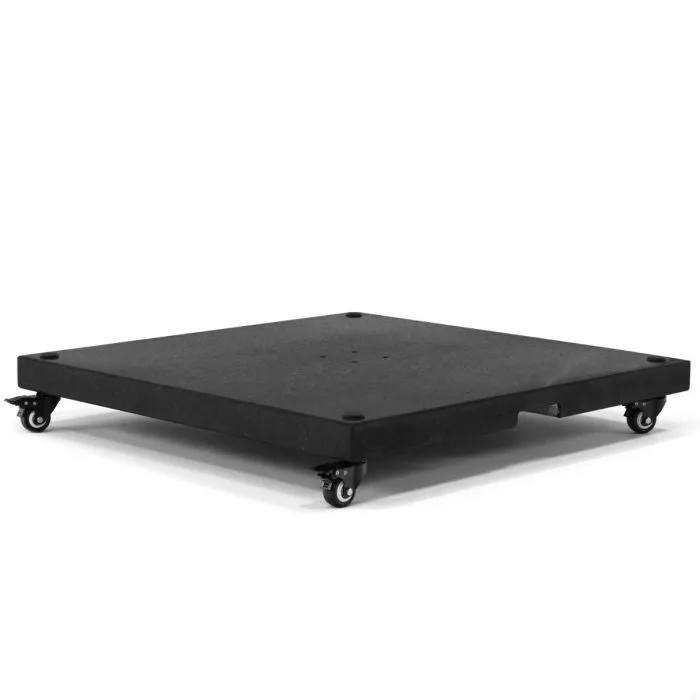
Madison 90 kg, 4 wheels with brake
View base →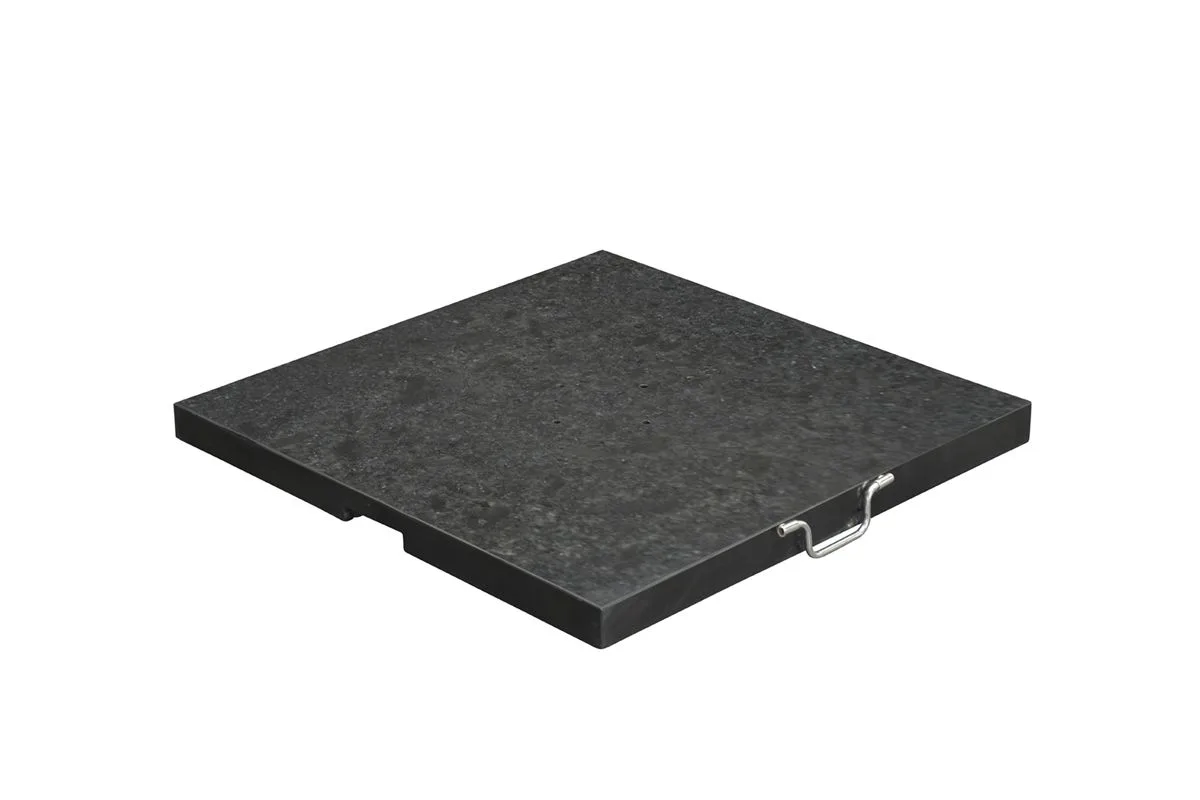
Hawaii 90 kg granite base
View base →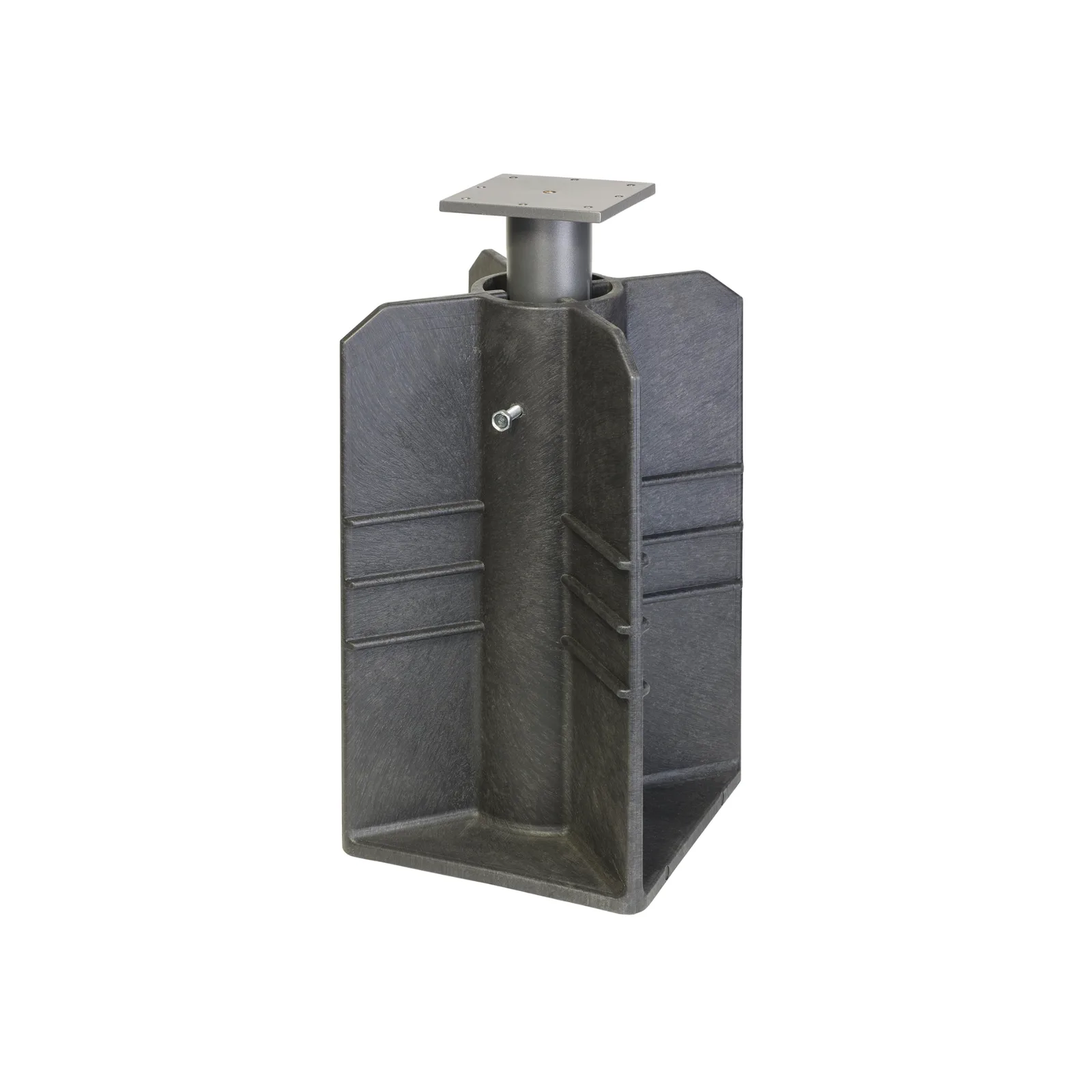
Platinum ground-insert base
View base →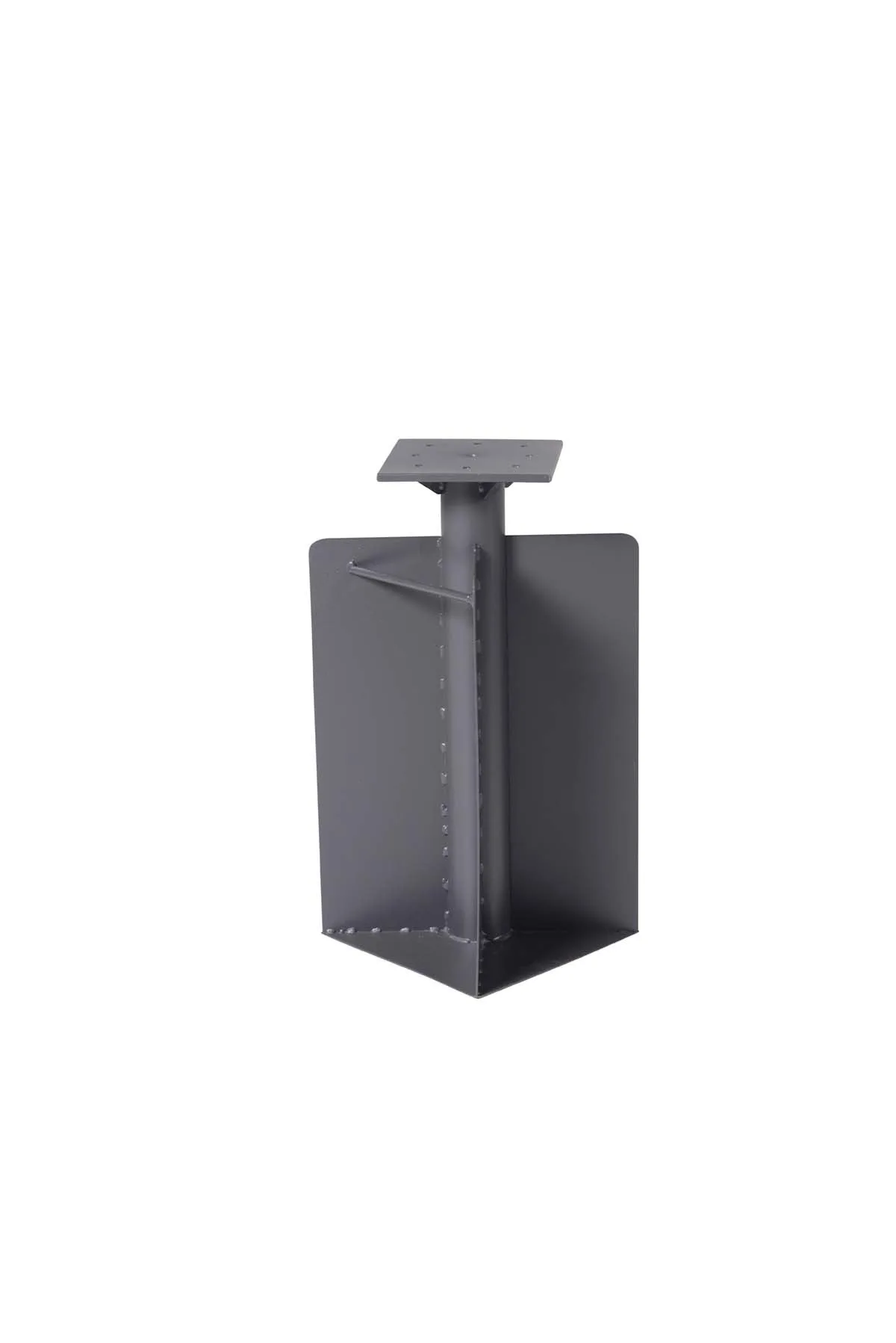
Hawaii ground anchor
View anchor →You'll find more choice in the parasol bases, the bases on wheels and the ground-insert bases. Would you rather not search separately? Look at parasols with base, and check the description there to confirm the base is actually supplied.
7. Operation and extras
You operate a cantilever parasol from the pole. How that works differs by model, and you'll notice it every time you open or close it:
- Lever: the Challenger has a cast aluminium lever which, according to Platinum, provides stability and strength.
- Gas strut: the Beaufort premium opens easily thanks to a gas strut and is extra sturdy thanks to a scissor system.
- Foot pedal: the Hawaii Deluxe is adjusted with a foot pedal and a sliding mechanism with a turning handle.
- Telescopic: the Hawaii Emperor opens and closes without moving chairs or crockery.
- Height adjustment: the Hawaii S, Deluxe, Big Pole II and Emperor are height-adjustable.
If you also sit outside after sunset, there are cantilever parasols with LED lighting in the ribs. You'll find them in best cantilever parasol 2026.
8. Cover and warranty
A cover keeps the canopy clean when the parasol is closed. For the Voyager and the Beaufort premium, among others, Platinum states in the product information which AeroCover cover fits, with the article number, which saves searching. Otherwise, choose a cover that suits the length of your closed parasol. You'll find them in the parasol covers range.
Also look at the warranty. Many cantilever parasols carry 2 years, such as the Hawaii models, the Voyager and the Beaufort. The Nesling Coolfit has a five-year warranty on the fabric. For how to keep your parasol looking good afterwards, read how do I protect my parasol?
Cantilever parasols compared on buying criteria
The two criteria that most often make the difference are the tilt function and the base. This table lists available cantilever parasols with only what the brand itself states. Apart from the Beaufort premium, they all rotate around their pole; for the Beaufort, Platinum doesn't state it.
| Model | Tilting | Base according to the brand |
|---|---|---|
| Madison Monaco Flex III 300x300 | Sideways and backwards | Included |
| Challenger T² premium 300x300 | Sideways and backwards | Modena 120 kg suitable |
| Challenger T¹ 300x300 | Backwards | Modena 120 kg suitable |
| Voyager T¹ 250x250 | Backwards | Without base, 90 kg recommended |
| Beaufort premium 320x320 | Not stated | Without base, 120 kg recommended |
| Nesling Coolfit 300x300 | Backwards | Modena 120 kg suitable |
| Hawaii Deluxe 300x300 | Sideways and backwards | Hawaii base or ground anchor |
| Hawaii S 250x250 | Not tiltable | Hawaii base or ground anchor |
| Hawaii Big Pole II 350x350 | Sideways and backwards | Big Pole ground anchor |
| Hawaii Emperor 300x400 | Sideways and backwards | Big Pole ground anchor |
Looking for the best choice for a particular situation, such as a small garden, a long table or lots of wind? Those are covered in best cantilever parasol 2026. Here, we look at what you get for each criterion.
Four examples: what are you paying for?
These four cantilever parasols clearly show how the criteria play out. Current prices are on the cards.
Madison Monaco Flex III: complete, with base
If you don't want to choose a base yourself, the Monaco Flex III 300x300 cm is an easy choice: according to Madison, the base is included. It rotates 360 degrees and tilts sideways and backwards. The canopy is 100% polyester at 220 g/m² with PA coating, water-repellent and with UV 50+, and wind vents at the top let air through. The frame is aluminium, with eight ribs.
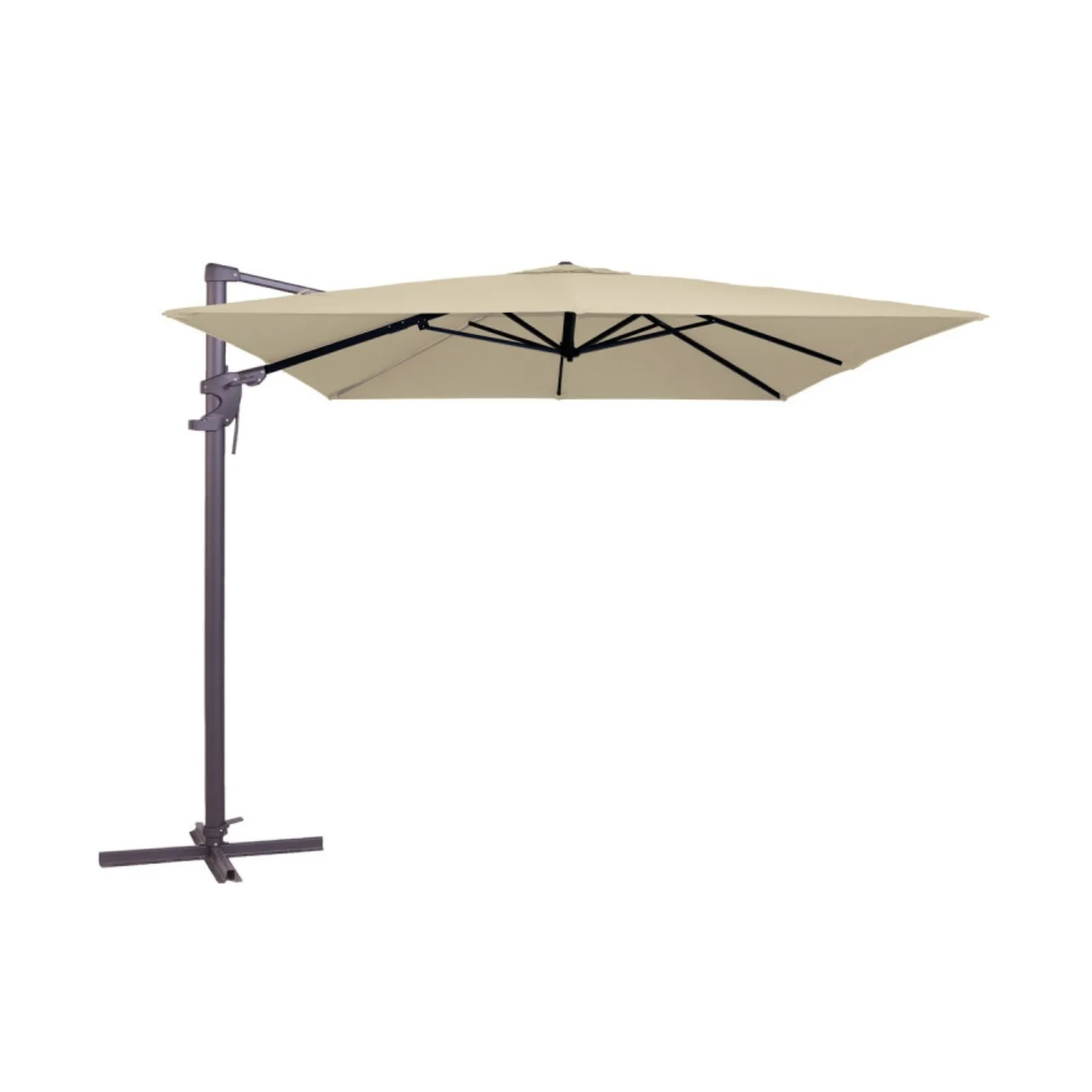
Monaco Flex III cantilever parasol 300x300 cm
What you pay for: convenience. One purchase and you're done, with both tilt directions.
Platinum Challenger T¹: solid base, backward tilt
The Challenger T¹ 300x300 has the same sturdy foundation as the T²: eight aluminium ribs, canopy tensioners and a cast aluminium lever. It only tilts backwards and rotates 360 degrees. The canopy is 300-gram polyester with, according to Platinum, up to 98% UV protection, water- and dirt-repellent. Platinum describes the canopy quality as high.
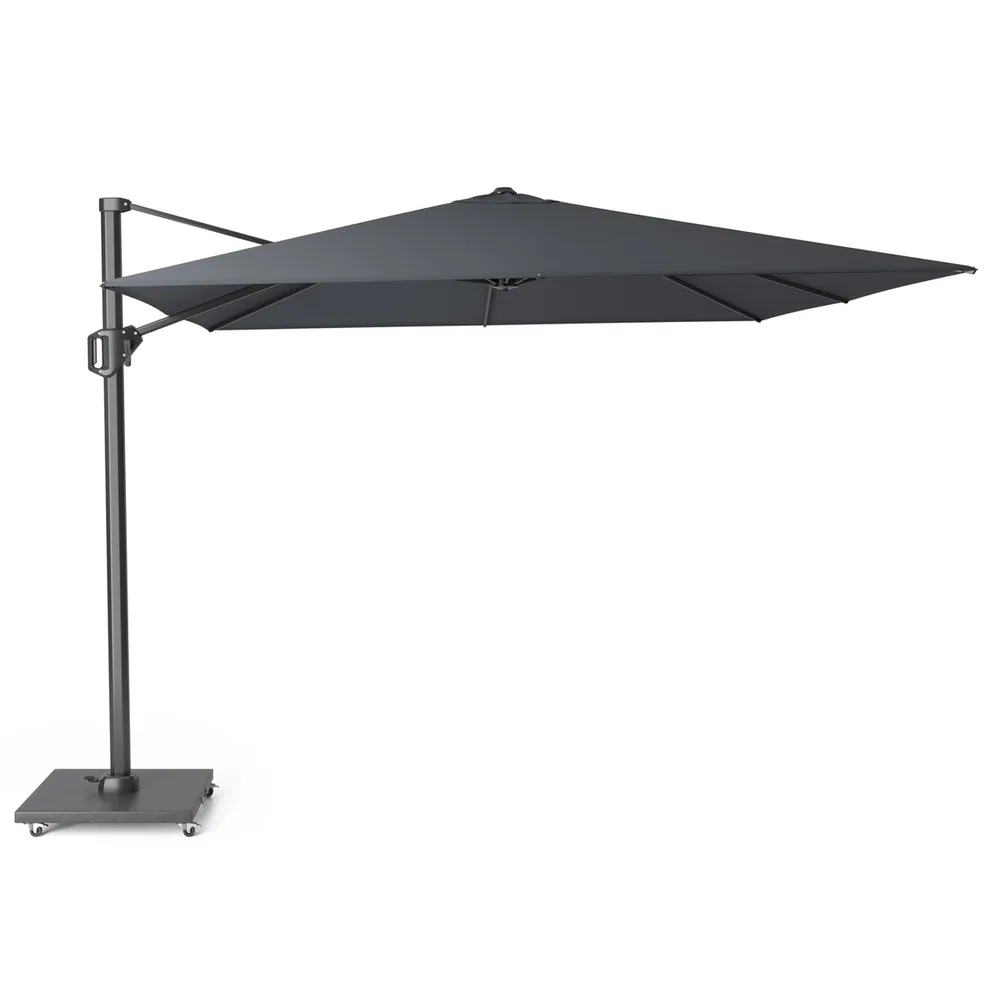
Challenger T¹ cantilever parasol 300x300 cm
What you pay for: a sturdy frame and a taut canopy. If you also want to tilt sideways, look at the Challenger T² premium with a 240-gram spun acrylic canopy. With both, include the base in your calculation.
Garden Impressions Hawaii Deluxe: colourfast canopy and foot pedal
The Hawaii Deluxe 300x300 cm tilts sideways and backwards and rotates 360 degrees. You adjust it with a foot pedal and a sliding mechanism with a turning handle. The canopy is 250 g/m² solution dyed polyester with PA coating: according to Garden Impressions, colourfast, dirt-repellent and splash-proof. At the top is a wind vent, so air can escape from under the canopy. The pole is 80x53 mm, and the clearance height is 205 cm.
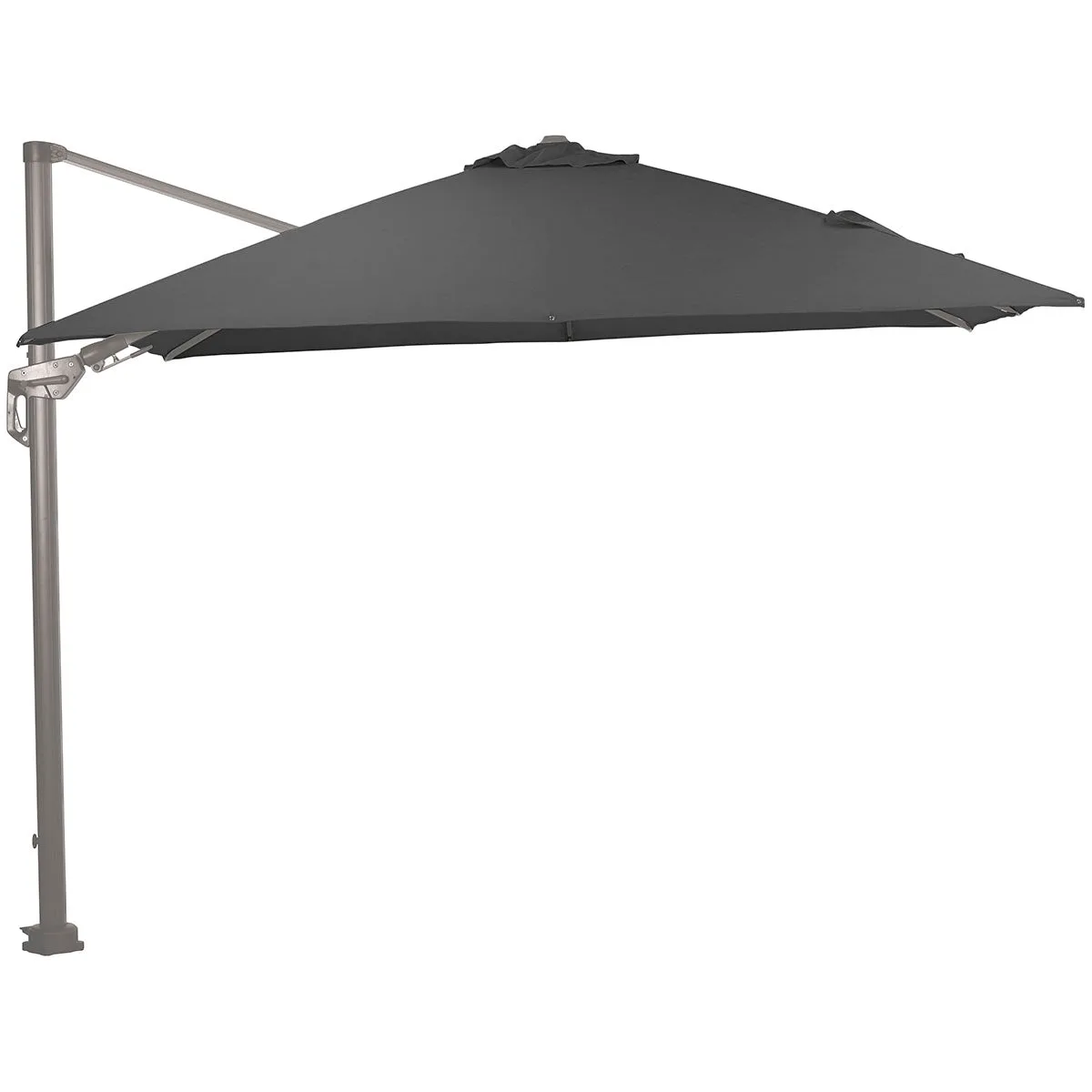
Hawaii Deluxe cantilever parasol 300x300 cm
What you pay for: a canopy that keeps its colour and easy operation. It fits the Hawaii 90 kg granite base and the Hawaii ground anchor.
Garden Impressions Hawaii S: simple and compact
The Hawaii S 250x250 cm shows what you're left with when you drop the tilt function: a simple cantilever parasol that you open, rotate and close again. It's height-adjustable, with a clearance height of 210 cm, and according to Garden Impressions, wind-resistant up to Beaufort 4. The canopy is 180 g/m² polyester on eight aluminium ribs.
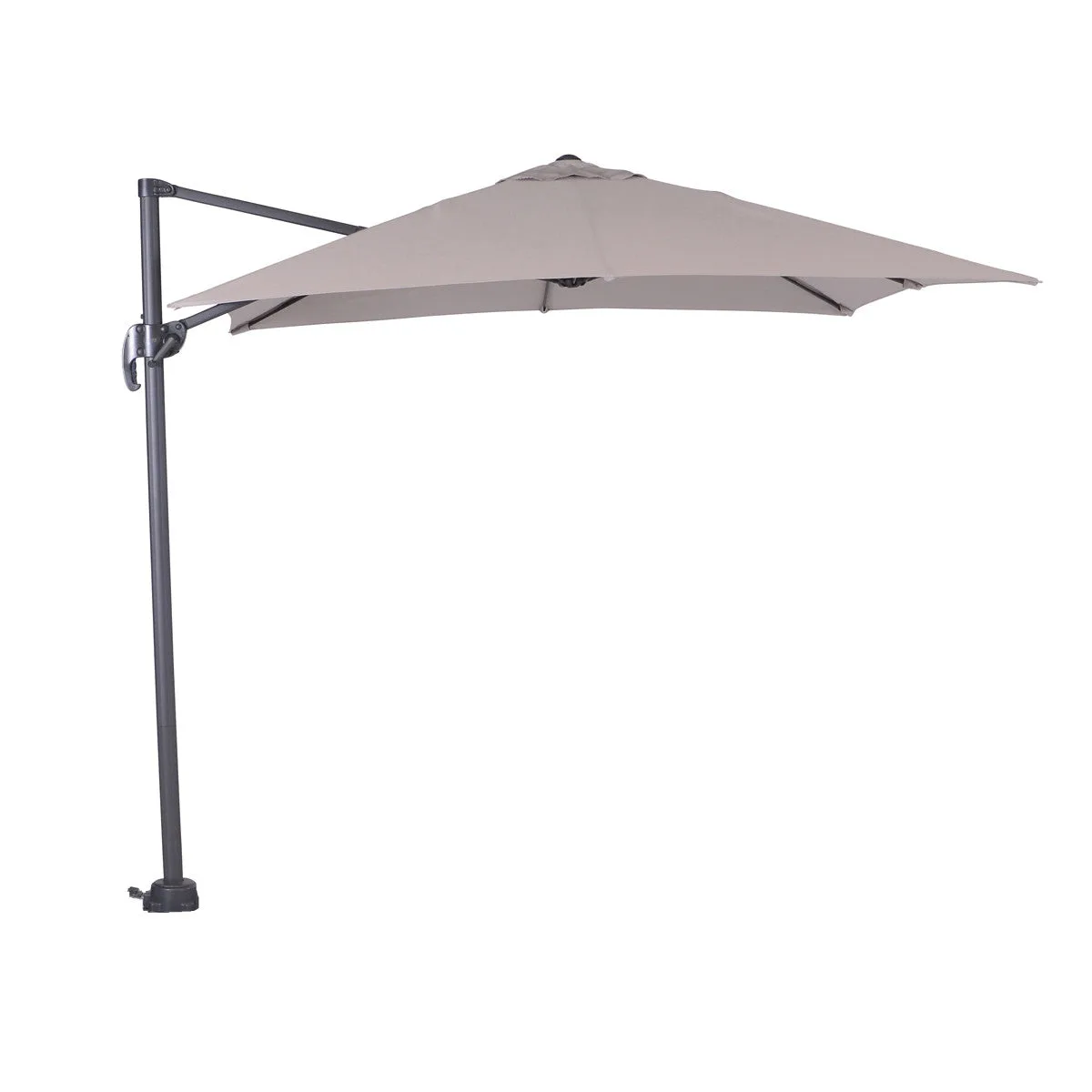
Hawaii S parasol 250x250 cm
What you pay for: simplicity in a small space. It can't tilt, so with low sun from the side you'll get less shade.
Browse all cantilever parasols or the large parasols if you want to compare more models.
Choice test: which cantilever parasol suits your needs?
Answer four questions about your space and your wishes to see which type of cantilever parasol suits you best.
Which cantilever parasol suits your buying needs?
What do you need the cantilever parasol to hang over?
- A lounge set or table for four to six
- A seating area where I sit until the evening
- A bistro set on a small patio
- A narrow strip along the wall
What would you rather not have to sort out yourself when ordering?
- Which base fits the parasol
- Nothing, I like to research everything for the best fabric
- How the tilt positions work
- How to fit a square canopy into a narrow space
How do you anchor the parasol?
- On the base that's supplied with it
- On a heavy granite base on castors
- With an anchor in the grass
- On a 90 kg base that I buy separately
Which canopy feature matters most to you?
- Water-repellent with UV 50+
- A premium fabric with up to 98% UV protection
- A canopy that can stay open in moderate wind
- A rectangular shape
Madison Monaco Flex III. The base is included, it tilts sideways and backwards and rotates 360 degrees. The polyester canopy is water-repellent with UV 50+.
Platinum Challenger T² premium. Tilts sideways and backwards, so you also get shade when the sun is low, with a 240-gram spun acrylic canopy. Place it on the 120 kg Modena base with castors.
Hawaii S. Compact, no tilt position and, according to Garden Impressions, wind-resistant up to Beaufort 4. With the Hawaii ground anchor, it stays firmly in the grass.
Platinum Voyager T¹ 300x200. A rectangular canopy for a narrow space, tilts backwards and rotates 360 degrees. Platinum recommends a 90 kg base.
Do you also need to choose garden furniture alongside the parasol? Then try our choice tool.
Common mistakes when buying
Comparing prices without the base
A cantilever parasol without a base looks cheaper than a set with one, but you can't stand it up yet. Include the base when you compare models side by side.
Buying a base that doesn't fit under the pole
A heavy base is no use if the pole doesn't fit on it. Check the "suitable for" list and the hole spacing, or choose a base from the same brand and series.
Only measuring the table
The canopy also needs to cover the chairs when they're pulled back, and there needs to be space next to the seating area for the pole and base. Measure the whole situation, not just the tabletop.
Assuming every cantilever parasol tilts sideways
Many models only tilt backwards, and some don't tilt at all. Check the tilt direction in the specifications if you sit outside late in the day.
Trusting the "with base" category
Not every parasol in a with-base category has the base actually in the box. Read the product information: does it say "included" or "supplied without base"?
Tip: choose the base at the same time as the parasol
If you order the base separately, do it straight away. That way you know it fits, and your parasol won't arrive without a base. Undecided between cantilever and centre pole? Read cantilever parasol vs centre pole parasol.
Checklist: before you order
Run through this list before you click order. If you can tick everything off, you can be sure the parasol suits your space.
- I have measured the seating area, with the chairs pulled back
- There is room next to the seating area for the pole and the base
- The canopy covers my seating area, in the right shape
- I know whether the parasol tilts only backwards or also sideways
- I have checked the canopy: fabric, weight and UV protection
- I know whether the base is included and, if not, what weight the brand recommends
- The base or anchor fits under my pole and on my surface
- I have looked at a suitable cover and know how long the warranty is
Quick picks
- No hassle with a separate base: Monaco Flex III, base included
- Sitting outside late in the day: a model that tilts sideways and backwards
- Small patio: 250x250 cm, such as the Voyager T¹ or Hawaii S
- Long table: a rectangular 300x400 cm canopy
- Grass instead of paving: a ground-insert base or ground anchor
Frequently asked questions
What should you look for when buying a cantilever parasol?
Start with your spot: measure the table or lounge set and the space beside it for the pole and base. Then choose the canopy size and shape, the tilt function (rear-only or also to the side), the fabric, and the strength of the pole. Next, check whether the base is included, what weight the manufacturer recommends, and whether the base fits your pole. Operation, cover and warranty complete the decision.
What size cantilever parasol should I buy?
Choose a canopy that covers your whole seating area, including the chairs when they are pushed back. The 300x300 cm size is the most common in the range and suits most lounge sets and tables for four to six people. For a small terrace, 250x250 cm is available, for a long table a rectangular canopy such as 300x400 cm, and for a narrow spot along the wall of a house, 300x200 cm.
What is the difference between a T¹ and a T² cantilever parasol?
T¹ and T² are names Platinum uses for its tilt function. A T¹, such as the Challenger T¹ and the Voyager T¹, tilts only towards the rear. A T², such as the Challenger T², tilts both to the side and to the rear. Both rotate through 360 degrees. If you sit outside late in the day, when the sun is low and comes from the side, a T² will serve you better.
How do I know whether a parasol base fits my cantilever parasol?
Check which parasols the base is suitable for, and look at the hole spacing. The Hawaii granite base, 90 kg, is designed for the Hawaii Deluxe, Original, Lumen and S, with 11 cm between the centres of the holes. The Platinum in-ground base fits cantilever parasols with a hole spacing of 7.6, 9.55 or 11.3 cm centre to centre. For other parasols, a separate adapter plate is available.
Which fabric is best for a cantilever parasol?
That depends on what matters most to you. Polyester with a PA coating is the most common and is water-repellent. Spun acrylic is Platinum's premium fabric, with up to 98% UV protection. Solution-dyed polyester has its colour built into the fibre, which Garden Impressions describes as colourfast. A HDPE shade fabric, as used in the Nesling Coolfit, lets wind and water through and feels light, but it will not keep out rain.
How long is the warranty on a cantilever parasol?
Many cantilever parasols in the range come with a 2-year warranty, such as the Garden Impressions Hawaii models and the Platinum Voyager and Beaufort. The Nesling Coolfit has a five-year warranty on the fabric. Always check the product information, and keep your proof of purchase.