
A good parasol not only provides shade, but must also be sturdy enough to withstand a breeze. Nobody wants to see their parasol blown away. That's why it's important to know what to look for when buying a wind-resistant model. In this blog, we explain which features make a model more stable.
What makes a parasol wind-resistant?
Not every model is equally capable of withstanding wind. You can recognise a sturdy model by the following features:
- Sturdy frame – Aluminium or steel is stronger than lighter materials.
- Wind vent – An opening in the fabric allows wind to escape and prevents too much pressure building up on the parasol.
- Heavy base – A well-fitting parasol base ensures that the parasol doesn't tip over or shift.
- Strong fabric – Materials such as olefin or polyester last longer and tear less easily.
Some people place a small model on an extremely heavy base to prevent it from being blown over. However, this doesn't help enough in strong wind — the construction of the parasol itself remains the weak link.
From which wind force should you close it?
| Wind force (Beaufort) | What you'll notice | Advice |
|---|---|---|
| 3 (gentle breeze, 12–19 km/h) | Twigs move, fabric flutters lightly | Fine to leave open |
| 4 (moderate breeze, 20–28 km/h) | Dust and thin branches move noticeably | Watch closely, straighten the canopy on a cantilever model |
| 5–6 (fresh to strong breeze, 29–49 km/h) | Large branches move, the parasol visibly shakes | Close it, even on a “wind-resistant” model |
| 7+ (near gale/storm, 50+ km/h) | Trees sway heavily | Always close it and store it lying down or secure it |
Rule of thumb: close the parasol from wind force 4. Do you notice it moving too much before that? Do it right away, regardless of the wind force on paper — the exact wind speed around your house varies with buildings, height and shelter.
Curious about what to look for when buying a parasol? Read this article!
Cantilever parasols and wind: what should you look out for?
A cantilever parasol offers a lot of flexibility, but not every model is equally stable. This is mainly due to the tilting mechanism.
- The more tilting options, the less sturdy – A Platinum T2 parasol, for example, can tilt both backwards and sideways, making it more susceptible to wind.
- Limited tilting options provide more stability – Do you live in a windy area? Then choose a cantilever parasol that only tilts backwards.
Because a cantilever parasol has no central pole, it generally moves more than a pole parasol. That's why it's extra important to choose a sturdy model.
A model specifically built for this is the Platinum Beaufort: the scissor system in the frame makes it more stable than an average cantilever parasol.

Cantilever Parasol Beaufort (320x320)
Disclaimer: even a parasol sold as “wind-stable” is no substitute for common sense. No parasol — however sturdy — can withstand every wind speed. Close a wind-stable model too at wind force 5 or higher, and when in doubt, close it a little too early rather than too late.
Check out the full range of wind-resistant parasols from Platinum, or discover Madison and Garden Impressions parasols too.
Curious which parasol colour is best against the sun? Read this article!
The importance of a wind vent
A wind vent is an opening in the fabric that allows wind to be diverted more effectively. This keeps the model more stable and reduces the chance of it being blown over.
- Without wind vent: more pressure and greater risk of damage
- With wind vent: more stable and safer – A model with a wind vent allows air to escape more easily, resulting in less strain on the frame.
Wondering if you can leave a parasol in the rain? Then read this article!
Pole parasol: the best choice in wind?
A pole model often offers more stability than a cantilever model, especially when it has a wind vent.
- Wind vent – Ensures that wind is diverted more easily.
- Strong olefin fabric – Hard-wearing, UV-resistant (UPF 50+) and water-repellent.
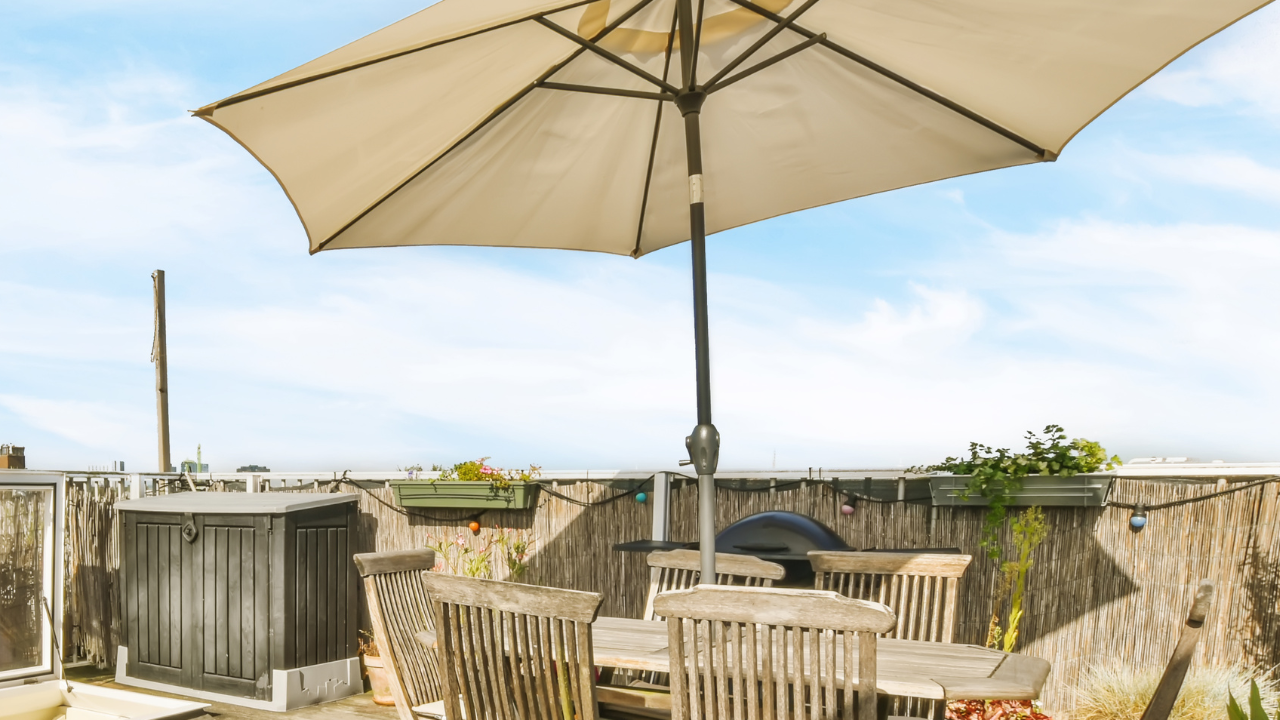
- Suitable for balcony or terrace – Compact and stable, ideal for smaller spaces.
Which parasol do you choose in the wind?
If you live in a windy area, opt for a pole model with wind vent or a sturdy cantilever model with limited tilting mechanism. Furthermore, ensure you have a well-fitting base and close it at wind force 4 or higher.
Would you like to buy a wind-resistant model? Then check out our range and choose the option that best suits your garden or balcony.
Curious which parasol base you need? Read this article.
Also read: These features characterise a wind-resistant parasol and Buying a parasol: What should I look out for
Also see: Cantilever parasols
Also see: Pole parasols