
Cantilever parasol or traditional parasol? This is one of the most frequently asked questions when it comes to shade solutions for the garden. Both types protect you from the sun, but they are fundamentally different in use, comfort and suitability for different situations. In this article we compare the two in detail so you make the right choice.
Video: Madison Monaco Flex III cantilever parasol in action
Watch below how a cantilever parasol (Madison Monaco Flex III) looks in use.
The difference: cantilever parasol vs. traditional parasol explained
The crucial difference lies in the position of the pole:
- Traditional parasol: The pole stands in the middle, through or beside the table. A classic, simple design that has proven itself for decades.
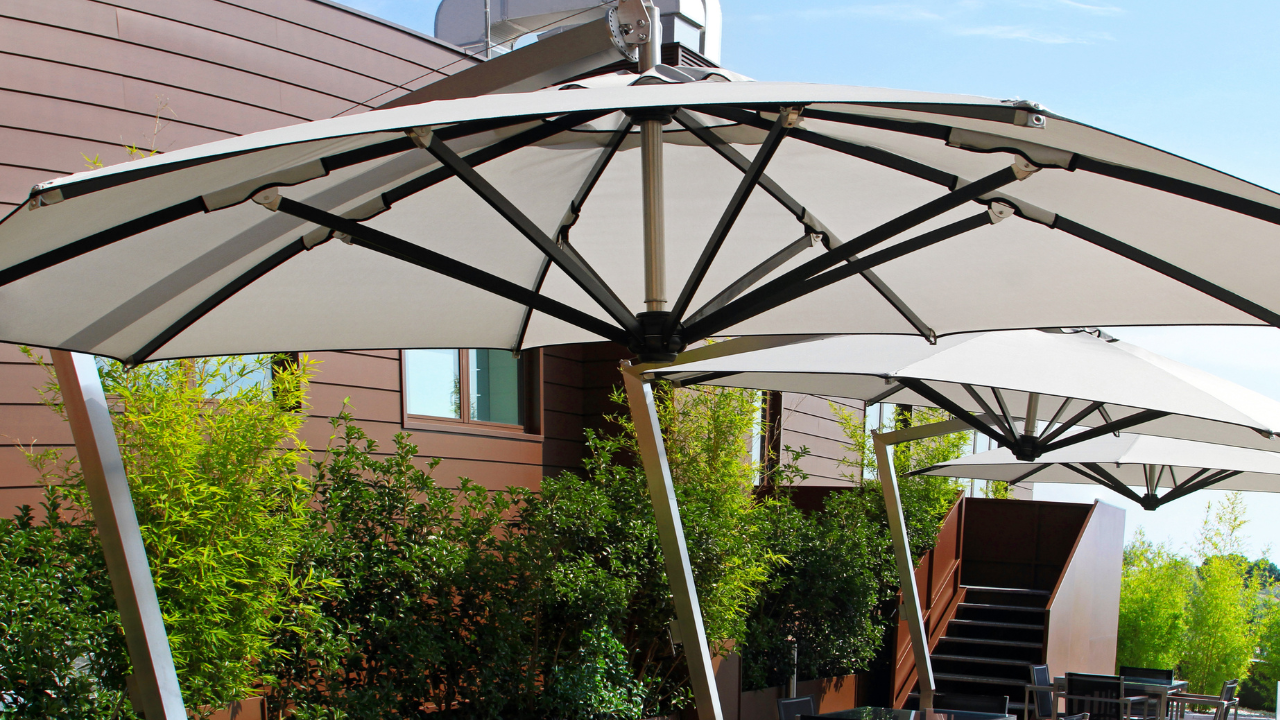
- Cantilever parasol: The pole stands to the side and the parasol hovers above the terrace as it were. Technically more complex but more comfortable to use.
Both types are available in various sizes, colours and quality grades. At Boender Outdoor you will find a wide range of both in our parasol range.
Advantages of a cantilever parasol
- Unobstructed shade area: No pole in the middle of the table or lounge set. You can stand up, move and serve unhindered without having to avoid the pole.
- 360-degree rotatable: Most cantilever parasols are fully rotatable so you can always direct the shade where you need it, regardless of the sun's position during the day.
- Large formats available: Cantilever parasols are available from 3 × 3 metres to 5 × 5 metres — much larger than most traditional parasols. Ideal for large terraces, swimming pools and lounge sets.
- Tiltable: Almost all cantilever parasols can be tilted for optimal protection against low morning or evening sun.
- Stylish appearance: The cantilever parasol is visually impressive and gives a terrace a luxurious, designer look. Check out our top 5 best cantilever parasols of 2026 for concrete recommendations.
Disadvantages of a cantilever parasol
- Heavier base needed: A cantilever parasol requires a heavy base (minimum 60–80 kg for 3 × 3 m). This is an additional purchase and makes the set less easy to move.
- More complex mechanism: The tilt mechanism and the rotation axis require annual inspection and lubrication. With cheaper models, the mechanism can fail or rust sooner.
- Higher price: Cantilever parasols are more expensive than traditional parasols of comparable quality due to the more complex construction and required heavier frame.
- More space required: The arm and base of a cantilever parasol extend beyond the shade zone and take up extra floor space on your terrace.
Advantages of a traditional parasol
- Simple and reliable: Fewer moving parts means less that can go wrong. A good traditional parasol with a solid frame will last for years without problems.
- Lightweight and moveable: A traditional parasol is easy to move to another spot in the garden. The base is also usually considerably lighter than with a cantilever parasol.
- Cheaper for equal quality: For the same budget you get better quality with a traditional parasol — thicker fabric, better frame — than with a cantilever parasol of the same price.
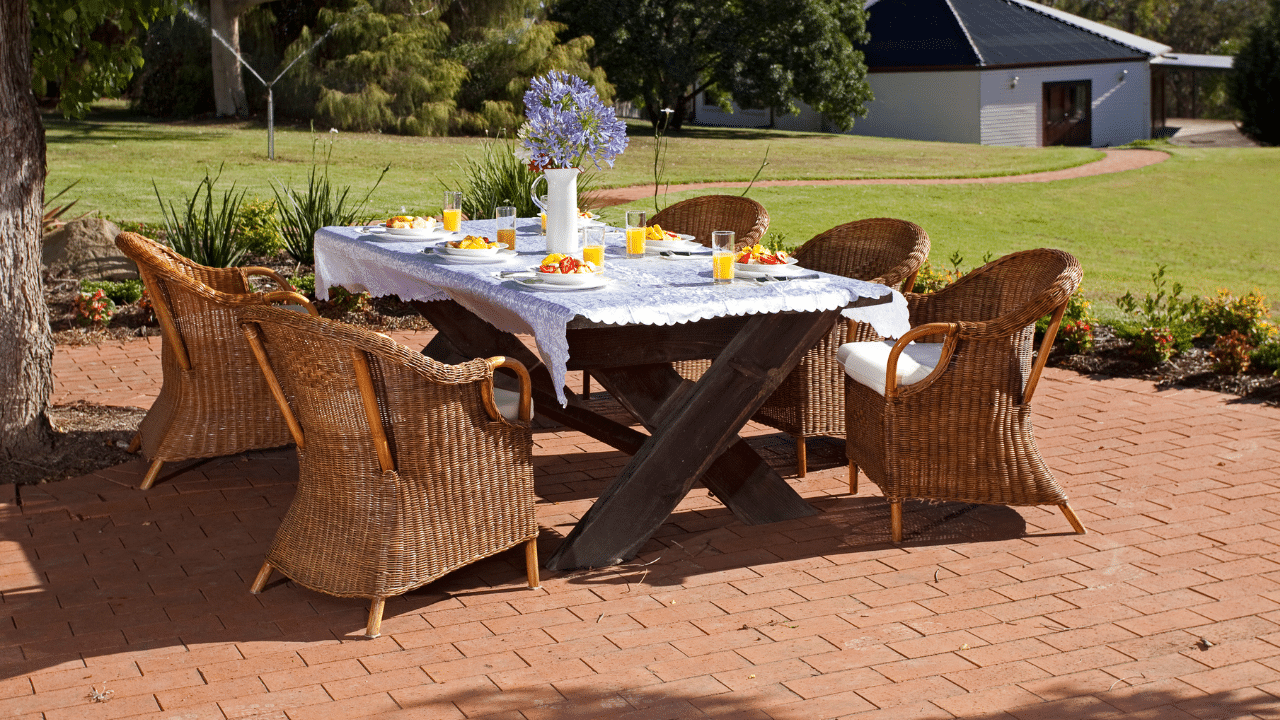
- Perfect for tables with parasol hole: Most garden tables have a parasol hole in the middle — the traditional parasol fits here seamlessly without a separate base.
- Tilt function: Good traditional parasols also have a tilt function to help you adjust for the sun at low angles.
Disadvantages of a traditional parasol
- Pole in the middle: With a table with a parasol hole, the pole runs straight through the middle — convenient for shade but sometimes obstructive when serving or standing up.
- Smaller shade area: Traditional parasols are typically available up to around 4 metres in diameter. For large terraces, swimming pools or lounge sets this is too limited.
- Less suitable for lounge sets: A lounge set has no parasol hole and needs more area than a traditional parasol can effectively cover.
Which situation suits which parasol?
Choose a cantilever parasol if...
- You have a lounge set without a parasol hole in the table.
- You have a large terrace (15 m² or more) that you want to shade completely.
- You want to cover a swimming pool, sunbeds or multiple seating areas.
- You want maximum freedom of movement without a pole in the way.
- Design and appearance are important to you.
Choose a traditional parasol if...
- You have a garden table with a parasol hole.
- You have a compact terrace or balcony.
- You want to move the parasol regularly to different spots in the garden.
- You have a limited budget and want maximum quality for your money.
- You want minimal maintenance.
Maintenance: traditional parasol vs. cantilever parasol
Traditional parasol: Minimal maintenance. Cleaning the fabric with lukewarm water and a soft brush, impregnating annually with textile impregnator and storing in a cover during winter is sufficient. The mechanism (pulley or button system) requires hardly any attention.
Cantilever parasol: A bit more attention needed. In addition to fabric maintenance, check the rotation mechanism and tilt arm annually and lubricate them with silicone spray. Also check the tension and fixing of the base. Always store in a protective cover or indoors after summer.
Price difference: how much does it matter?
For the same quality grade, you typically pay 50–100% more for a cantilever parasol than for a comparable traditional parasol:
- Traditional parasol Ø 300 cm: €80–€300 (excluding base)
- Cantilever parasol 3 × 3 m: €250–€700 (excluding base)
- Cantilever parasol base: €80–€200 extra
Check our parasols and cantilever parasols range at Boender Outdoor for current prices and models from brands such as Madison and Platinum.
Frequently asked questions
Can a cantilever parasol blow over?
A cantilever parasol can blow over in strong winds if the base is too light or if you don't close it in windy conditions. Always ensure a base of at least 60 kg for a 3 × 3 m parasol, and close the parasol at wind force 4 or higher. Quality brands such as Madison and Platinum offer wind-resistant constructions with safety locks.
What size cantilever parasol do I need for my lounge set?
Choose a parasol that is at least 50 cm larger on all sides than the lounge set. For a corner lounge set of 250 × 200 cm choose at least a 3.5 × 3.5 metre cantilever parasol. Read our detailed size table in what size parasol do I need?
Is a cantilever parasol harder to install?
Installation is not difficult but requires more steps than a traditional parasol: filling or weighting the base, setting the arm at the correct angle and adjusting the rotation and tilt mechanism. With the manual it should take two people about an hour.
Can a traditional parasol also stand beside the table?
Yes, with a separate parasol base you can also place a traditional parasol beside the table — useful for lounge sets and situations without a parasol hole. The disadvantage is that the pole is noticeable from the side and the shade is less precisely adjustable than with a cantilever parasol.