

White, taupe, anthracite or olive green: the colour of your parasol affects your garden's look more than you might think. It changes how light or dark the shade feels, how warm the canopy gets and how quickly you notice dirt or fading. But does a dark parasol really protect you better from the sun? The honest answer: the fabric and the UV rating matter more than the colour. In this guide you'll read what colour does and doesn't do, how to read a UV rating and which colour suits your garden. With a short test and examples from our range.
In short: a dark canopy gives deeper shade, but it heats up itself. A light canopy looks fresh and airy, but often lets more light through. For UV protection, check the stated UV rating, not the colour: for the parasols below, each range has the same rating for light and dark versions. Not sure about colour? Take the parasol colour test.
At a glance: today's prices
| Product | Today's price | |
|---|---|---|
| Coolfit cantilever parasol 300x300 cm off-white | €499 at bol.com | View at bol.com → |
| Timor luxe parasol Ø400 cm taupe | €179 at bol.com | View at bol.com → |
| Challenger T² premium cantilever parasol 300x300 cm Jet black | €619 at Tuinmeubelwereld | View at Tuinmeubelwereld → |
| Saint-Tropez parasol 355x300 cm Safier blue | €629 at bol.com | View at bol.com → |
Light or dark canopy: what's the difference?
Every parasol canopy does three things with sunlight: it reflects some of it, absorbs some of it and lets some of it through. The colour determines how that split works out.
- Dark canopy (anthracite, black, dark grey): absorbs a lot of light and usually lets little through. The shade beneath is deeper and calmer on the eye. The downside: the canopy itself gets warmer in the sun.
- Light canopy (white, ecru, off-white): reflects a lot of light, so the canopy itself stays cooler. Often more light gets through, so the shade feels lighter and softer. On a small terrace, that keeps the spot fresh and open.
- Mid-tones (taupe, sand, grey): sit in between and are often the safest choice if you're undecided.
The old rule of thumb "dark protects better, light is cooler" is therefore too simplistic. How a parasol feels in practice depends just as much on the fabric, the thickness of the canopy, the height and the wind. For the different types of parasol, read what types of parasols are there?
UV protection: colour or fabric?
For protection against sunburn, UV radiation is what counts, and that depends mainly on the canopy itself: the material, how tightly it's woven, its weight and any coating. If you look at what manufacturers state, you'll notice something striking: within a range, light and dark colours get the same UV rating.
| Parasol | Canopy | UV according to manufacturer |
|---|---|---|
| Challenger T² premium (Jet black, Manhattan) | 240 gr. Spuncrylic | Up to 98% |
| Challenger T¹ (white) | 300 gr. polyester | Up to 98% |
| Timor luxe (all colours) | Polyester 220 g/m², PA coating | UV 50+ |
| Coolfit (anthracite, off-white) | HDPE 285 g/m² | Up to 95% |
You'll also see that manufacturers note protection in different ways. Platinum and Nesling give a percentage, Madison a UV or UPF rating. UPF 50 means that roughly one fiftieth of the UV radiation gets through. So ideally compare within the same notation, and read the word "up to" as an upper limit.
You read a parasol's UV protection from the product information, not from its colour. Choose a canopy with a clear UV rating first, then choose the colour that suits your garden.
Also keep in mind what a parasol doesn't block. UV radiation also comes from the side and bounces back off light paving, water or a white tabletop. Sun cream is still necessary, even in the shade.
Warmth and shade under the parasol
Whether it feels pleasant under your parasol depends on more than colour alone. These points make a real difference in practice:
- Height: the closer a warm canopy hangs above your head, the more you feel that warmth. A higher or tilted canopy gives more air.
- Airflow: an open-weave canopy such as the HDPE of the Coolfit lets wind and water pass through easily, according to Nesling. That feels airy, but as a result the canopy isn't waterproof.
- Colour cast: a strongly coloured canopy tints the light beneath it. Under a red or blue parasol, your food, your table and your skin take on a red or blue glow. For a dining table, a neutral colour is therefore often more pleasant.
- Following the sun: a parasol that tilts and rotates keeps the shade in the right place all afternoon. That helps more than any colour does. Also read where do you place a parasol?
Tip: the floor matters too
Light tiles or a white floor reflect sunlight and UV back upwards, even under the parasol. If you have a light floor, choose a parasol large enough to shade a bit of the floor around the table as well. For the size you need, read what size parasol do I need?
Parasol colours compared
Every colour has its own strengths. This table helps you choose based on feel, upkeep and style.
| Colour | Characteristic | Suits |
|---|---|---|
| White, ecru | Light and fresh, dirt shows | Small garden, Ibiza style |
| Taupe, sand | Neutral, warm shade | Teak, country garden |
| Grey, anthracite | Deep shade, dirt less visible | Modern garden, aluminium |
| Black | Deepest shade, canopy gets warm | Sleek design, black frames |
| Green, olive | Blends in among plants | Natural garden |
| Blue, red | Tints the light beneath | Mediterranean feel, accent |
Fading shows up fastest on dark and bright colours, while light colours show dirt and green algae more quickly. If your parasol stands under trees, a mid-tone is more practical than white. For how to keep a canopy clean, read how to clean and maintain a garden parasol.
Test: which parasol colour suits your garden?
Still no idea which colour to go for? Answer four short questions about your furniture, your spot and the atmosphere you're after.
Which parasol colour suits your garden?
What colour is your garden furniture?
- White, light wood or light grey
- Teak, warm wood or rope in sand tones
- Anthracite or black aluminium
- Calm in colour, I actually want an accent
Where does the parasol usually stand?
- On a small terrace that mustn't get dark
- Above the dining table, where it should feel cosy
- In full sun, I really want deep shade
- In the middle of greenery or by the pool
What bothers you most about a parasol?
- A dark, heavy corner in the garden
- A parasol that stands out too much
- Dirt and green algae you can see
- A dull garden without colour
What feeling do you want under the parasol?
- Fresh and airy, like in Ibiza
- Warm and rustic
- Sleek and modern
- Cheerful and Mediterranean
White or ecru A light canopy keeps your terrace open and fresh, and stays cool itself. Don't place it under trees, as dirt shows up. An open-weave canopy such as the Coolfit feels extra airy.
Taupe or sand A neutral mid-tone suits wood and rope, gives a warm shade and shows dirt less quickly than white.
Anthracite or black A dark canopy gives the deepest shade and suits sleek aluminium furniture. Choose a parasol that stands high enough so the warmth of the canopy doesn't bother you.
A colour such as blue or green A coloured parasol makes your terrace a real eye-catcher. Bear in mind that the canopy tints the light beneath it, and that bright colours show fading sooner.
Want the parasol to fit a complete garden style? For ideas, take a look at the modern garden, the rustic garden and the Ibiza garden.
Five parasols in five colours
To make the choice concrete, below are five available parasols in different colours. For each parasol you'll see the UV rating stated by the manufacturer. You can see current prices on the cards.
Off-white: Nesling Coolfit cantilever parasol
The Coolfit has an HDPE canopy (285 g/m²) that, according to Nesling, blocks up to 95% of harmful UV radiation. The open structure lets wind and water through, which gives an airy feel. The canopy is 300 x 300 cm, tilts backwards and Nesling gives five years' warranty on the fabric. The same parasol is also available in anthracite, with the same stated UV protection.
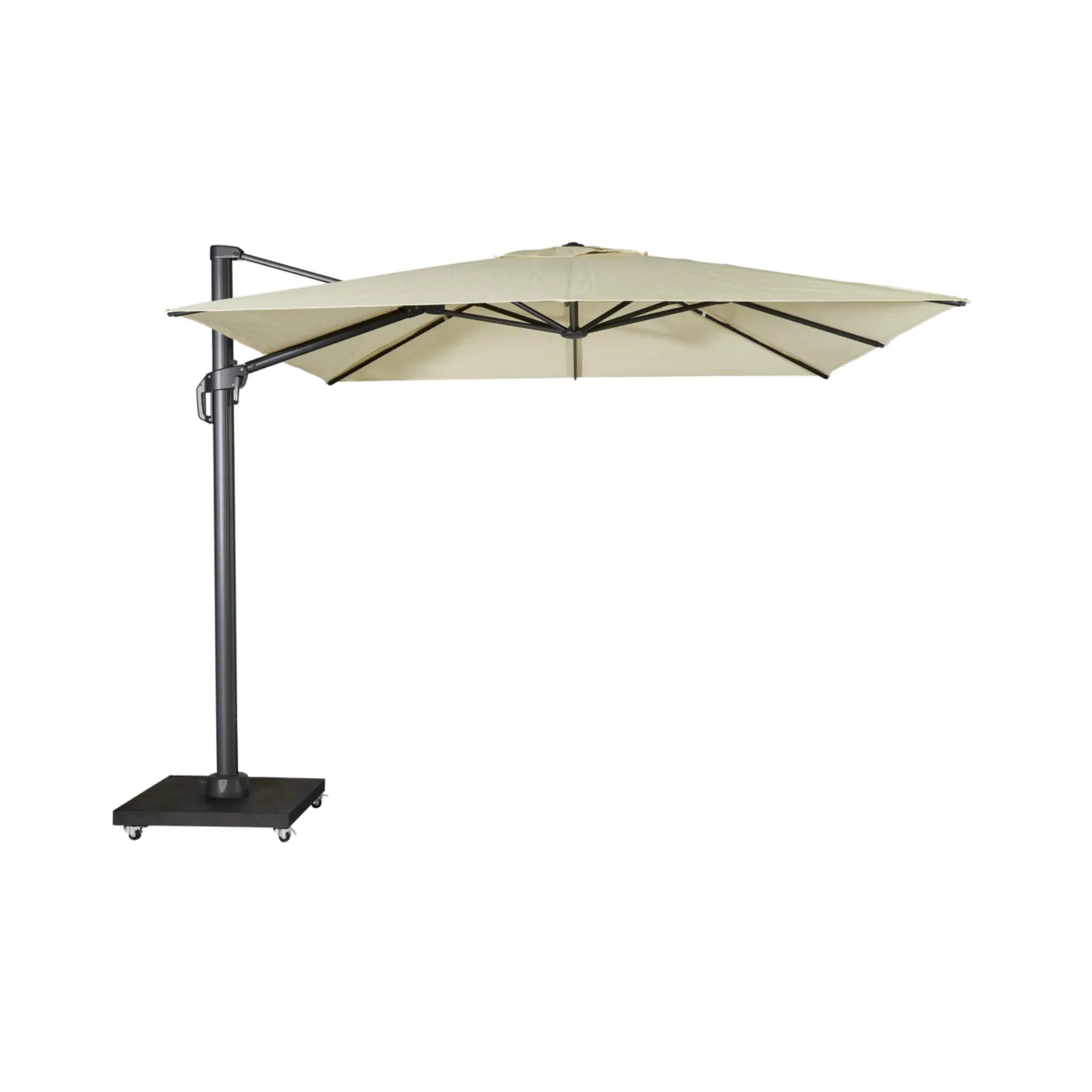
Coolfit cantilever parasol 300x300 cm off-white
Note: an open canopy isn't designed to keep rain out. If you also want shelter during a shower, choose a closed canopy.
White: Platinum Challenger T¹
Want white with a closed canopy? The Challenger T¹ has a 300 gr. polyester canopy in white on an anthracite frame. Platinum states up to 98% UV protection and describes the canopy as water- and dirt-repellent. The parasol tilts backwards and rotates 360 degrees, and canopy tensioners keep the fabric taut.
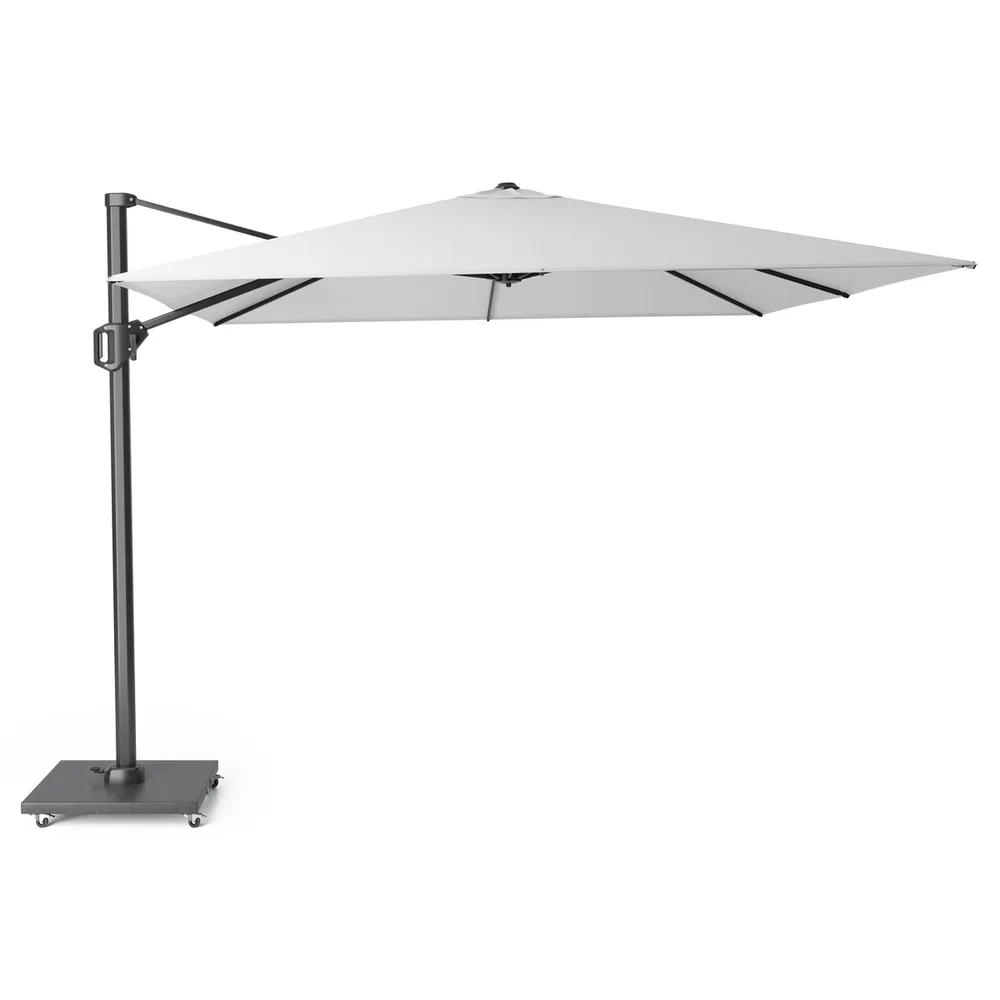
Challenger T¹ cantilever parasol 300x300 cm white
Taupe: Madison Timor luxe Ø400 cm
The Timor luxe is a large round parasol with a canopy of around 400 cm. The canopy is 100% polyester (220 g/m²) with a PA coating, water-repellent and, according to Madison, rated UV 50+. Eight ribs keep the canopy taut and the frame is anthracite. Taupe is a calm mid-tone that goes well with wood and rope.
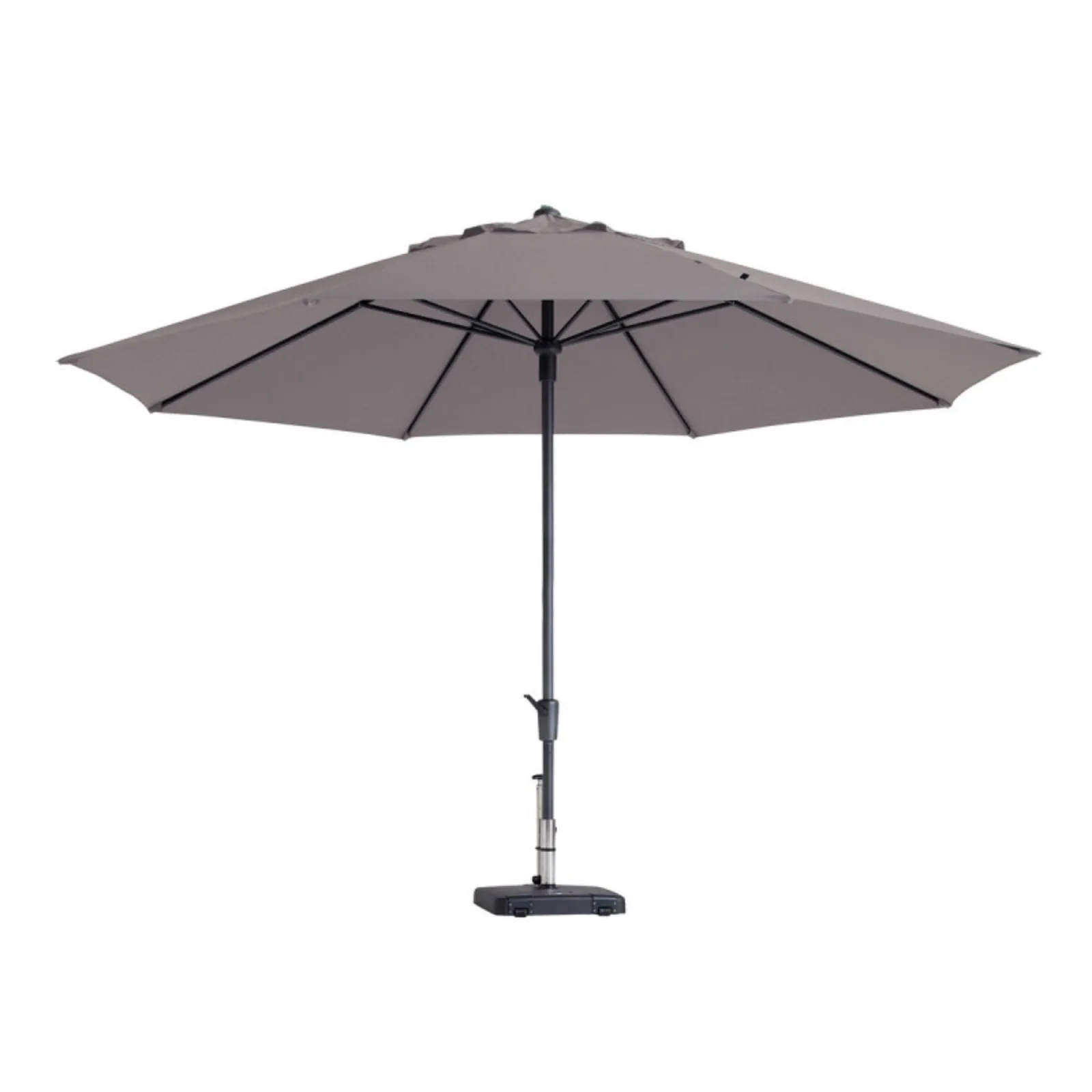
Timor luxe parasol Ø400 cm taupe
Note: the Timor can't be tilted. In a spot where the sun moves a lot, you'll therefore need to move the whole parasol.
Black: Platinum Challenger T² premium Jet black
For the deepest shade there's the Challenger T² premium in Jet black, with a matt black frame. The canopy is 240 gr. Spuncrylic and Platinum states up to 98% UV protection, just like the lighter Manhattan version of the same parasol. It tilts sideways and backwards and rotates 360 degrees.
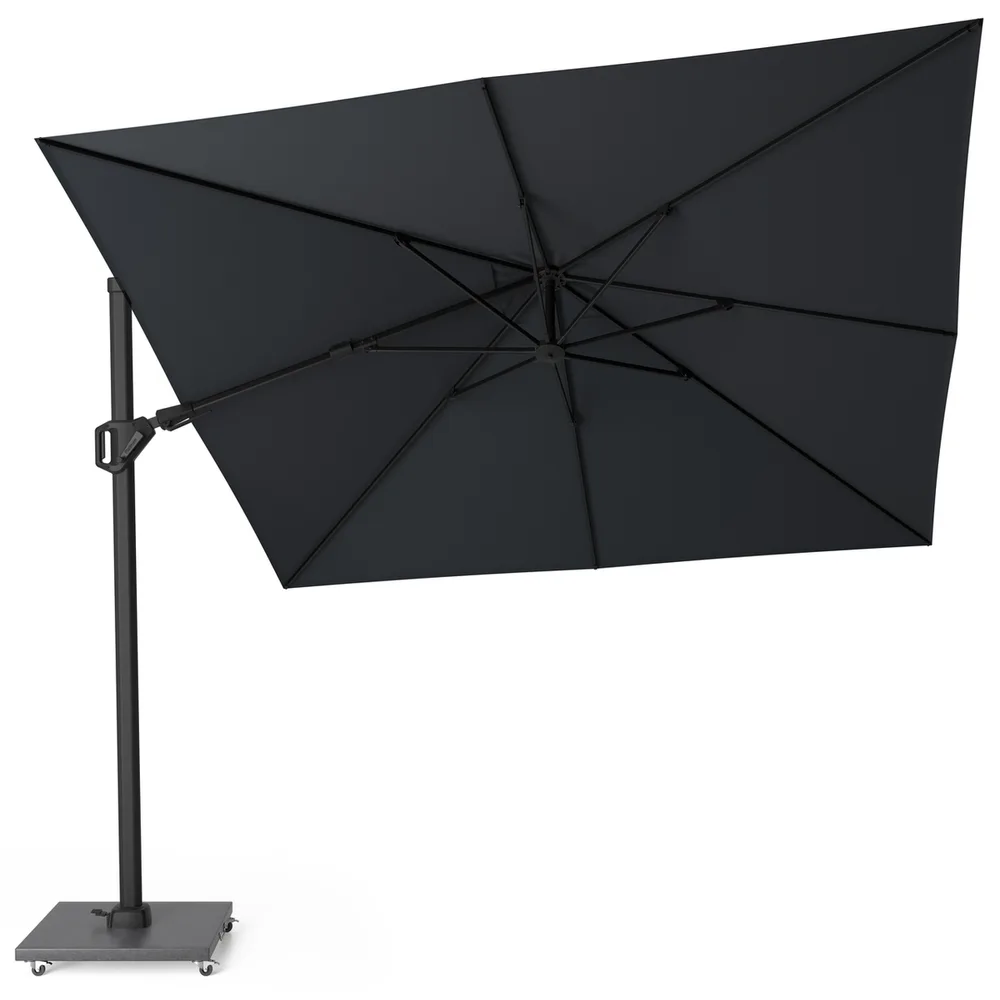
Challenger T² premium cantilever parasol 300x300 cm Jet black
Why: by tilting it sideways, you keep the shade on your table even in the late afternoon, so the dark canopy works to its fullest extent.
Blue: Madison Saint-Tropez Safier blue
If you want colour, the Saint-Tropez in Safier blue is an eye-catcher. This cantilever parasol has a 355 x 300 cm canopy of 100% polyester (220 g/m²) with a PA coating, and Madison gives it UV 50+ protection. It rotates 360 degrees and tilts sideways and backwards.
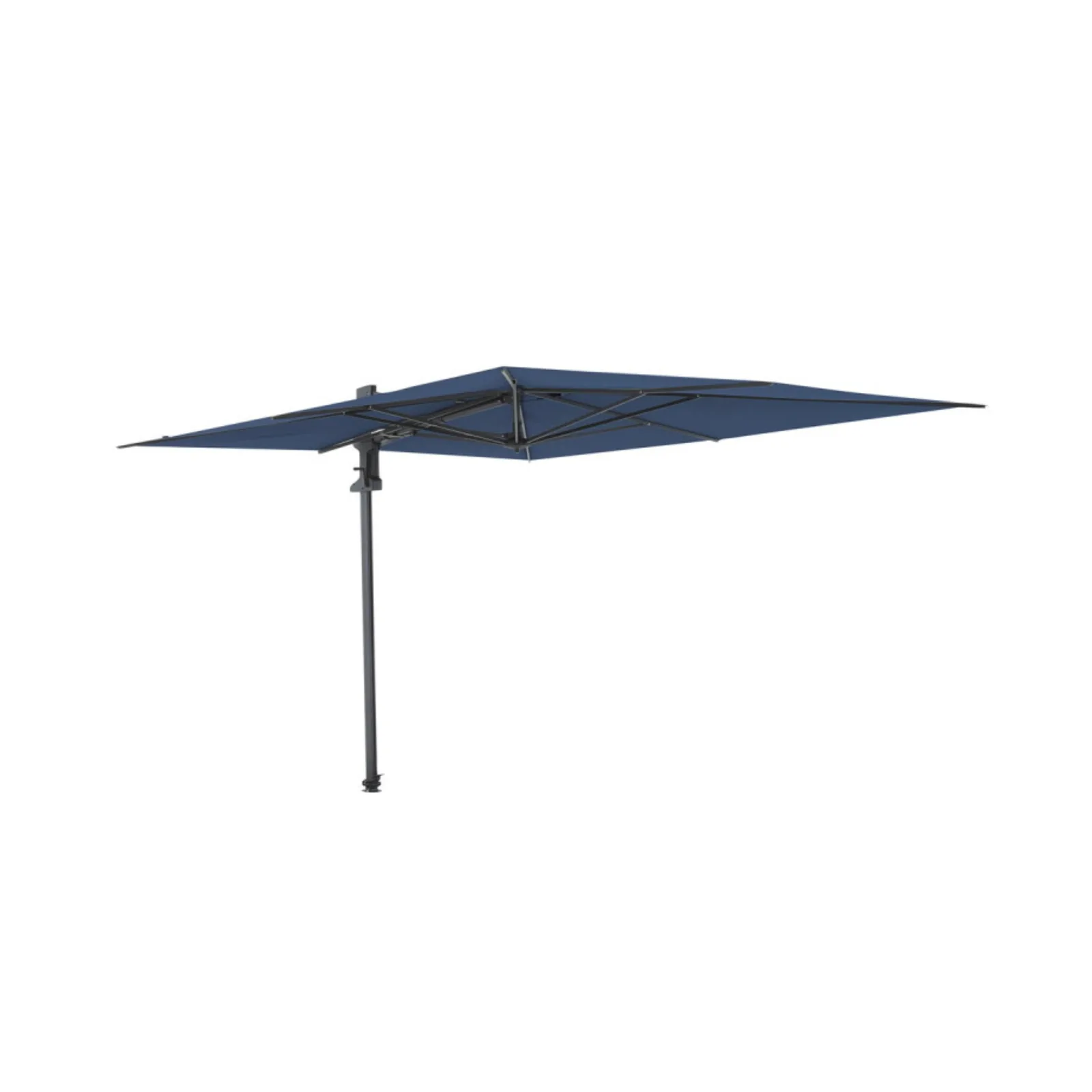
Saint-Tropez parasol 355x300 cm Safier blue
Note: the parasol base is not included with this parasol. Have a look at the parasol bases or read which parasol base do you need?
Prefer a different colour? These parasols are available in green, olive and brown:
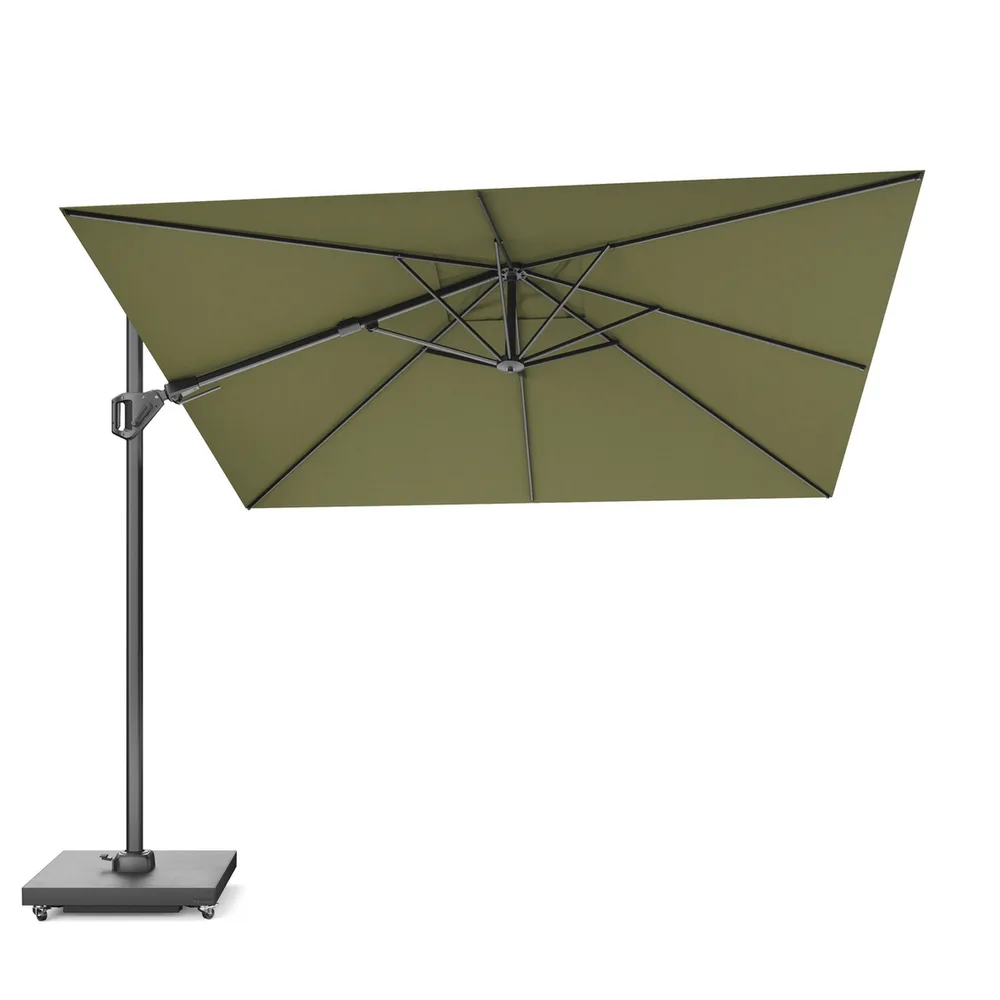
Challenger T² premium Lush green
View parasol →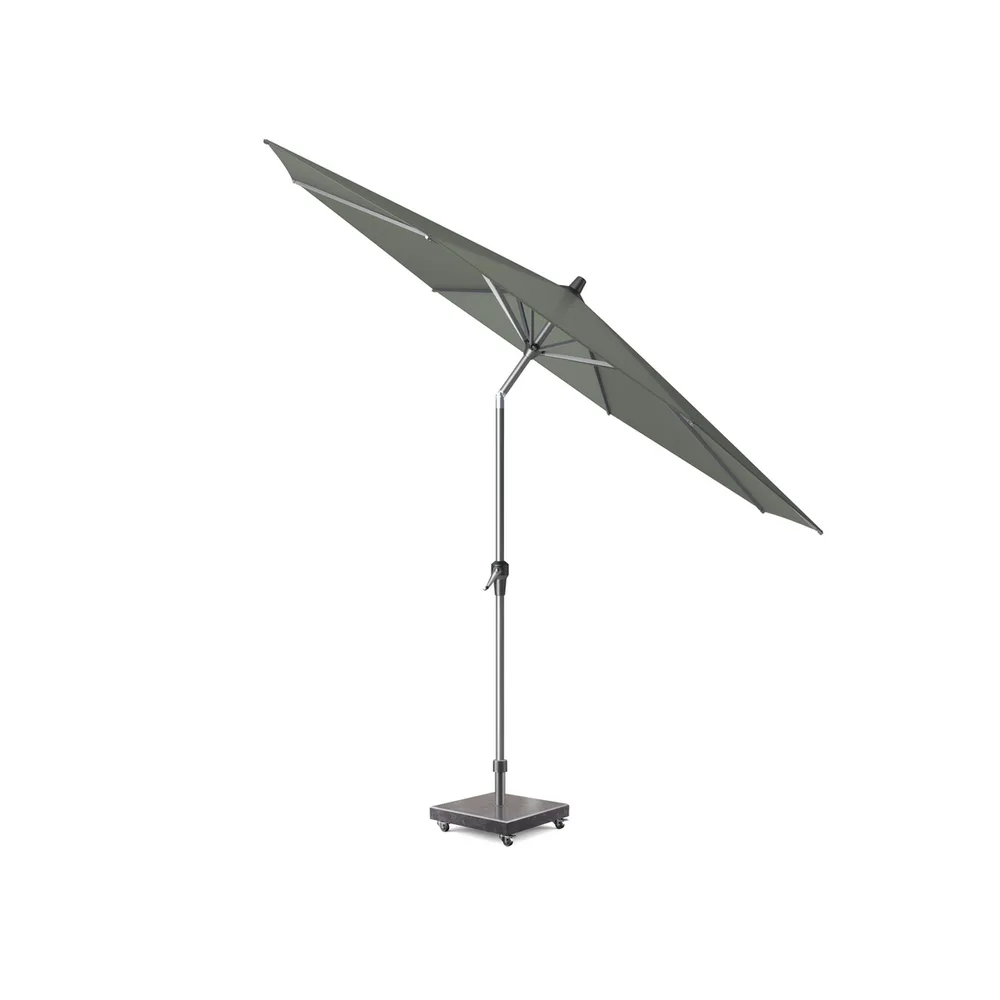
Riva parasol Ø300 olive
View parasol →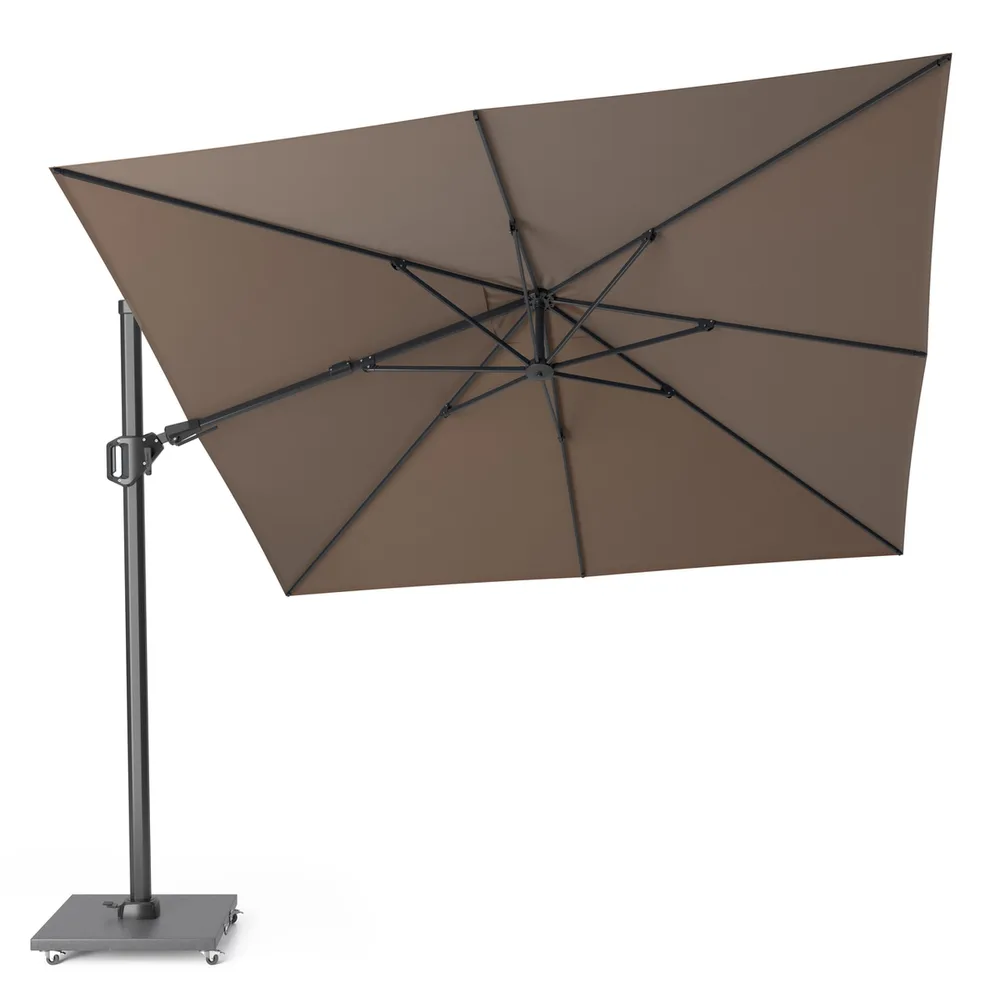
Challenger T² premium Havana
View parasol →Or browse all cantilever parasols, centre pole parasols, beige parasols and large parasols. Still unsure about the type of parasol? Our buying guide will help you on your way in a few questions.
Checklist for your parasol colour
- Checked the UV rating in the product information (percentage or UPF)
- Looked at the canopy material and the weight of the fabric
- Chosen between deep shade (dark) and a fresh spot (light)
- Matched the colour to your garden furniture and the floor
- Checked whether the parasol stands under trees: if so, preferably not white
- Chosen a parasol that tilts or rotates with the sun
- Looked for a suitable parasol base and parasol cover too
How to choose quickly
- Choose a canopy with a clear UV rating first, then the colour
- Dark for deep shade, light for a fresh and open spot
- If in doubt, choose a mid-tone such as taupe or grey
- Above the dining table, neutral is preferable to bright colours
Common mistakes
Choosing by colour for UV protection
A black canopy with no stated UV rating tells you less than a white canopy with a clear rating. Always check the product information to see what the manufacturer states.
A dark canopy hung low over a small spot
On a small, sheltered terrace with no wind, a dark canopy hung low can feel stifling. In that case choose a higher parasol, a lighter colour or an open-weave canopy.
A bright colour above the dining table
A red or blue canopy tints the light beneath it. Lovely as an accent, but your food and your guests take on the same tint. Above the table, a neutral colour is often more pleasant.
White under trees
Leaves, resin and bird droppings show up immediately on a white canopy, and so does green algae. Under trees, taupe, grey or anthracite is more practical. Also read how do you protect your parasol?
Thinking shade is enough
Even under the parasol, UV radiation reaches you, via the side and via a light floor. Apply sun cream and move the parasol along with the sun.
Frequently asked questions
Which parasol colour offers the most protection from the sun?
Colour alone says little about UV protection. Check the UV rating the manufacturer states. For the parasols in this comparison, each range lists the same value for light and dark canopies, such as up to 98% for the Challenger T² premium in Jet black and in Manhattan. A dark canopy usually lets through less light, though, so the shade feels deeper.
Is it warmer under a dark parasol?
A dark canopy absorbs more sunlight and therefore heats up itself. You can feel that warmth underneath, especially when the canopy hangs low and there is no wind. A light canopy reflects more sunlight but often lets through more light. How much difference you notice depends on the fabric, the height of the parasol and the wind.
What does UV 50+ or up to 98% UV protection mean?
They are two ways of showing how much UV radiation the canopy blocks. UPF 50 means that roughly one fiftieth of the UV radiation gets through. A percentage such as up to 98% states how much is blocked. Read the word up to as an upper limit, and ideally compare parasols using the same notation.
Which parasol colour fades the least?
Fading shows up fastest in dark and bright colours. Light colours, by contrast, show dirt and green staining more quickly. Neutral shades such as taupe and grey are the most forgiving. Also check what the manufacturer says about the fabric: Platinum describes its canopies as colourfast, and Madison gives the Timor a PA coating that resists fading from sunlight.
Do I still need sunscreen under a parasol?
Yes, certainly if you spend a long time outdoors. A parasol blocks direct sun, but UV radiation also comes from the side and bounces back off light paving, water or a white tabletop. So apply sunscreen and move or tilt the parasol along with the sun.