String lights are the quickest way to make a terrace or balcony feel cosy. You hang them up, plug them in, and the garden instantly has atmosphere. Still, things often go wrong: an indoor set that breaks after a downpour, a plug that just doesn't reach the socket, or bulbs so bright and blue that the place looks like a car park. In this guide you'll read which outdoor string lights suit your spot, what IP44 and IP65 mean, how to work out the length, which power supply is handy, and how to hang a string light safely.
Would you like a broader picture of garden lighting, from spotlights to wall lights, first? Then read buying garden lighting: what should you look for? This article is only about string lights.
In short: choose a string light that is suitable for outdoor use according to the product information, with at least IP44, and IP65 if it hangs freely in the rain. Choose bulbs or filament lamps for a terrace, and wire lights for shrubs and trees. A low-voltage string with a transformer is safe and often connectable, while a battery string is handy where there's no socket. Warm white at around 2,000 to 2,700 Kelvin gives the most atmosphere.
Choice test: which string light suits you?
Answer four questions and see which type of string light best suits your spot. Afterwards you can read about each aspect in more detail. All the string lights you see below can also be found on the ambient lighting page.
Which string light suits you?
Where will the string light hang?
- Above the terrace or dining table, between the wall and the fence
- Through a shrub, around a tree or along a pergola
- On the balcony or at the tent, with no socket nearby
- Over a large canopy or terrace, and I want to control it from my phone
What kind of atmosphere are you looking for?
- Calm and warm, like in a garden café
- Lots of small points of light, like little stars
- A few lights, just enough for a cosy corner
- Varied: warm white when eating, colour at a party
How do you want to switch it on and off?
- With a switch or dimmer on the cable
- With the plug or a switch, simple
- With a timer, so I don't have to think about it
- With an app, a schedule or voice control
What do you find most important?
- Being able to extend it if the terrace gets bigger
- Lots of light for little money
- No fuss with cables and sockets
- Weatherproof and smart, even if it costs more
A connectable string light with bulbs or filament lamps suits you. It runs on low voltage with a transformer, is dimmable, and can be extended with a second string from the same series.
Wire lights with lots of small lamps suit you. You wind the string through a shrub or around a tree and get a starry sky in the garden.
A battery-powered string light with a timer suits you. No socket is needed, so it's ideal for a balcony, garden shed or campsite pitch.
A smart string light suits you. With IP65, control via an app and schedules, so the light comes on automatically when it gets dark.
What types of outdoor string lights are there?
"String lights" cover more than a cable with lamps on it. The shape of the lamps and the spacing between them determine how the light falls. In product information you'll see terms such as bulb string lights, filament string lights, lanterns or wire lights. Here's what they mean:
| Type | What it looks like | Suits |
|---|---|---|
| Bulb string lights | Round lamps spaced well apart | Above a terrace or dining table, between the wall and the fence |
| Filament string lights | LED lamps with a visible filament, the retro look | An atmospheric outdoor room or canopy |
| Lanterns | Lamps in a shade or lantern, often coloured | Parties, a summer evening, a children's garden |
| Wire lights | Many small lamps close together on a thin cable | Shrubs, trees, a pergola or railing |
| Festoon lights with fittings | Cable with fittings where you screw in your own lamps | Anyone who wants to replace or swap bulbs |
For a terrace or outdoor room, most people choose bulbs or filament lamps: each gives a clear point of light and they hang nicely in a curve. Wire lights work best in greenery, where you hardly see the cable itself. If you're looking for ideas on where to place light in the garden, the six principles for creating atmosphere with garden lighting can help.
Konstsmide Sweden 2394: connectable bulb string light
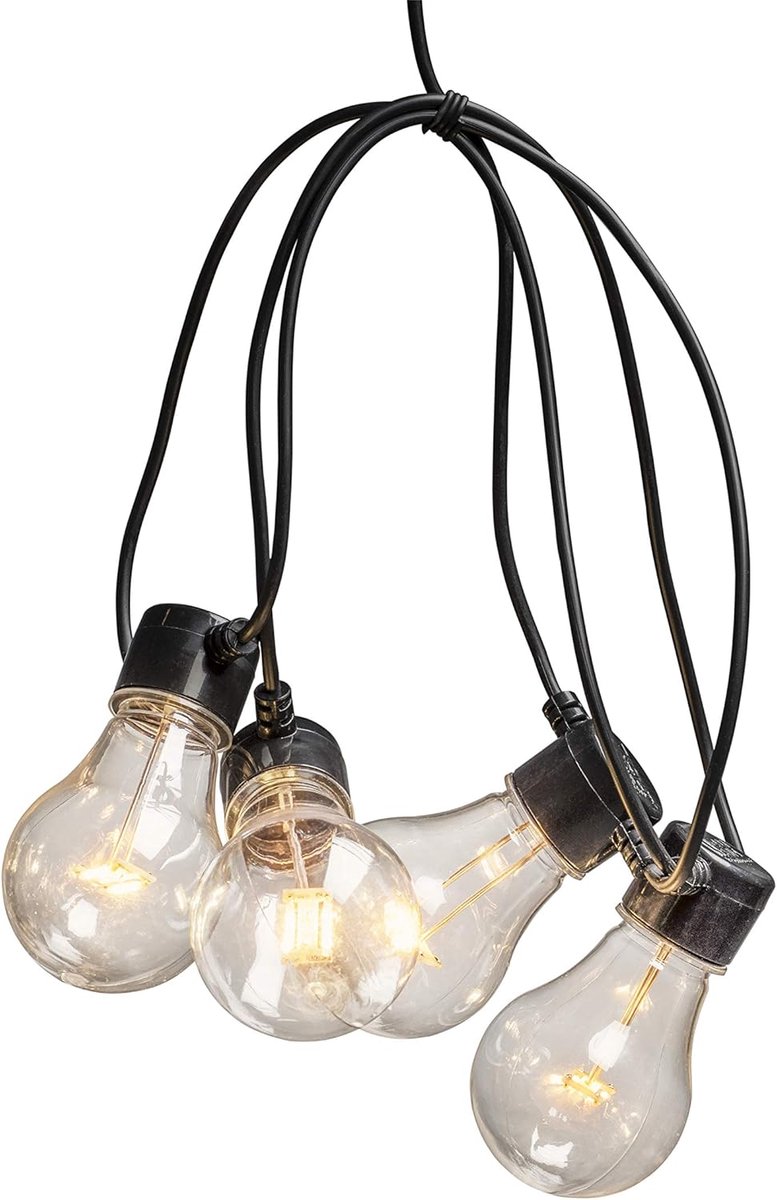
A bulb string light with ten lamps spaced one metre apart, spanning ten metres. According to the product information, it runs on low voltage (24 V), is dimmable and connectable, and the lamps are replaceable. It's a starter set, so the transformer is included. IP44, so suitable for outdoor use.

Konstsmide 3691: wire lights with 80 lamps
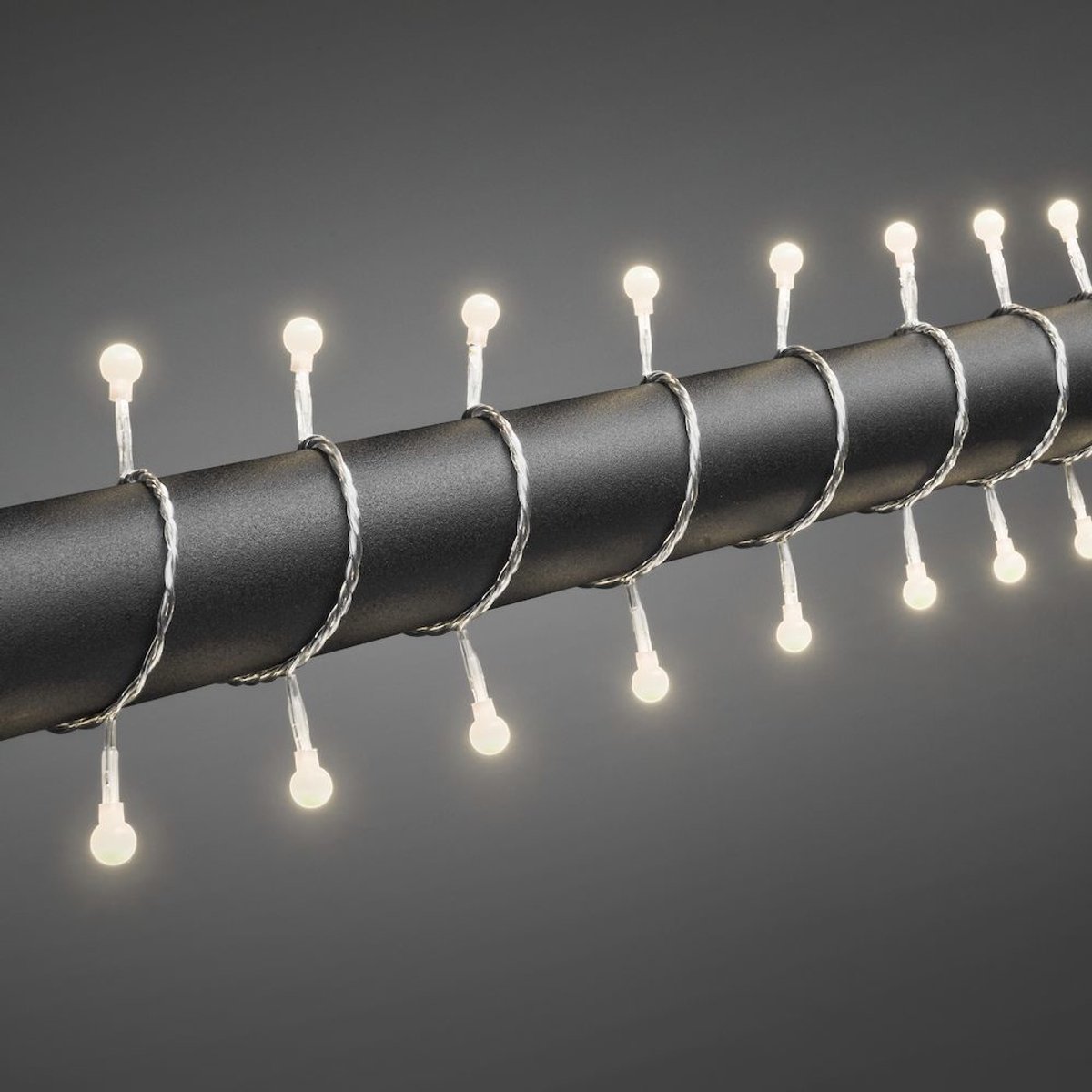
Wire lights with 80 small LED lamps close together, on low voltage. According to the product information, IP44, with an on/off switch in the cable. Wind it through a shrub or around the trunk of a tree for a sea of tiny points of light.
Are string lights waterproof? IP44 and IP65 explained
The IP rating tells you how well a lamp is protected against dust and water. The first digit covers dust and dirt, the second covers water. For an outdoor string light, the second digit is the most important:
| IP rating | Meaning | Suitable for |
|---|---|---|
| IP20 | No protection against water | Indoors only |
| IP44 | Protected against splashing water from all directions | Outdoors under a canopy, against the wall of a house, on a sheltered terrace |
| IP54 | Better protected against dust, also against splashing water | Outdoors, with a little extra margin against dirt |
| IP65 | Dust-tight and protected against water jets | Hanging freely in weather and wind, all year round |
| IP67 and higher | Protected against temporary immersion | Places where water may collect |
Most outdoor string lights have IP44. That's fine for a string under a canopy, a pergola with a roof, or along the wall under the eaves. If the string hangs in the middle of the garden with no shelter, IP65 is a reassuring choice. Also always check the plug and the transformer: these sometimes have a lower IP rating than the lamps, and should then be placed in a dry outdoor socket or indoors. You can read more about outdoor sockets and low-voltage systems in the garden in installing garden lighting with a 12V system.
Keep the transformer dry
Don't hang the transformer or adaptor in a puddle or on the ground. Mount it against the wall under a canopy, or in a lockable outdoor socket, with the cables pointing downwards so that water doesn't run into the connection.
Philips Hue Festavia: smart string light with IP65
A smart string light with globe lamps spanning roughly seven metres. According to the product information, it's IP65, dimmable, offers white and coloured light, has a timer, and is controlled via the Hue app. The lamps are replaceable and the string is connectable. A logical choice if you already have Philips Hue in your home or garden.

Festavia outdoor string light 7 metres
String lights on mains, battery or solar power?
The power supply determines where you can hang the string and how much hassle it causes. There are three types, each with its own advantages and disadvantages:
| Power supply | Advantage | Watch out for |
|---|---|---|
| Mains (230 V) or low voltage with transformer | Constant light, often dimmable and connectable | You need an outdoor socket or a dry spot for the plug |
| Battery or rechargeable pack | Can be hung anywhere, no cable to a socket | Batteries need replacing or recharging; fewer lamps and less light |
| Solar power | No electricity bill, no cables | Little sun in autumn and winter, so fewer hours of light |
Many outdoor string lights run on low voltage: the transformer converts the 230 V from the socket to, for example, 24 V. That's safer in the garden, and with connectable series you can power several strings from one transformer, up to the maximum the manufacturer specifies. A battery string is handy on a balcony without an outdoor socket, in the garden shed, or at the tent on a campsite. If you're taking a tent on the road, also read buying a tent: what should you look for?
Solar string lights exist, but don't count on them too much in the darker months: with short days and little sun, the panel charges less. You can read why solar lamps burn for less time in winter and what you're better off choosing in lighting your garden in winter.
Konstsmide Sweden 2372: battery string light with timer
A short string light with five LED lamps, battery-powered. According to the product information, IP44 and with a timer, so the string switches itself off. Small and handy for a balcony railing, a parasol or a spot without a socket.
How long should a string light be?
Length is where things most often go wrong. The product information gives two figures that you need to keep clearly apart:
- Lit length: the section with the lamps on it. This is what you see glowing.
- Lead cable: the section of cable without lamps between the plug or transformer and the first lamp. This bridges the distance to the socket.
So first measure how far the socket is from the spot where the first lamp should hang. The lead cable has to cover that distance, possibly with an outdoor extension cable. Then measure the route the lamps will follow. A string that hangs in curves is longer than the straight-line distance, so allow some extra length for the sag.
| Situation | What you measure | What to watch for |
|---|---|---|
| Straight along the wall or gutter | The length of the wall | Little extra needed; watch the lead cable to the socket |
| In curves above the terrace | The distance between the hanging points | Extra length for the sag in each curve |
| Zigzag above the terrace | Each run from point to point, added together | Often a second string is needed: choose a connectable string |
| Around a tree or through a shrub | Circumference times the number of loops | Wire lights with many lamps close together |
| Balcony railing | The length of the railing | A short string, battery-powered if there's no socket |
The spacing between the lamps matters too. With lamps one metre apart you get a calm look with clear points of light; with lamps a few centimetres apart you get a glow. For a larger terrace, a connectable string is useful: you start with a starter set and extend later with a string from the same series.
Konstsmide Sweden 2396: connectable filament string light
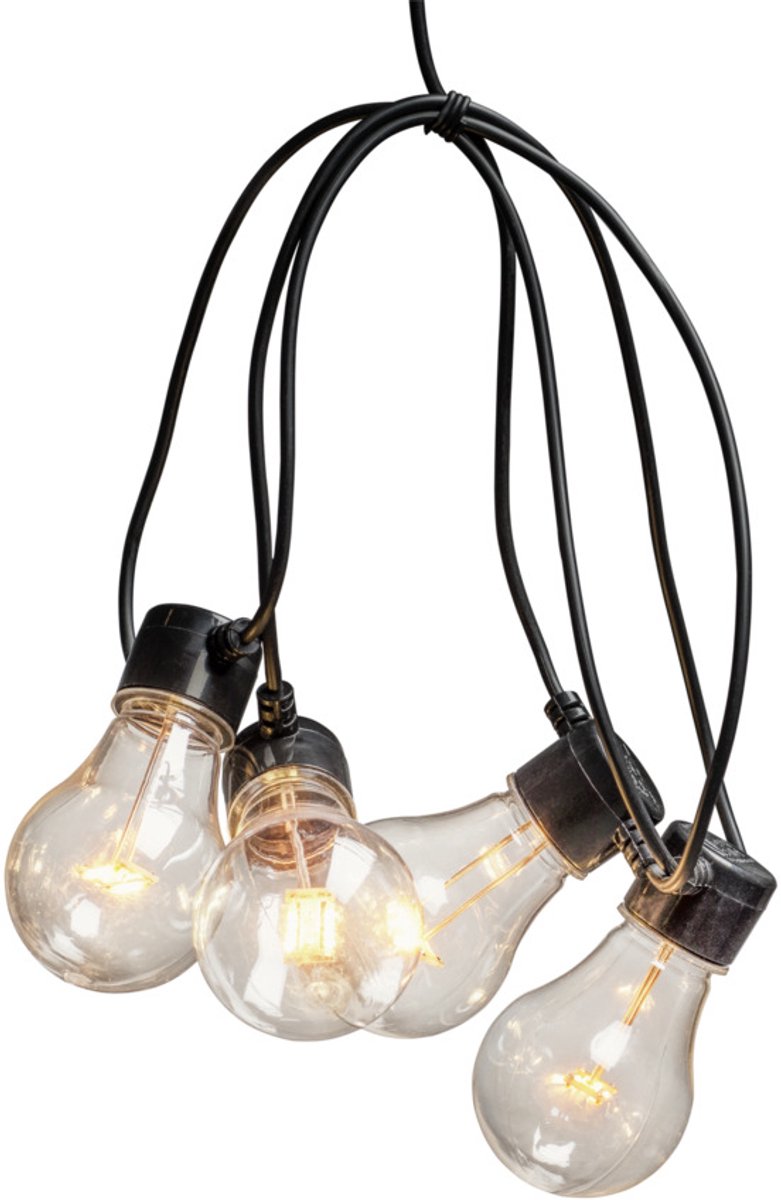
A filament string light with ten lamps spanning ten metres, on low voltage. According to the product information, it's dimmable, connectable and gives extra warm light at 2,000 Kelvin. The lead cable is also ten metres, handy if the socket is further away. IP44.
Sweden 2396 filament string light 10 metres
Which light colour is the coziest?
The colour of white light is expressed in Kelvin. The lower the number, the warmer and more yellow the light. For atmosphere in the garden, warm white works best:
| Kelvin | Colour | Effect |
|---|---|---|
| Around 2,000 to 2,200 K | Extra warm white, almost candlelight | Snug, ideal above a dining table or lounge area |
| Around 2,700 to 3,000 K | Warm white | Cosy, but a little brighter |
| 4,000 K and above | Neutral to cool white | Functional, less atmospheric |
| Coloured or RGB | Red, blue, green or changing | Parties and seasons; often found on smart strings |
Editor's tip: if you're torn between two strings, choose the one with the warmest light and a dimmer. A string light is there for atmosphere, not for reading by. If you want more light on the table, add a table lamp.
A dimmer makes a big difference. A string light that's perfect at full brightness for a party is often too bright during a quiet evening at the table. If you want light on the table as well as the string light, a cordless table lamp such as the Konstsmide Scilla is a handy addition. You'll find more standalone outdoor lamps under floor lamps and wall lights.
How do you hang a string light in the garden?
A string light is lightweight, but wind and rain make the cable heavier and pull on it. With this approach it will hang neatly for years:
- Choose fixed hanging points: the wall, a pergola, a fence post or a sturdy pole in a parasol base. Don't hang the string from a branch that moves in the wind.
- Stretch a wire: for a curve longer than a few metres, stretch steel or tensioning wire between the points and hang the string from it using clips or cable ties. That way the wind pulls on the wire, not the string.
- Let the string sag slightly: a tightly stretched string comes under strain in wind and cold. A gentle curve also looks better.
- Keep the plug dry: the plug and transformer belong under a canopy or in an outdoor socket, with a drip loop in the cable so that water runs down and doesn't reach the connection.
- Test before you hang it: plug it in while the string is still lying on the ground. A faulty lamp is much easier to replace before the string is hung up high.
Use an outdoor extension cable
If you need an extension cable, choose one that is suitable for outdoor use and unroll it fully. Don't leave connectors lying in the grass or in a puddle.
If you also want to furnish the rest of your terrace as an outdoor room, with zones for eating and lounging, you'll find ideas in setting up an outdoor living room. On a small balcony, balcony styling: tips and clever layouts can help.
Is a smart string light worth it?
You control a smart string light with an app, a schedule or your voice. The benefit is most noticeable in autumn and winter: the light comes on automatically when it gets dark and goes off when you go to bed. Some smart strings also let you choose the colour, and you can have the string work together with the other lights in the garden.
| What you want | Standard string light | Smart string light |
|---|---|---|
| On and off | Switch, plug or timer | App, schedule, voice, light sensor via the app |
| Dimming | Sometimes, with a dimmer on the cable | Yes, from the app |
| Colour | Fixed white or fixed colours | Often white and coloured light |
| Working with other lights | No | Yes, within the same system |
You'll find smart string lights under smart garden lighting. You can read how the different systems work, whether you need a bridge, and which brands there are alongside Philips Hue in smart garden lighting: Philips Hue and the alternatives.
Can a string light stay outside in winter?
It's in autumn and winter that a string light is most useful: it gets dark early, and a few warm points of light make the garden look cosy from indoors. An outdoor string light can stay up in winter if the cable, plug and transformer are suitable for outdoor use. Do watch out for three things:
- Weight of snow and ice: a string on a tensioning wire holds up better than one that has to bear its own weight.
- Wind: after a storm, check the hanging points and the clips.
- Damage: remove a string with a damaged sheath or a cracked lamp straight away; moisture and electricity don't mix.
To find out how to light the whole garden during the darker months, from the path to the front door to the lounge area, read lighting your garden in winter: ideas for the dark months. If you like sitting outside in winter, combine your string light with a fire table; buying a fire table: gas, bioethanol or wood? explains which one suits you.
Six outdoor string lights compared
Here are the string lights from this guide at a glance. The details come from the product information; you can see the current price and retailer on the cards.
| String light | Type | Power | IP | Special feature |
|---|---|---|---|---|
| Konstsmide Sweden 2394 | Bulbs | Low voltage | IP44 | Connectable, dimmable |
| Konstsmide 3691 | Wire lights | Low voltage | IP44 | 80 lamps |
| Philips Hue Festavia | Globe lamps | Mains via adaptor | IP65 | Smart, white and coloured |
| Konstsmide Sweden 2372 | Bulbs | Batteries | IP44 | Timer, no socket needed |
| Konstsmide Sweden 2396 | Filament | Low voltage | IP44 | Extra warm, 10-metre lead cable |
| Konstsmide 4161 | Lanterns | Low voltage | IP44 | 40 coloured lanterns |
Konstsmide 4161: string light with coloured lanterns
A string light with 40 small LED lamps in coloured lanterns, on low voltage. According to the product information, IP44 and with a long lead cable. Cheerful for a garden party or a summer evening, and just as good in autumn under a canopy.
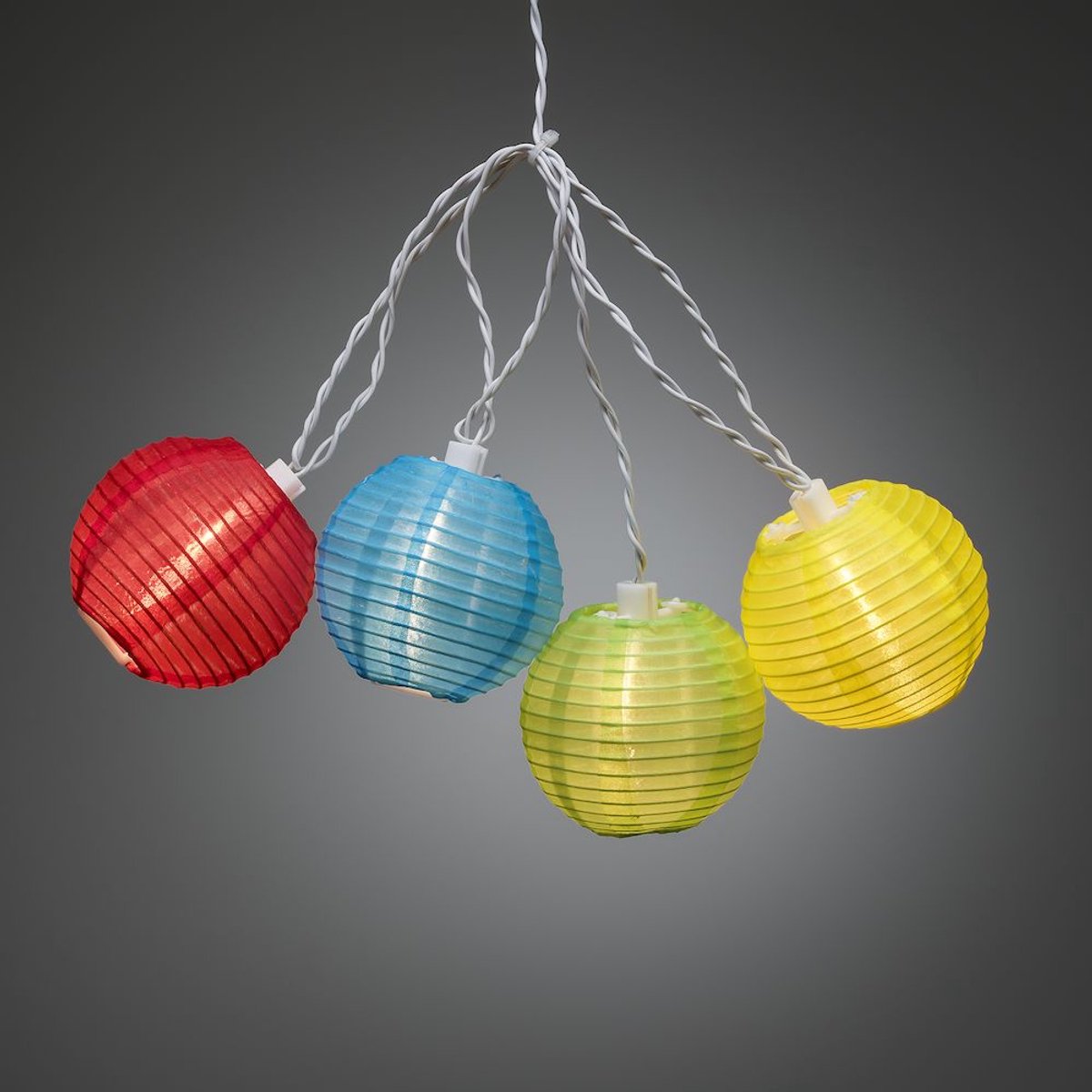
4161 string light with coloured lanterns
Also worth a look:

Konstsmide Sweden 2386: dimmable with bulbs
View string light →
Philips Hue Festavia: 14 metres
View string light →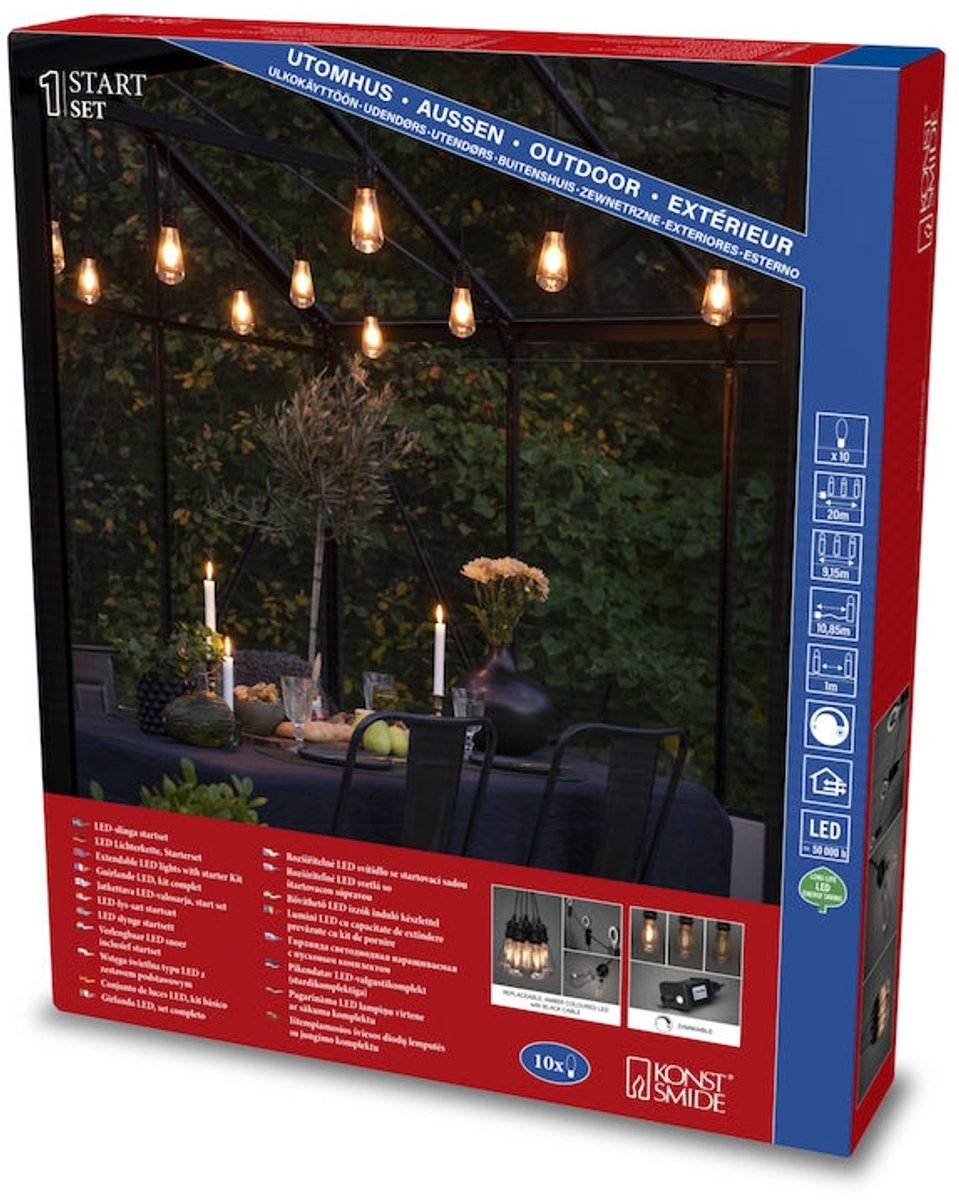
Konstsmide festoon lights with fittings
View festoon lights →How to choose quickly
- Under a canopy or against the wall: at least IP44
- Hanging freely in weather and wind: IP65
- Terrace or dining table: bulbs or filament, warm white and dimmable
- Shrub or tree: wire lights with lots of lamps
- No socket: a battery string with timer
- Larger terrace: a connectable series with a starter set
Compare all string lights from Konstsmide and Philips Hue on the ambient lighting page, or visit garden lighting for spotlights, wall lights and complete sets.
Which mistakes do people often make with string lights?
Click "Avoided" next to each pitfall you already steer clear of, and see how well prepared you are.
Hanging an indoor string light outside
A string without an outdoor IP rating isn't resistant to rain and moisture. Check in the product information that the string is suitable for outdoor use.
Only looking at the lamps
The plug and transformer sometimes have a lower IP rating. Keep them dry, under a canopy or in an outdoor socket.
Confusing lit length with lead cable
A ten-metre string with a short lead cable may not reach the socket. Measure both distances.
Stretching the string tight
Wind, rain and cold pull on a taut string. Hang it from a tensioning wire and let it sag slightly.
Connecting strings from different series
Only connect strings that the manufacturer says belong together, and stay below the maximum number.
Choosing cool white light for atmosphere
Light at 4,000 Kelvin and above is functional, but not cosy. For atmosphere, choose warm white around 2,000 to 2,700 Kelvin.
Checklist before you buy a string light
Tick off what you already know. Your browser remembers your ticks, so you can carry on later.
- The string is suitable for outdoor use according to the product information
- The IP rating suits the spot: IP44 sheltered, IP65 hanging freely
- You know where the socket is and how long the lead cable needs to be
- The lit length suits the route, with a little extra for the sag
- The type of lamp suits the spot: bulbs, filament, lanterns or wire
- The light is warm white, preferably with a dimmer
- You know whether you want to extend later and whether the string is connectable
- There are sturdy hanging points and, if needed, a tensioning wire
Frequently asked questions
Can an indoor string light also be hung outside?
No. An indoor string light is not made for rain, moisture and temperature changes. Outdoors, only use a string light that the product information states is suitable for outdoor use, with at least IP44. The plug, the transformer and the extension cable must also be suitable for outdoor use, or stay dry indoors or under a canopy.
What IP rating does an outdoor string light need?
For a string light under a pergola or against a wall, IP44 (protection against splashing water) is often sufficient. If the cable hangs freely in weather and wind all year round, IP65 (dust-tight and protected against water jets) gives you more margin. Also check the IP rating of the plug or adapter: it is often lower than that of the lights.
Can you connect string lights to each other?
Only if the manufacturer says so. With a connectable string light, the product information states that the set can be extended, often with a starter set (including a transformer) and separate extensions. Never connect strings from different brands or series, and stay within the maximum number of sets the manufacturer specifies.
How many metres of string light do I need for my terrace?
Measure the route the cable must follow, including the distance to the power socket. For a cable that hangs in curves between two points, you need more length than the straight-line distance. Also note the difference between the lit length and the lead cable: the lead cable carries power to the first bulb and does not produce light.
Can a string light stay outside all winter?
It can, if the cable, plug and transformer are suitable for outdoor use and are securely fixed. Snow, sleet and strong wind put extra strain on the cable, so hang it from a tensioned wire rather than stretching it tight between two points, check it now and then, and remove any damaged cables immediately.