
Why an outdoor rug completes your terrace
A terrace can be beautifully furnished with a lounge set or garden set — but without a rug underneath, it still feels rather bare. An outdoor rug is one of the simplest ways to complete your outdoor space at once, just as a floor rug does inside a living room.
Yet an outdoor rug is often added last, or even skipped altogether — whilst it's actually one of the most defining styling choices for how "finished" your garden looks. In this article, we explain why, and how to choose the right rug for your situation.
Defining a seating area
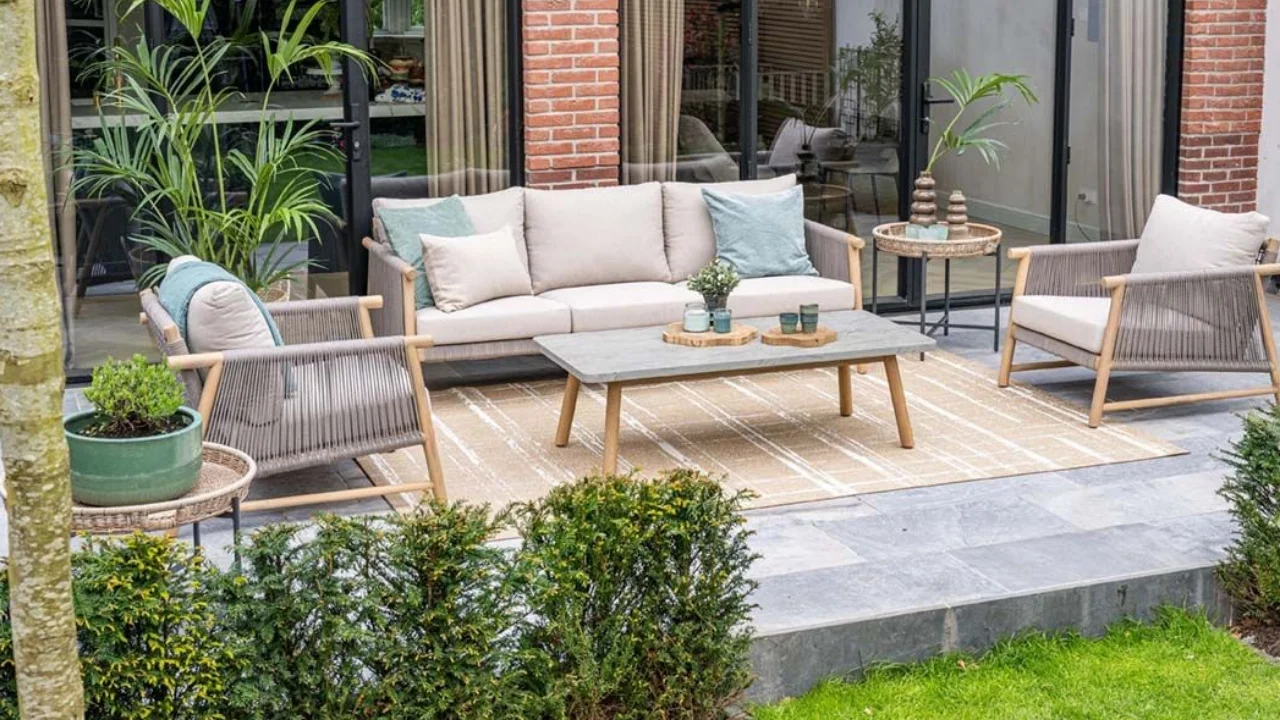
Especially on a large terrace or lawn, a rug visually indicates where the "room outside" begins and ends. Without that definition, loose pieces of furniture quickly appear randomly scattered, even if the layout is actually well thought out.
Completing the styling at once
The colour and pattern of the rug can be echoed in your decorative cushions, creating a neat, coordinated whole. This is the same styling trick used indoors: a rug as the foundation, with the rest of the colours built around it.
Softer underfoot
Nice on a tiled or wooden terrace, especially around a lounge set where you often walk barefoot. A rug also prevents furniture legs from scratching or sliding directly on hard surfaces.
Which material do you choose for outdoors?
For outdoor use, it's important to choose a rug that can withstand moisture and UV light — a regular indoor rug will be destroyed outdoors in no time. Synthetic fibres, such as polypropylene, are the most commonly used choice for this: they dry quickly after rain, don't fade easily in the sun and are easy to clean with a garden hose.
There are also outdoor rugs made from recycled plastic, often in weave patterns that resemble natural materials such as sisal or jute, but completely weatherproof. These combine a natural appearance with the practical advantages of synthetic material.
Avoid rugs made from natural fibres such as wool, cotton or jute for permanent outdoor use: these materials absorb moisture, can become mouldy and quickly lose their colour and shape under the influence of sun and rain.
Size and placement: how to avoid a rug that's too small
A common mistake is choosing a rug that's too small. Make sure that at least the front legs of your sofa, chairs and coffee table stand on the rug — this immediately makes the seating area look like one unit rather than standing loose on the tiles beside it.
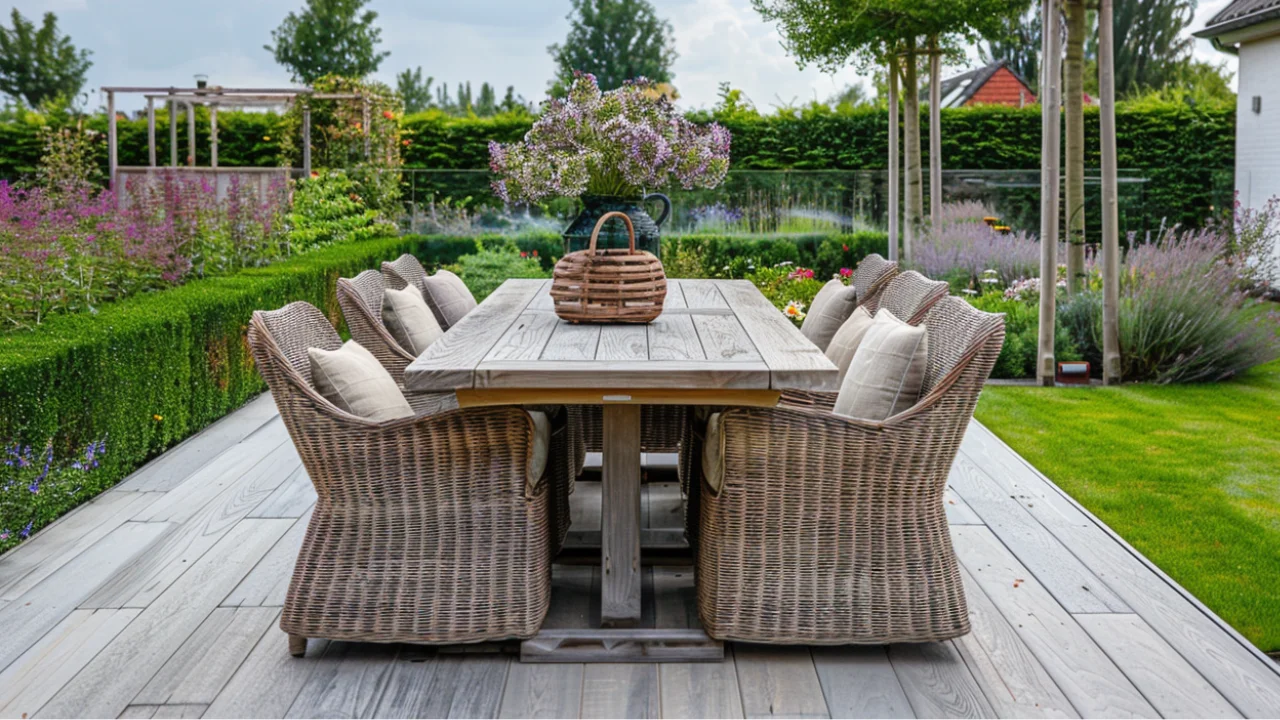
The same principle applies to a garden set: make sure the rug is large enough so that the chairs also stand on it when they're pulled out from under the table to sit down. Therefore, don't just measure the table, but also the space you need when everyone is seated at the table.
Also consider the walkways around the seating area: ideally leave enough space on all sides of the rug to walk around it comfortably, so that the rug doesn't feel like an obstruction.
Combining with your garden style
If you're going for a neutral look, choose a plain rug in grey, taupe or sand — that will match virtually any lounge set and looks timeless, even if you adapt the rest of your garden later. If you prefer more atmosphere, look for a rug with a subtle pattern and combine it with coloured decorative cushions for a bohemian or Mediterranean feel.
For a modern, streamlined garden, a rug with a graphic pattern in two colours works well, whilst a country or rustic garden benefits from a rug with an organic, woven texture.
Shape and pattern: more than just a rectangle
Most outdoor rugs are rectangular, but round and oval variants are also available, which work well around a round garden table or a compact lounge corner. A round rug under a rectangular seating area, however, can look restless — ideally keep the shape of the rug in line with the shape of your furniture arrangement.
As for pattern: the busier the pattern, the more important it is to keep the rest of the styling calm. An eye-catching rug combined with lots of coloured cushions can quickly feel overwhelming. Instead, choose either a statement rug with plain cushions, or a plain rug with colourful accessories.
Maintenance: keeping your outdoor rug beautiful for years
Most outdoor rugs can simply be left outside, even in the rain. However, a few simple habits significantly extend their lifespan:
- Sweep loose leaves and dirt off regularly with a broom, before it gets deep into the fibres.
- Rinse the rug with the garden hose when it's really dirty, and let it drain and dry thoroughly.
- Roll up the rug during persistent frost and store it dry, especially in the first few years until you know how the material behaves in winter.
- Move furniture around occasionally, so the rug doesn't get permanent indents in exactly the same spots.
Why a regular indoor rug outside is not a good idea
It's tempting to take a spare floor rug from inside out to the garden — it saves a purchase after all. However, this is almost always a short-lived venture. Indoor rugs are made from materials such as wool, cotton, jute or viscose, which are not resistant to moisture. Once such a rug gets wet, the moisture stays in the fibres, which can lead to mould formation, a musty smell and discolouration within a few weeks.
Additionally, indoor rugs are not treated to be UV-resistant: bright colours and patterns often fade noticeably in the full sun within just one season. The underside of an indoor rug is usually fitted with a non-slip layer that is not resistant to damp outdoor conditions — this layer can come loose or become sticky.
In short: what seems like a saving in the short term is often more expensive in the long run, because you'll have to replace the rug within a season anyway. A rug specifically designed for outdoors is a one-off, thoughtful investment that will last for many years.
Price and quality: where's the difference?
Outdoor rugs vary greatly in price, and the difference usually comes down to three things: the density of the fibres, the thickness of the rug and the finish of the edges. A denser woven rug feels firmer underfoot and generally lasts longer, whilst a thinner woven rug may start to fray or lose its shape more quickly.
Also pay attention to how the edges are finished: a well-finished edge with double stitching frays less easily than a rug with a simple, thin seam. With a cheaper rug, this is often the first part to deteriorate, even if the rest of the rug remains in good condition.
A slightly higher investment in a quality outdoor rug usually pays off in longevity: whilst a cheap rug may need replacing after one or two seasons, a quality rug often lasts many years, even with intensive outdoor use.
Frequently asked questions
Can an outdoor rug simply stay out in the rain?
With rugs made from synthetic fibres such as polypropylene, this is generally not a problem — they dry quickly and are moisture-resistant. During persistent frost, however, it's sensible to temporarily store the rug.
What size outdoor rug goes with my lounge set?
Make sure that at least the front legs of the sofa, chairs and coffee table stand on the rug. First measure the full area of your furniture arrangement, including any corner elements, before choosing a size.
Does an outdoor rug fade in the sun?
Quality outdoor rugs made from synthetic fibre are treated against UV light and therefore fade much less quickly than a regular indoor rug. However, they're never completely colourfast — after years of intensive sun exposure, some light fading may occur.
Can I lay an outdoor rug on grass?
Yes, you can, although it's important to move the rug regularly so the grass underneath doesn't suffocate and turn yellow. On a terrace or decking, an outdoor rug is more practical for permanent use.
How do I properly clean an outdoor rug?
Start by sweeping away loose dirt, then rinse with the garden hose and use a mild solution with a soft brush for stubborn stains. Let the rug dry thoroughly before putting the furniture back on it.
Can I combine an outdoor rug with a parasol base on it?
Yes, you can, but keep in mind that a heavy parasol base may eventually leave a permanent impression in the rug. Preferably place a small piece of felt or rubber under the base to avoid point loading, and move the parasol occasionally so the rug isn't always under stress in exactly the same spot.
Looking for the right outdoor rug for your terrace? Check out our range of outdoor rugs and complete your seating area in one go.