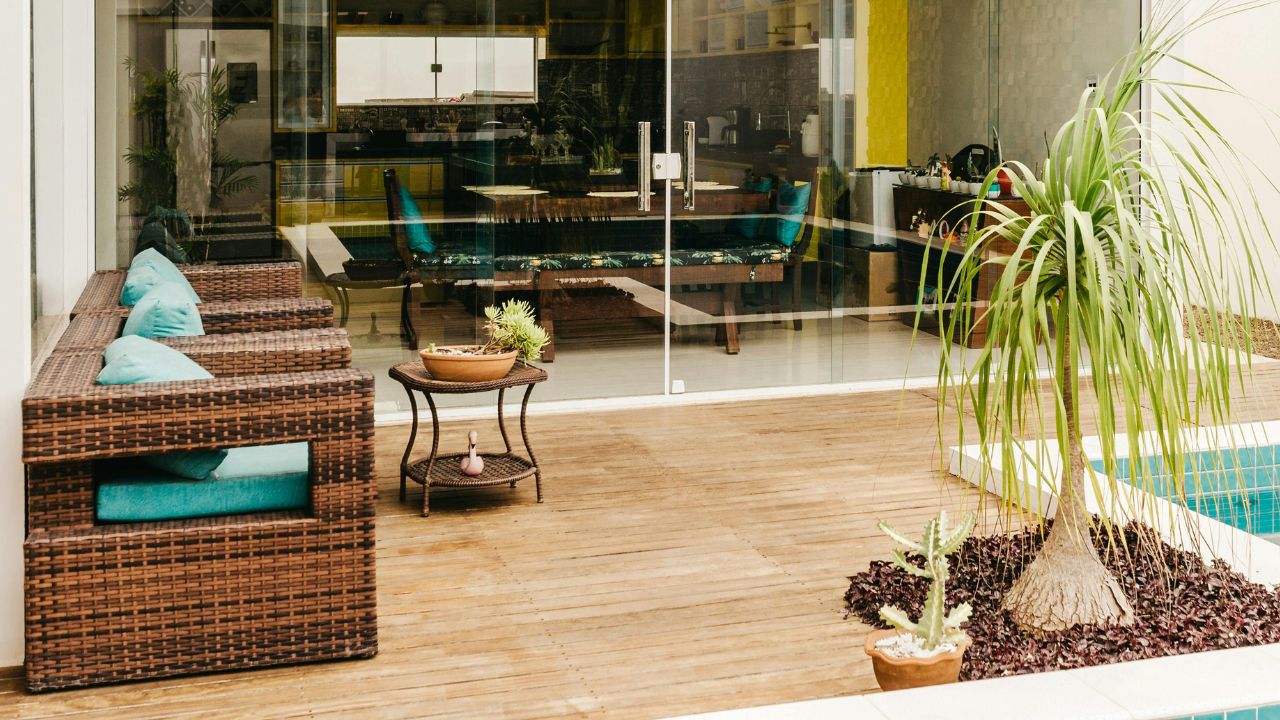

A patio is perhaps the most pleasant outdoor spot there is: sheltered between walls, right next to the kitchen or living room, and often warm enough to sit outside early in spring. But those very walls make arranging it different from an open terrace. It heats up faster, there is less light in the corners, and sound bounces back. In this guide you'll read how to lay out a patio smartly, whether it's two by three metres or has room for a complete lounge-dining set. With furniture, shade, lighting, plants in pots and flooring that suit a patio.
In short: use the walls as a backdrop: furniture against them, lamps on them, greenery against them. On a small patio a bistro set or a compact corner sofa fits, on a large patio a lounge-dining set with a separate lounge zone. Hang shade between the walls instead of a large parasol base in the middle of the floor, and dampen the echo with a rug, cushions and plants. Not sure about the layout? Take the choice test.
What exactly is a patio?
A patio is an outdoor space that lies directly against the house and is enclosed on several sides by walls, facades or high fences. You'll find them at townhouses, terraced houses with a courtyard and at homes with an L-shaped extension. Sometimes part of it is covered by a canopy, a projecting roof or a pergola: a semi-covered patio.
The difference from an ordinary terrace lies mainly in the surroundings. A terrace sits open in the garden, a patio is more of an outdoor room with walls. That is exactly why it's so pleasant: sheltered, private and close to the kitchen. If you want to know how to arrange an outdoor space as a room in general, with zones and atmosphere, then also read how to furnish an outdoor living room. Here it's about what makes a patio special.
What makes a patio different
The walls around a patio are at once its greatest strength and its greatest challenge. You'll notice four things straight away:
| What you notice | Cause | Solution |
|---|---|---|
| Hot in the afternoon | Stone walls hold heat | Shade sail or roller blind |
| Dark corners | Walls block the sun | Light colours, wall lights |
| Sound echoes | Hard surfaces reflect sound | Rug, cushions, plants |
| Green build-up | Moisture in the shade | Fall, keeping it clean |
The wall as a backdrop. On a patio you don't have to place furniture in the middle of the space. A bench against the facade or a corner sofa in the corner between two walls feels sheltered and keeps the middle free. The walls are also your place for lamps, climbing plants and shade sails.
Warmth. Stone walls and tiles heat up in the sun and release that warmth again in the evening. As a result you can often sit outside on a patio longer than in an open garden, but it also gets too hot sooner in the middle of the day. Shade is therefore no luxury on a sunny patio.
Acoustics. Between hard walls, voices, chair legs and crockery sound louder. Soft materials dampen that. An outdoor rug, cushions, a canopy overhead and plenty of greenery make a patio genuinely calmer.
Stand on your patio on a sunny afternoon and again in the evening before you buy anything. Look at where the sun lingers longest, which wall feels warm and where it's darkest. That's where you put the seating area, the shade and the lamps.
Small or large patio: the differences
A patio of a few square metres calls for different choices than a courtyard that can fit a complete dining area. Here's how they differ:
| Element | Small patio | Large patio |
|---|---|---|
| Furniture | Bistro set or corner sofa | Lounge-dining set |
| Zones | One seating area | Dining and lounging separately |
| Shade | Sail or slim parasol | Large sail or cantilever parasol |
| Light | Two or three wall lights | Wall lights plus mood lighting |
| Greenery | Tall: climbers, tall pots | Groups of large pots |
| Rug | Around 120 x 170 cm | Around 160 x 230 cm or larger |
Is your outdoor space more of a narrow back garden than an walled-in patio? Then you'll find more ideas in furnishing a small back garden. If you live on a floor of a building, look at furnishing a balcony.
Choice test: which layout suits your patio?
Answer four questions and see which arrangement best suits your patio.
Which patio layout suits your courtyard?
How much free floor do you have between the walls of your patio?
- Less than roughly three by three metres
- A corner of roughly three by two and a half metres along two walls
- Well over four by four metres
What do you most often step out onto the patio for?
- A cup of coffee or breakfast together
- Reading, lounging and relaxing afterwards
- Eating with family or friends
What needs to stay clear between the back door and the rest of the patio?
- Almost everything: we walk through here with bikes and bin bags
- The middle, the seating area may sit in a corner
- A walking route around the table is enough
How many people do you usually sit out with on an ordinary evening?
- Alone or with one other person
- With two or three
- With four or more
A bistro corner against the wall A small table with two chairs against the facade takes up little floor and keeps the way through clear. Ideal for breakfast in the morning sun.
A corner sofa in the corner between two walls The walls become your backrest and the middle of the patio stays free. This turns a corner into a genuine outdoor room.
A lounge-dining set as the centrepiece You have the space to both dine and lounge on one set. Leave a walking route around it and place the shade above it.
Would you rather see more options side by side? Then take the extensive selection guide.
Furnishing a small patio
On a small patio every square metre counts. The rule is simple: keep the floor as free as possible, and the walls as full as possible. Place the furniture against the facade or in a corner, hang the lamps and let the greenery grow upwards.
- Choose one seating area instead of a dining spot and a lounge spot next to each other.
- Light colours on walls, cushions and rug make a small, enclosed space look larger and lighter.
- A mirror for outdoors on a dark wall reflects daylight and adds depth.
- A small side table next to a chair is often enough for a cup of coffee or a book.
Alfa: bistro set for against the facade
The Alfa is a 3-piece bistro set with two chairs and a small table in carbon black. The seat height is 43 cm and the cushions are included. You place a set like this against the facade next to the kitchen door, so the rest of the patio stays free to walk through.
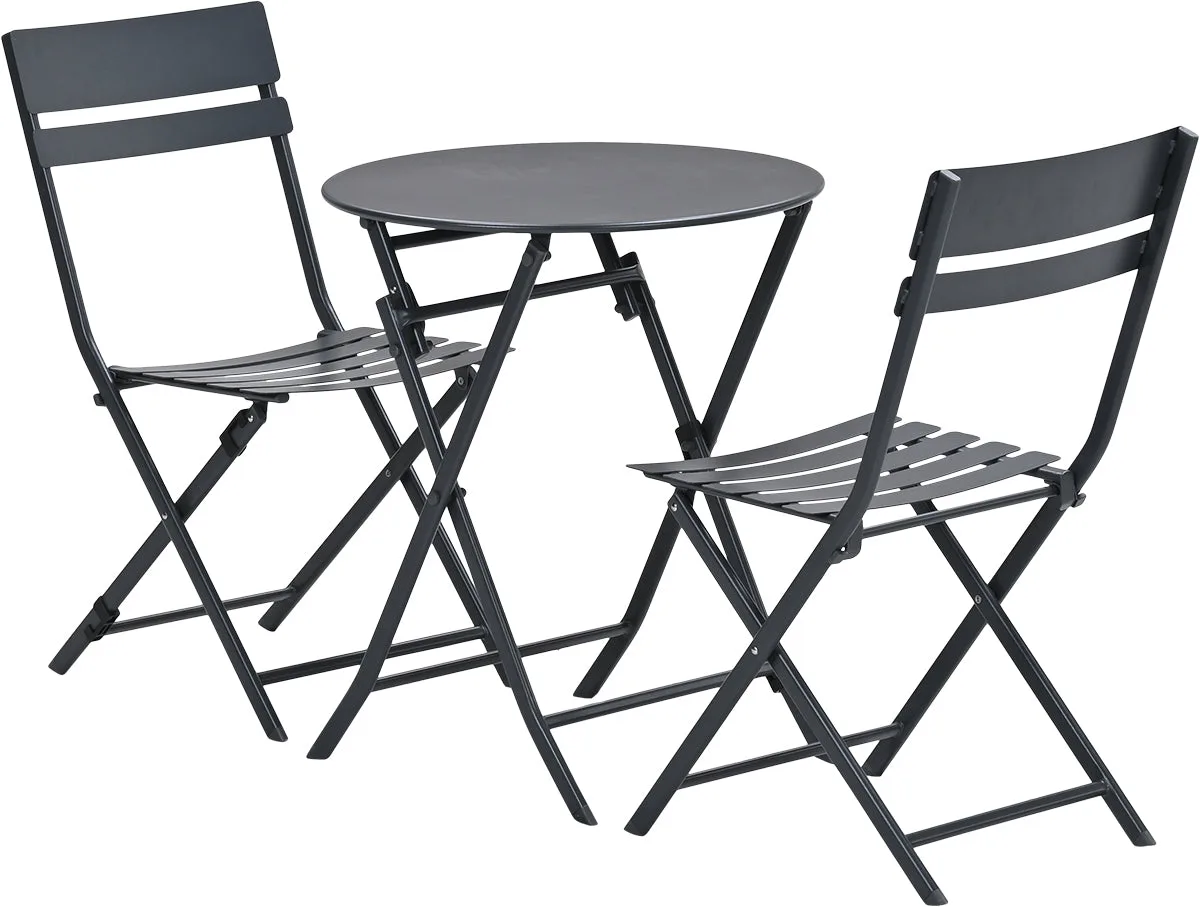
Alfa bistro set 3-piece carbon black
You'll find more compact sets at the bistro and balcony sets. You can read what to look out for when choosing in buying a bistro set.
Esmee: corner set for the corner between two walls
If you have a corner of roughly two and a half metres free, a corner sofa is the best way to make use of it. The Esmee is a 3-piece corner set measuring 248 x 179 cm with an aluminium frame, 9 cushions in mystic grey and a table with a glass top. Against two walls it forms a sheltered seating area, while the middle of the patio stays free.
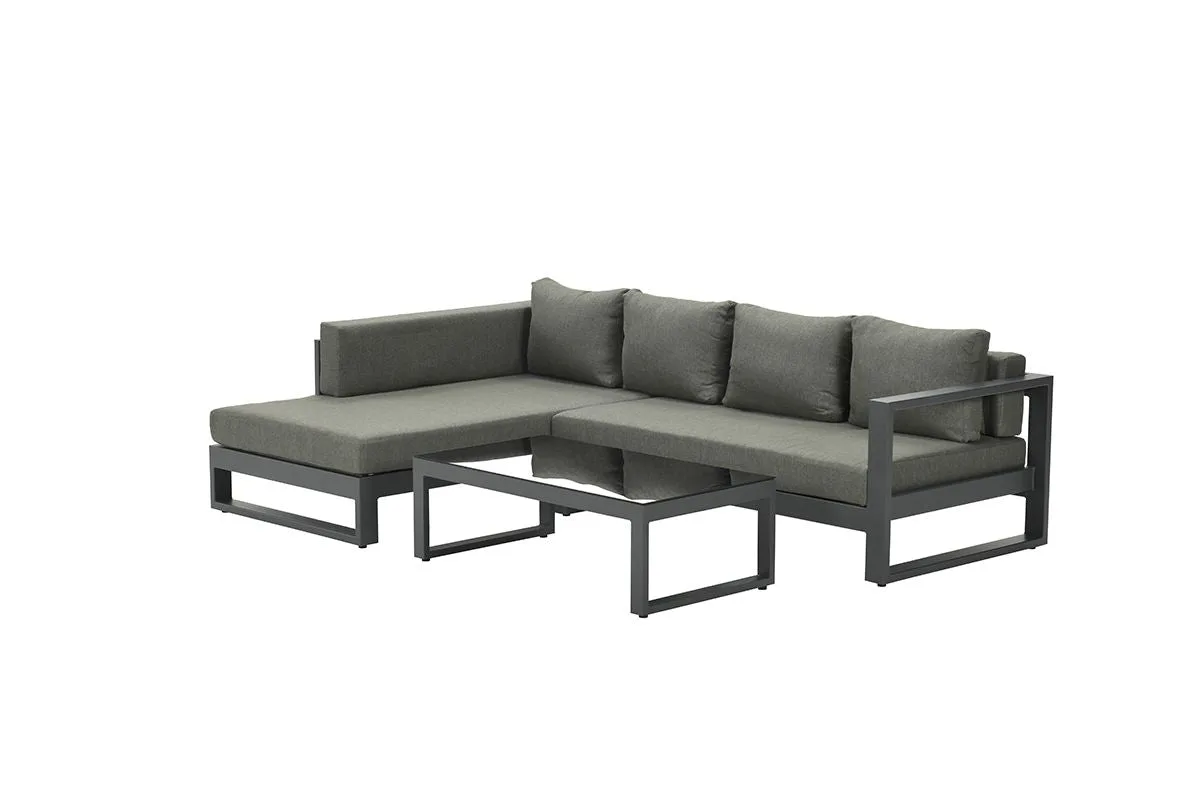
Esmee corner set 3-piece right
Please note: this version is right-hand. Check on the product photo which side the long side is on and compare that with your corner. The Esmee is also available in a left-hand version. More models are at the corner lounge sets.
Furnishing a large patio
On a large patio the risk is the opposite: a set in the middle of the floor and bare space everywhere else. So work with zones. A dining or lounge-dining set as the centrepiece, a quiet corner with a chair and a side table, and greenery in between as a divider. That way a large courtyard feels like several rooms rather than a car park.
- Place the table close to the kitchen door, so you have the shortest route when carrying food and plates.
- Put the lounge zone in the quietest corner, ideally where the evening sun lingers longest.
- Separate zones with pots rather than screens, so the light still gets through.
- Keep at least one walking route clear from the door to the garden, gate or shed.
Monti: lounge-dining set for a spacious patio
The Monti is a 5-piece lounge-dining set with a corner sofa measuring 278.5 x 213.5 cm and a table measuring 147 x 85 cm. The aluminium frame is carbon black, the upholstery is taupe rope and you get 13 cushions included. The seat height is 42 cm and the seat depth 57 cm. Because the set is modular, you can adjust the arrangement to the shape of your patio.
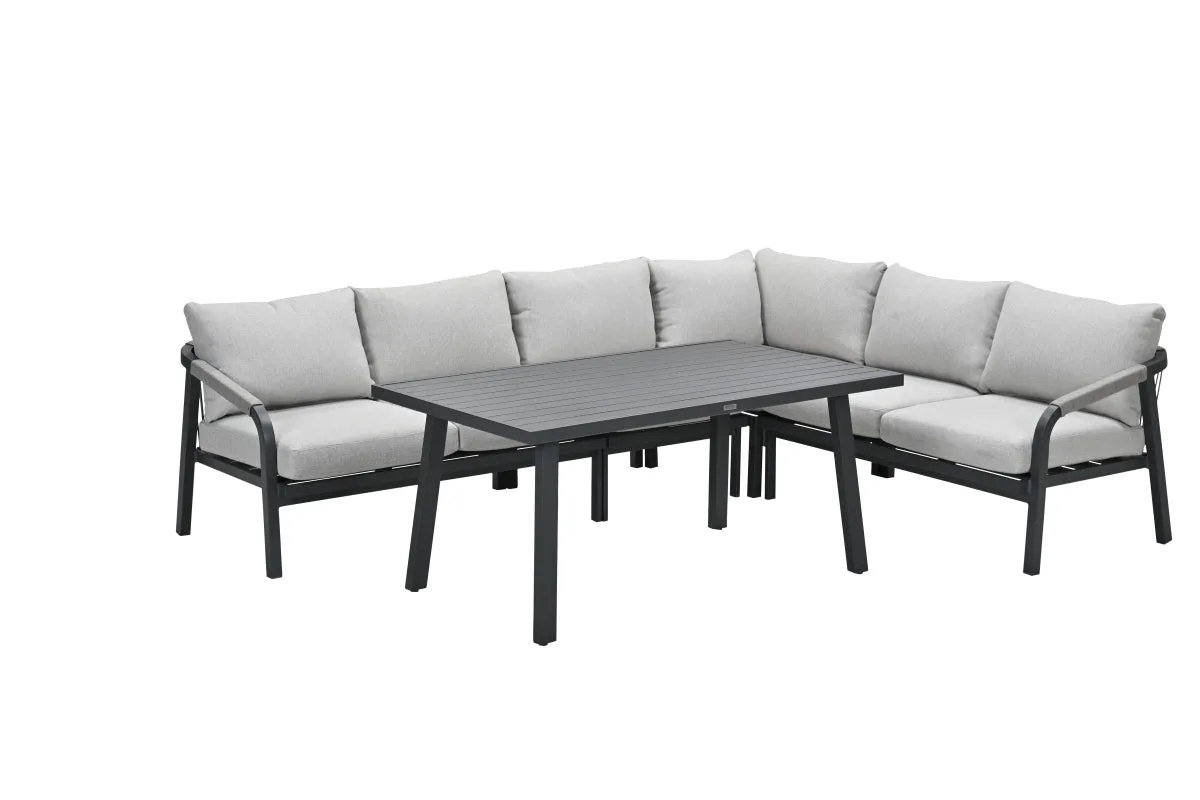
Monti lounge-dining set 5-piece
Please note: allow some extra walking space around the set, especially on the side of the table. To find out how much you need, read how much space you need for a lounge set. More sets are at the dining lounge sets.
For a quiet reading corner next to the set, a small side table is enough:
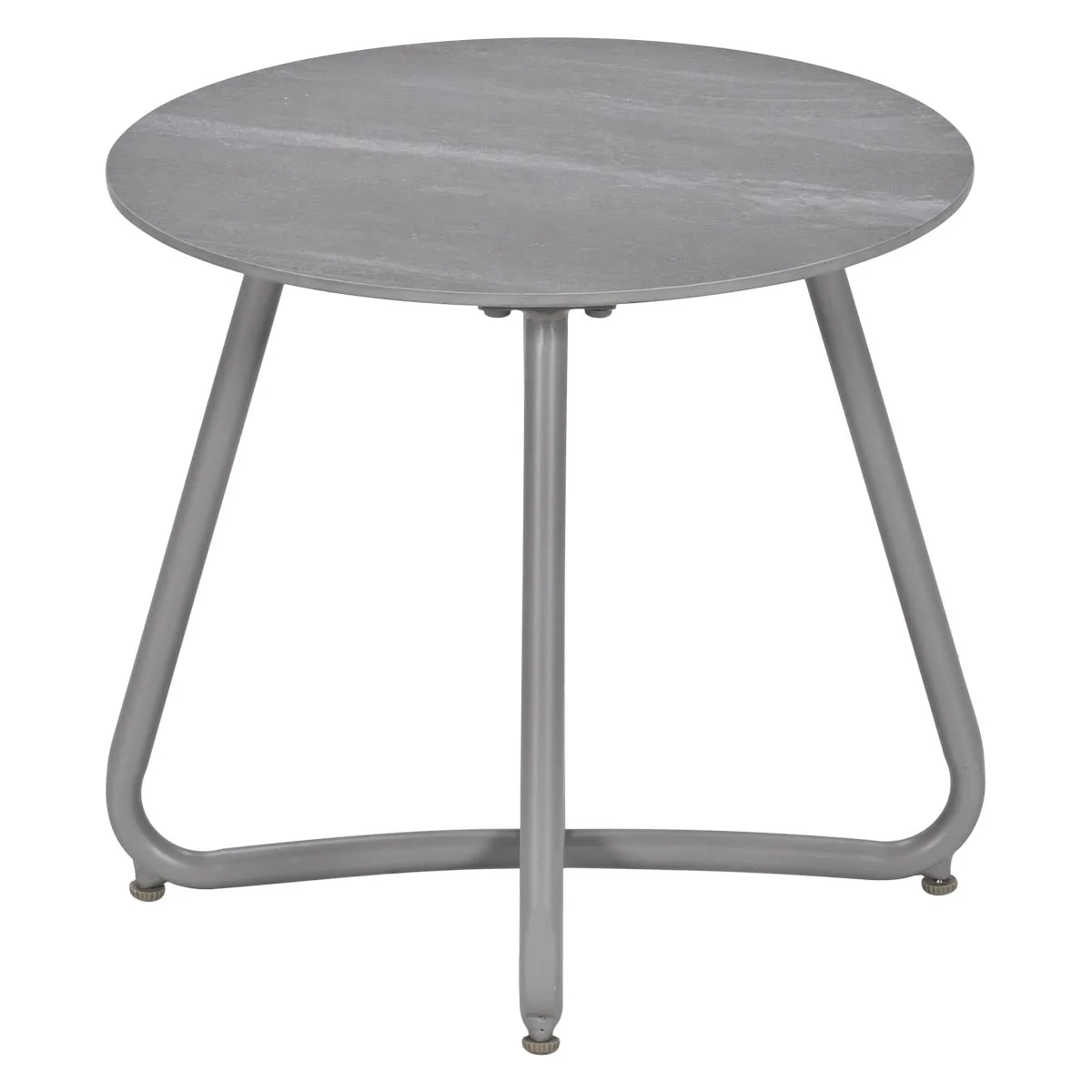

Shade between the walls
On an open terrace you put up a parasol and that's that. On a patio you have something better: walls to hang things from. That way there's no heavy parasol base standing in the middle of the floor. Four solutions that work well on a patio:
- A 90-degree triangular shade sail fits neatly into a right-angled corner between two walls, with one pole or fixing point on the open side.
- A roller blind under a canopy or pergola blocks low-hanging sun on a semi-covered patio.
- A rectangular cantilever parasol with a tilt function can stand close to a wall and still cover the seating area.
- A large cantilever parasol on a spacious patio, with the mast set in a corner and the canopy hanging over the table.
Coolfit shade sail triangle 90 degrees
This Platinum Coolfit shade sail is a 90-degree triangle with sides of 4 x 4 x 5.7 m. The sail is made of densely woven HDPE (285 g/m2), is water- and wind-permeable and, according to the manufacturer, offers up to 95% UV protection. The fixing rings are made of RVS 316 stainless steel. Fixing hardware is not included: you choose that based on your walls.
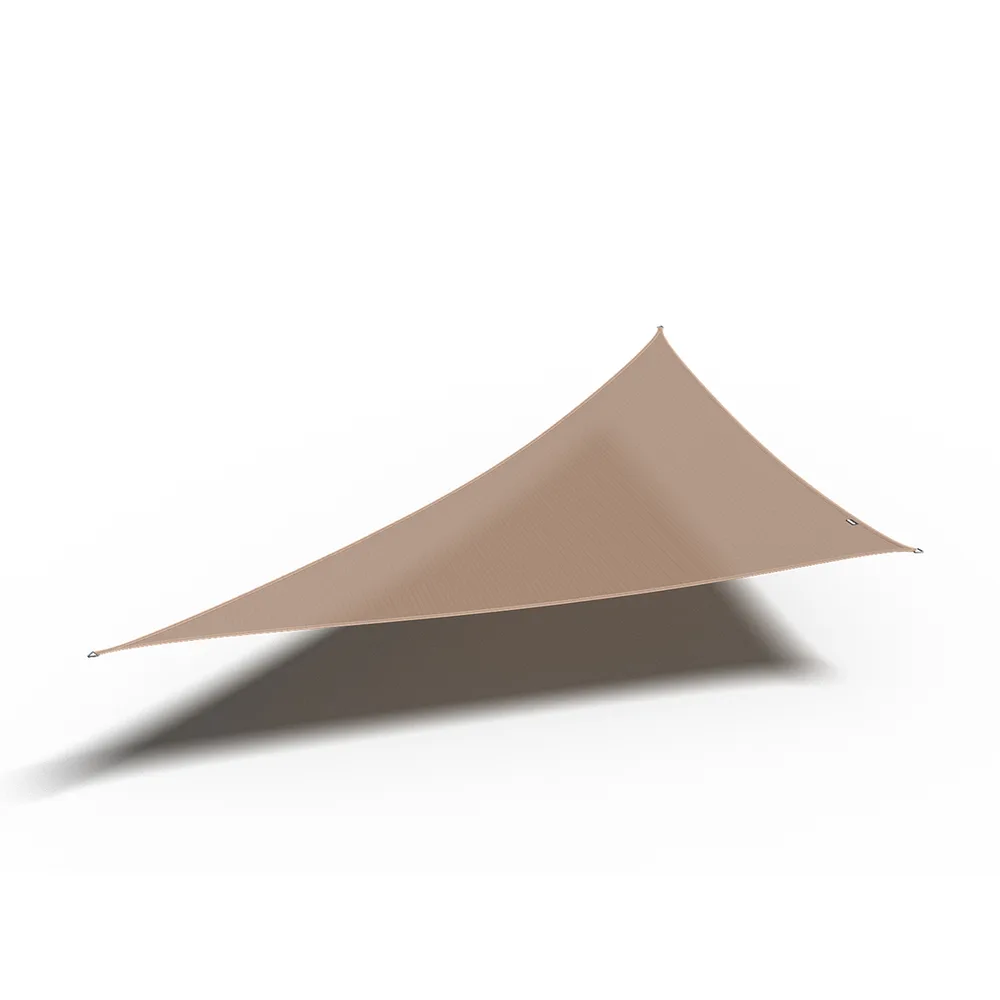
Coolfit shade sail triangle 90° sand
Because the sail lets water through, it's a shade sail and not a rain canopy. Make sure the walls can take the tension and stretch the sail taut. You can read how to tackle that in hanging a shade sail. More shapes and sizes are at the shade sails.
Coolfit roller blind for a semi-covered patio
Do you have a canopy, a projecting roof or a pergola over part of your patio? Then a roller blind blocks the sun that shines in at an angle beneath it. The Platinum Coolfit roller blind is 198 cm wide and 240 cm long, with an open, wind-permeable structure. According to the manufacturer, you fit it between, under or onto the frame or pergola, and operate it with a pulley system.
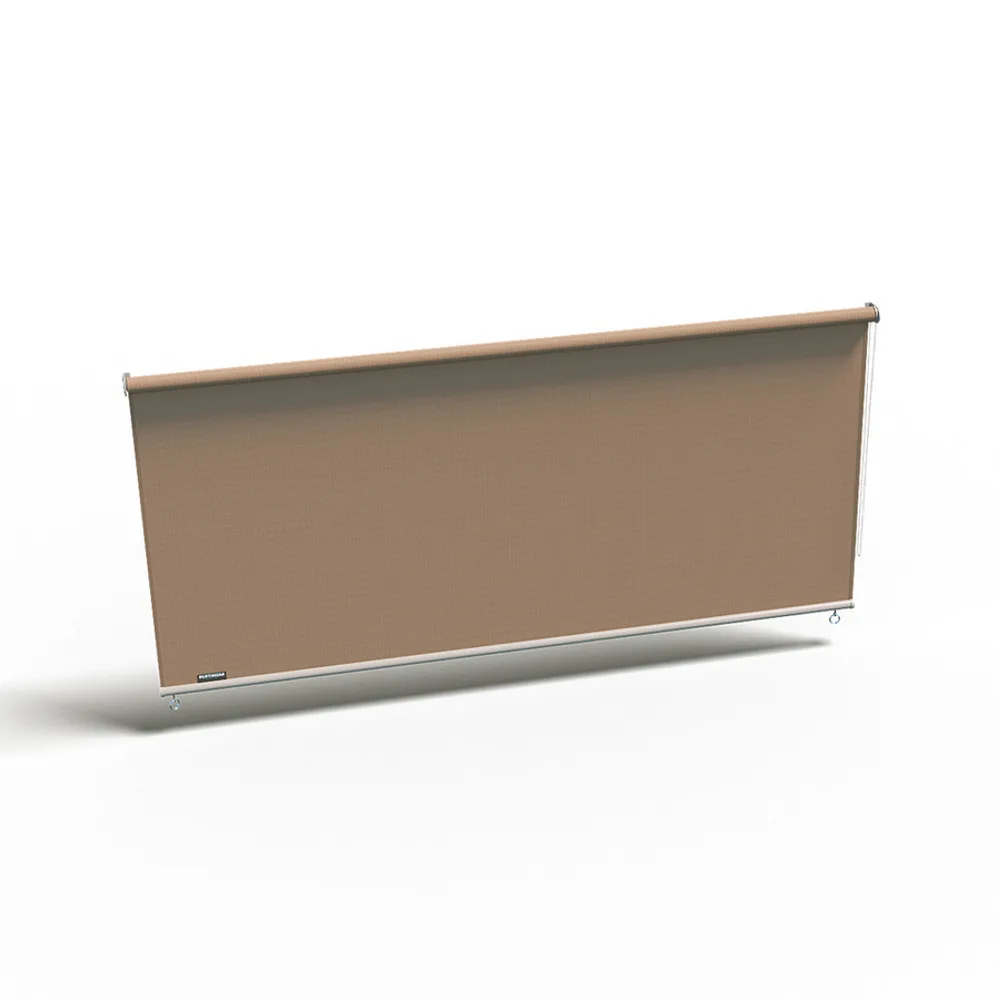
Coolfit roller blind 198 x 240 cm sand
Not sure whether you want a fixed canopy or pergola? Then read veranda, canopy or pergola.
Parasols for a small and a large patio
On a small patio the rectangular Riva at 250 x 200 cm is handy: it tilts, has an aluminium frame and a 38 mm mast, and its rectangular canopy fits well along a wall. On a large patio the Hawaii Emperor at 300 x 400 cm gives a large area of shade above the table. This cantilever parasol has a telescopic function and a clearance height of 225 cm. Neither comes with a parasol base; choose one that suits the size.
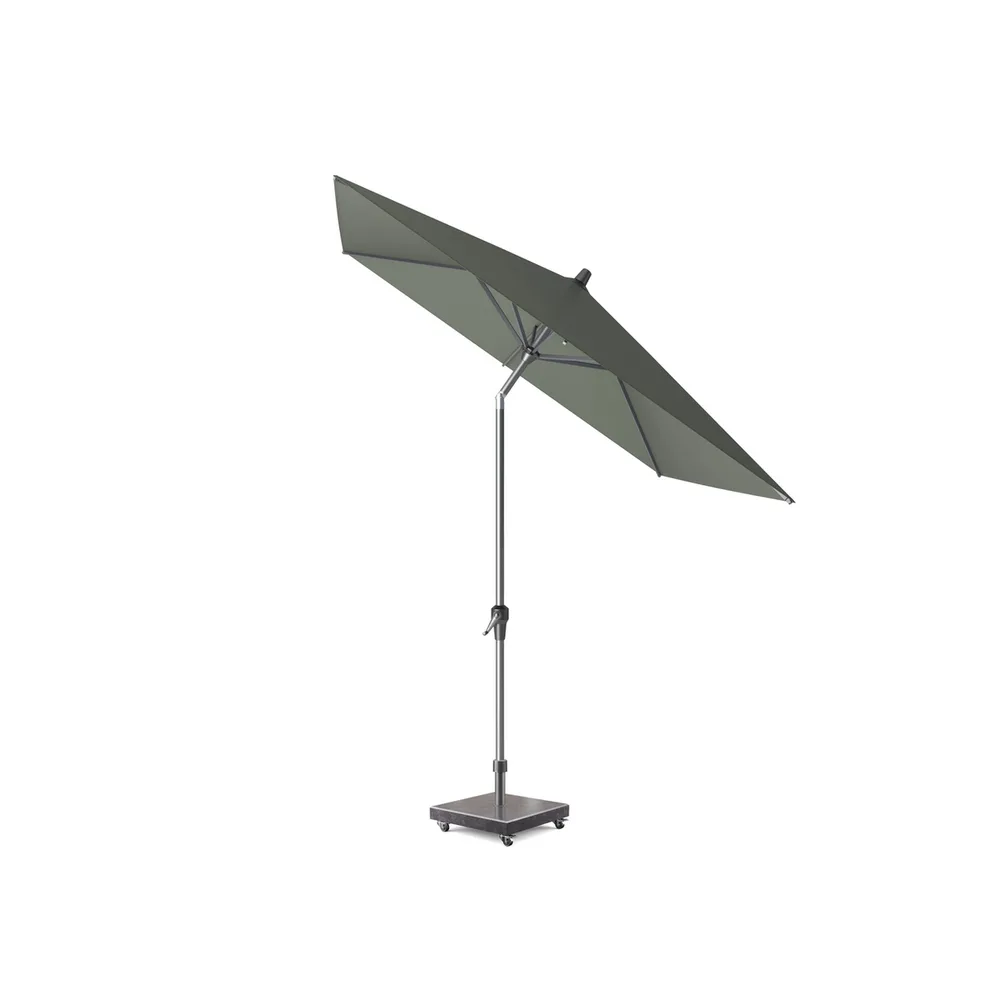
Riva parasol 250 x 200 cm
View parasol →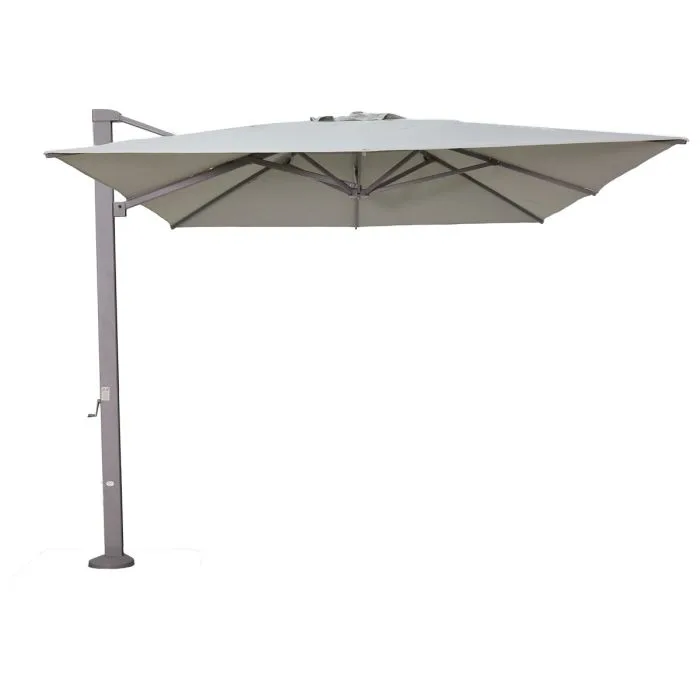
Hawaii Emperor 300 x 400 cm
View parasol →All pole parasols
View range →You'll find more choices at the cantilever parasols. For an overview of all the options, read shade solutions for the garden.
Light on the walls
The walls of a patio are perfect for lighting. Wall lights take up no floor space, you won't trip over cables and the light reflects softly off the wall. Spread two to four lamps across the walls instead of one harsh lamp above the door: then the patio feels like a room in the evening.
- Light up and down brings out the texture of a brick or rendered wall beautifully.
- Small wall spots placed low on the wall light a walking route or a step.
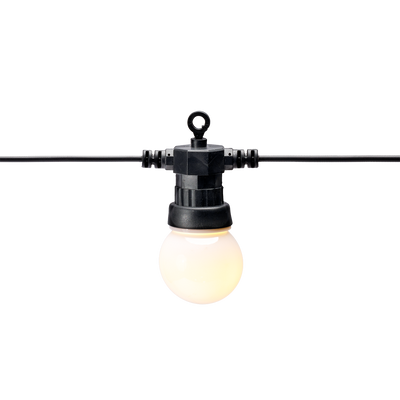
- A lamp with filament light next to the door gives a cosy glow.
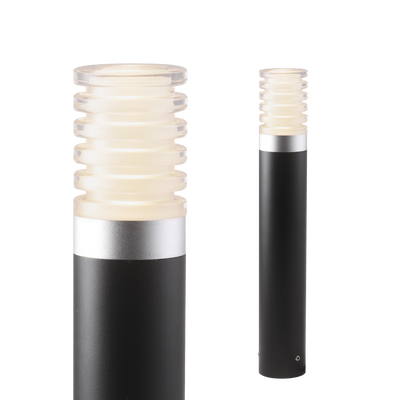
The Garden Lights Mauri is a black aluminium wall light that shines light up and down; you can adjust both light beams by angle. The Palm is a small round stainless steel light measuring 100 x 100 x 60 mm that shines downwards. The Columba is a black aluminium wall light with a filament LED. These lamps run on 12 volts and connect to a transformer from the Garden Lights system.
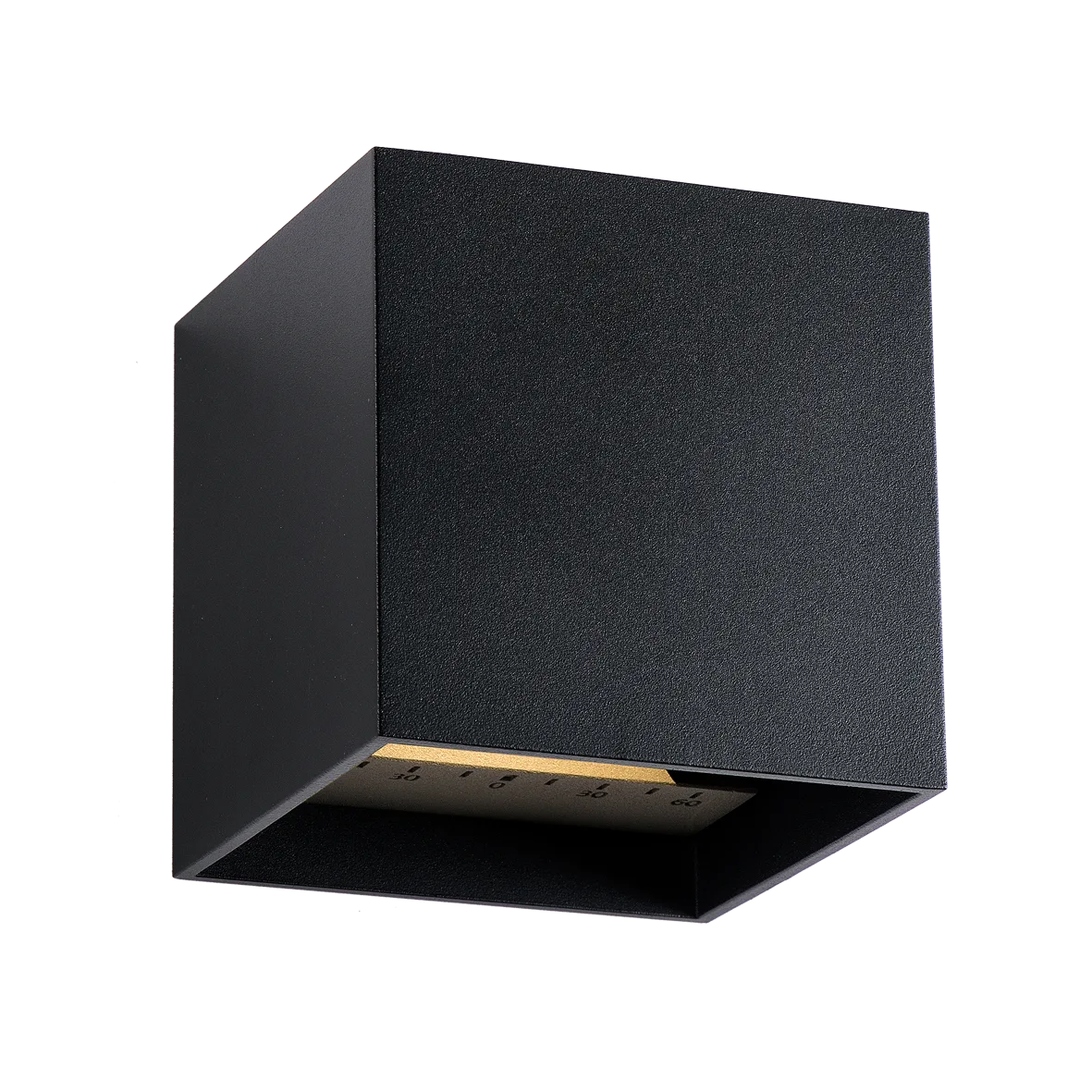
Mauri: light up and down
View lamp →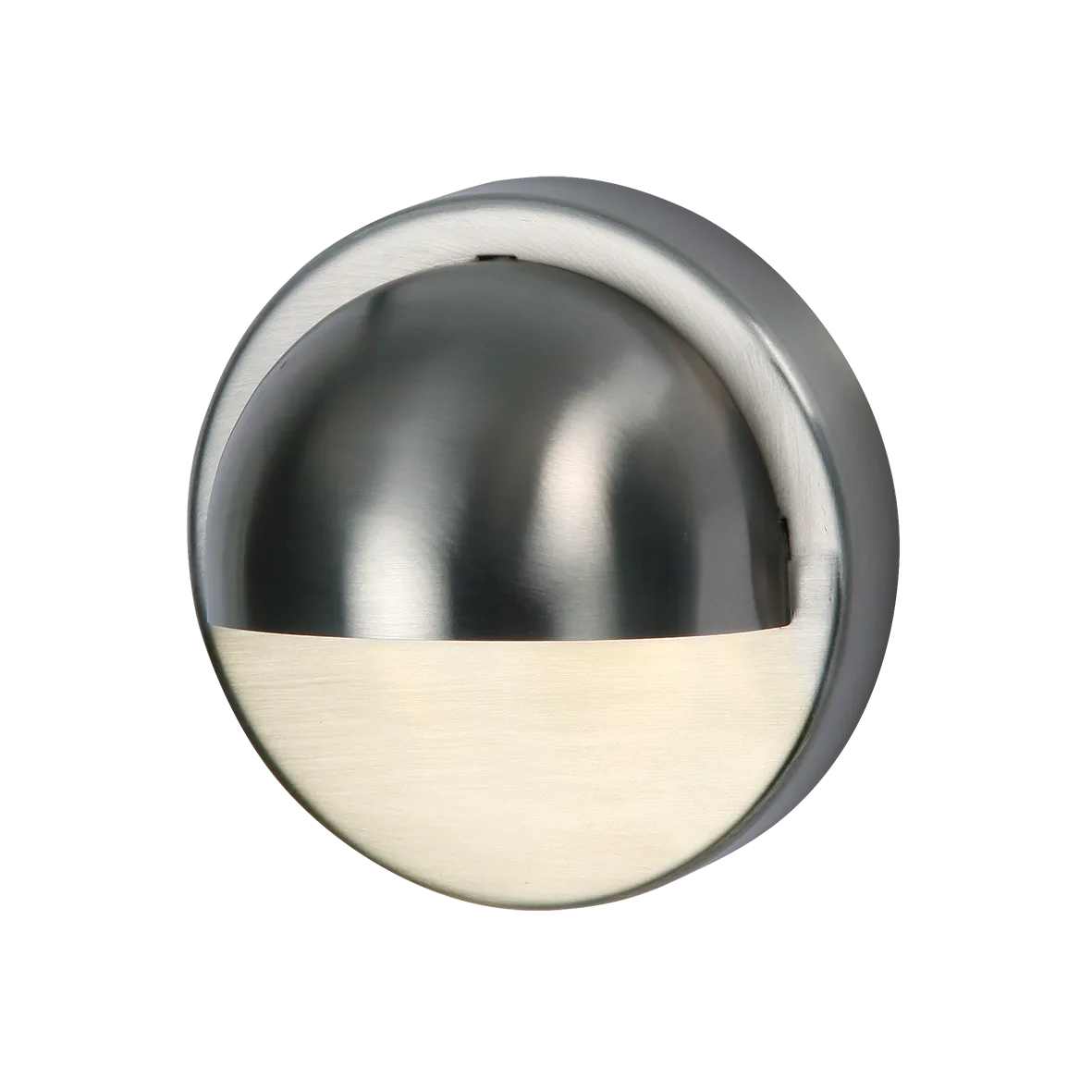
Palm: small and compact
View lamp →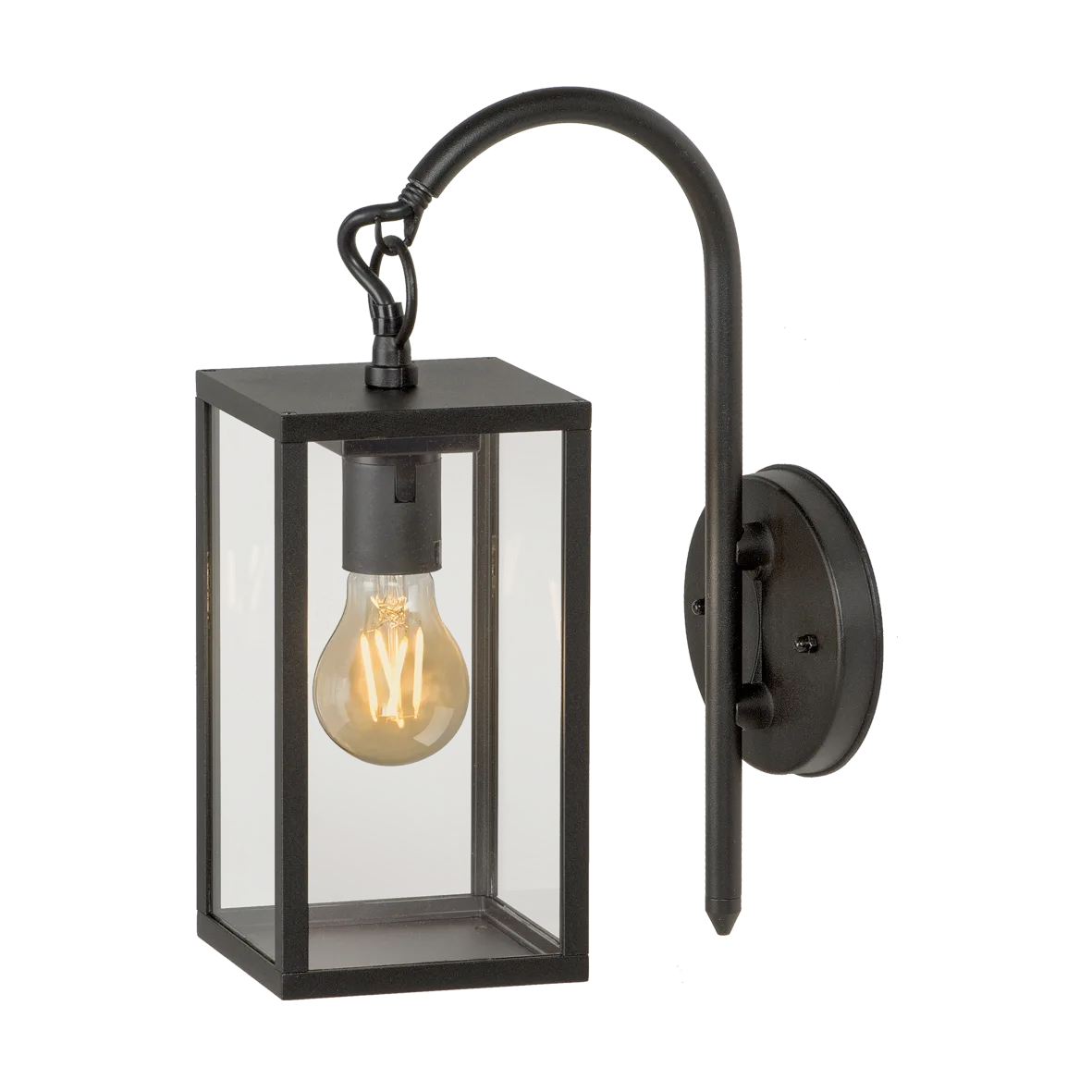
Columba: filament light
View lamp →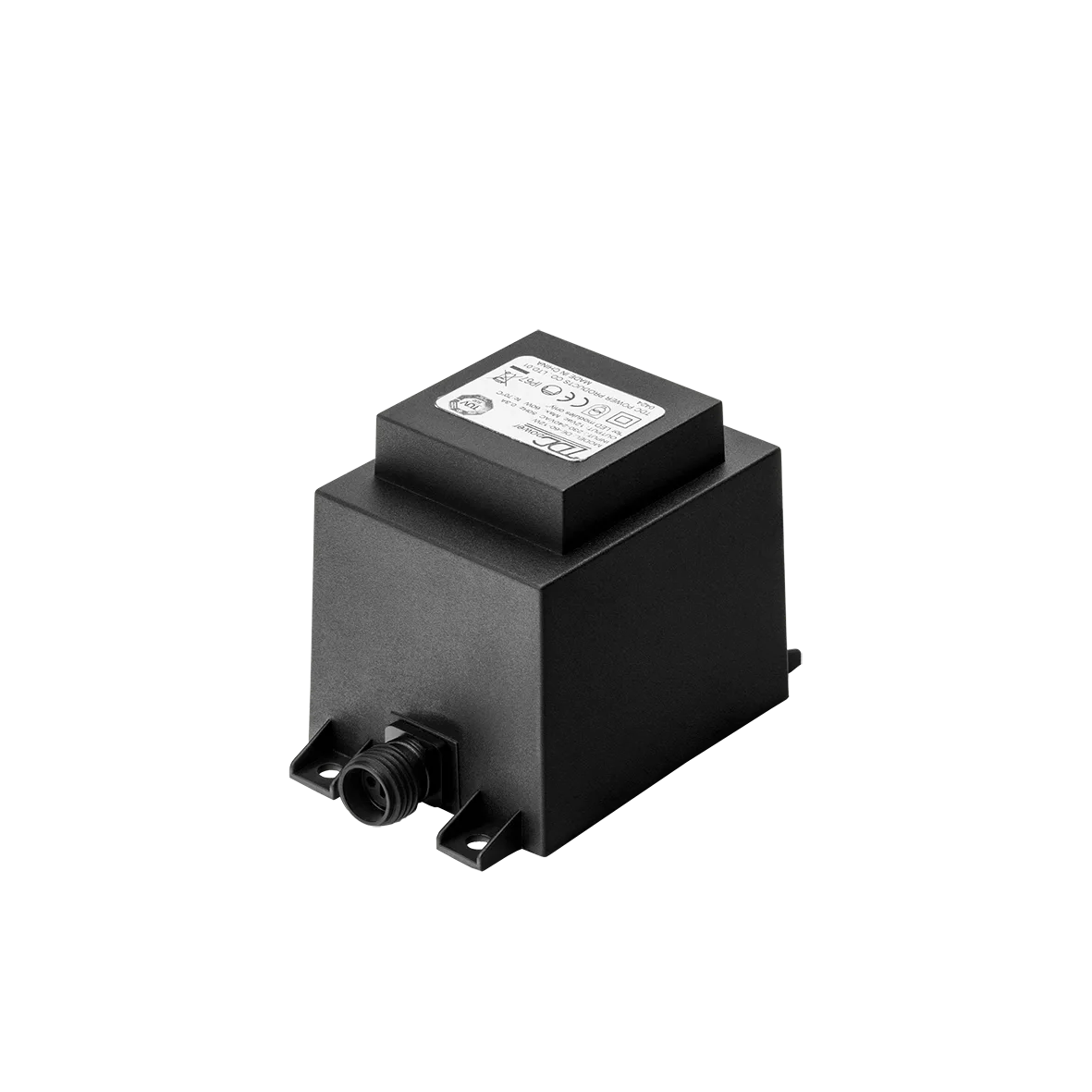
Transformer 60W
View transformer →You can read how to put together a 12V system like this in installing garden lighting with the Garden Lights 12V system. All models are at the wall lighting.
Greenery in pots and against the wall
On many patios there's no border and no open ground. Everything then goes into pots, troughs or against the wall. That's not a disadvantage: with pots you can keep moving things until the layout works, and greenery dampens the echo and softens the hard walls.
Choose by sun and shade
First check how many hours of sun fall on each spot. A warm, sunny wall is ideal for herbs such as lavender and rosemary. In a shady corner, ferns and hostas do better. A patio often has both, so choose corner by corner.
Prefer a few large pots
A group of three large pots at different heights looks calmer than ten small ones. Large pots also dry out less quickly, which makes a difference on a warm patio. Always use pots with a drainage hole, otherwise the water stays standing.
Let climbers do the work
String wires or a trellis against the wall and let a climbing plant grow along it. That gives you a green wall without losing any floor space. On a small patio this is the quickest way to make it feel greener.
Looking for a Mediterranean feel with terracotta, olive trees and white walls? In furnishing an Ibiza garden you'll find colours, materials and planting for that style, and on the style page Ibiza garden the matching furniture. Prefer something sleek or calm? Look at modern garden or Japandi garden.
The floor: tiles, fall and a rug
The floor of a patio has a lot to put up with: rainwater from the roof, shade where it stays wet for a long time and often the walking route to the garden. Three points to watch:
- Fall away from the facade: let the floor slope gently away from the house and towards a drain, so rainwater doesn't stand against the wall.
- Large tiles on a small patio: fewer joints give a calmer and more spacious look.
- Green build-up in the shade: in corners that get little sun, algae grows faster. You can read how to remove it in removing green algae from your terrace.
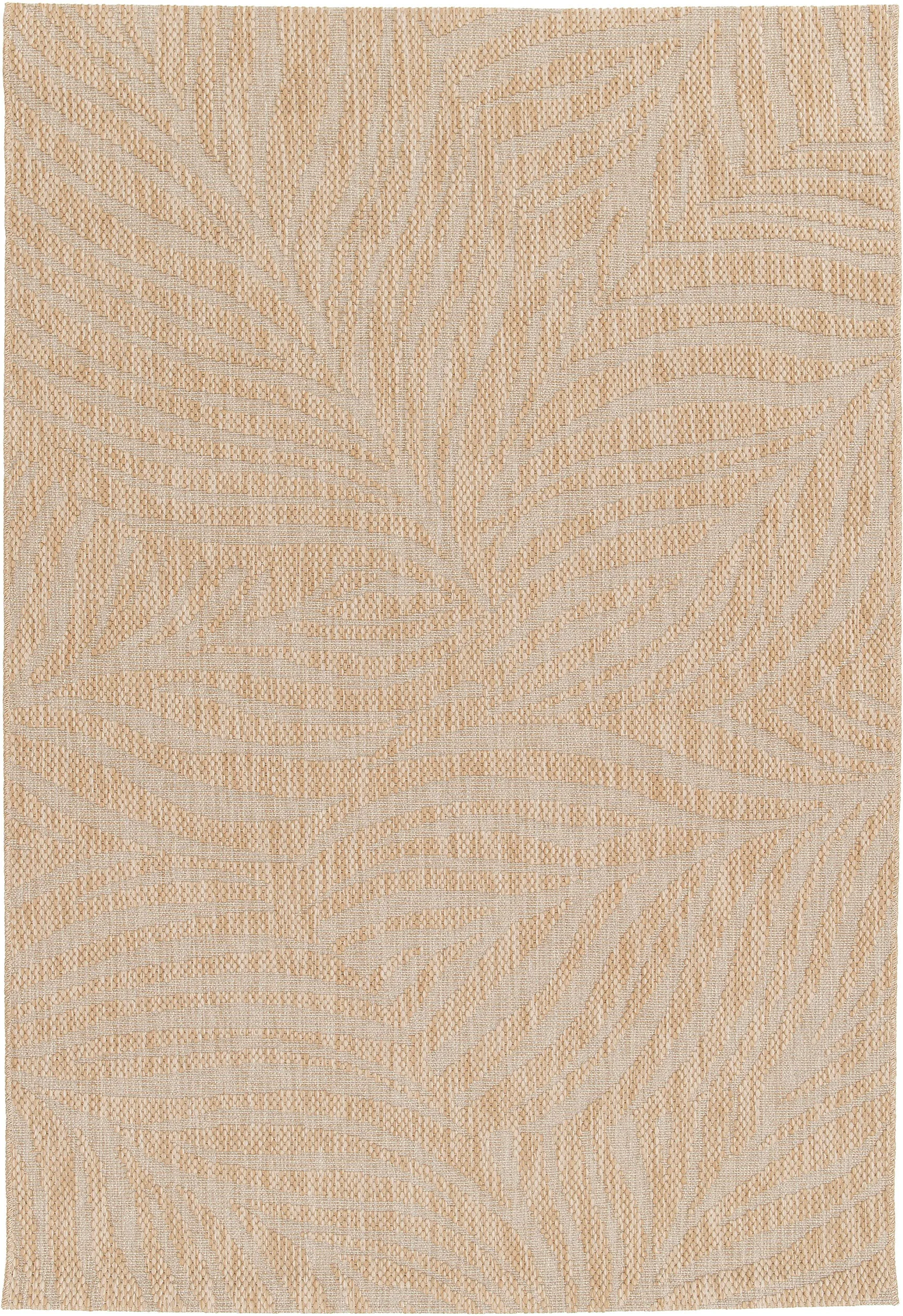
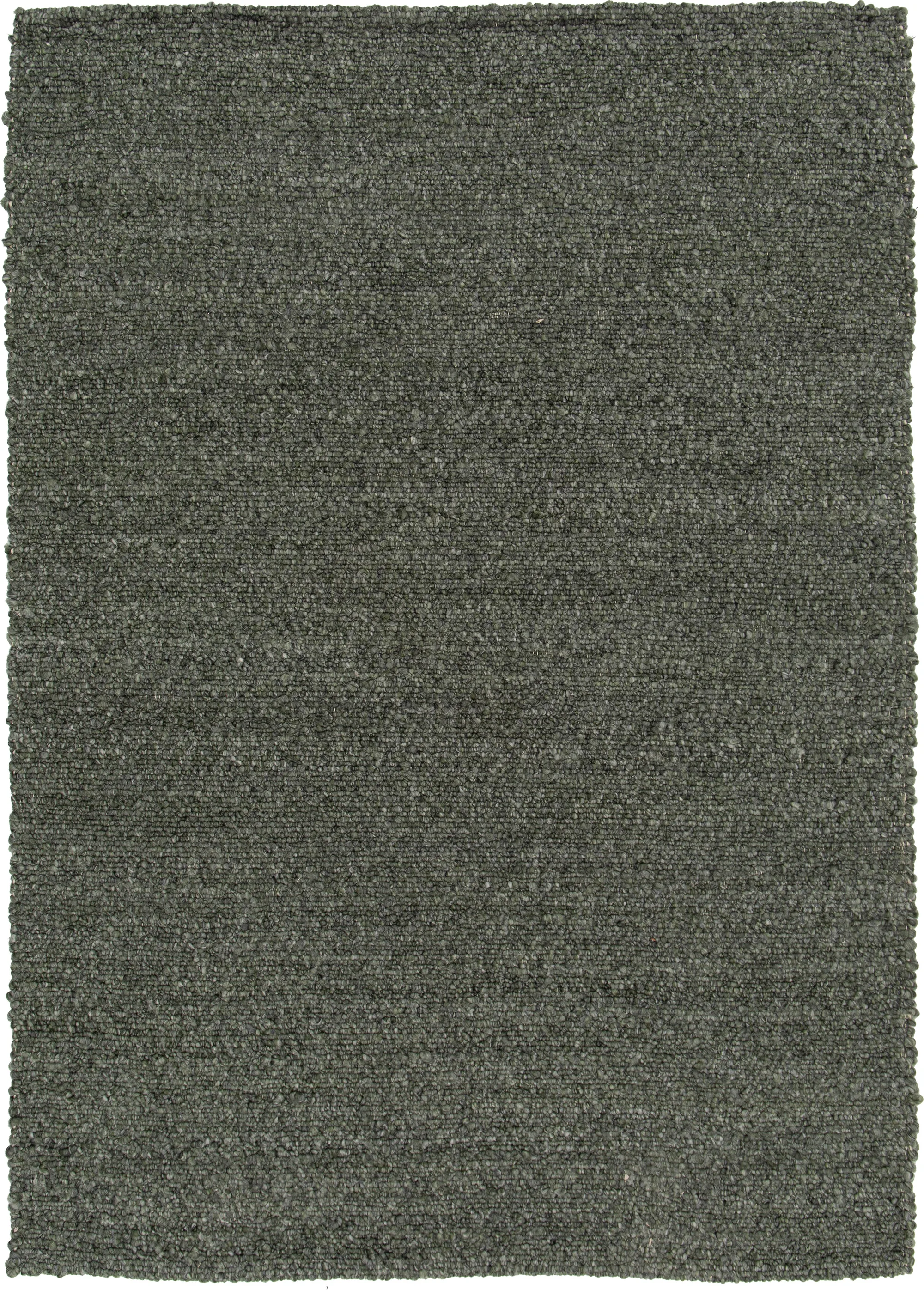
An outdoor rug turns a stone floor into a room and at the same time dampens the sound. Choose a rug that is large enough to place the front legs of your furniture on. On a small patio the Naturalis rug at 120 x 170 cm in leaf sand is a light choice. On a large patio the Ankara rug at 160 x 230 cm in dark green brings the greenery down onto the floor too. Both are weather-resistant.
To find out which size and material suit your furniture, read outdoor rugs for the terrace.
Furnishing your patio in 5 steps
Stand on your patio at different times of the day. Note where the sun lingers longest, which wall becomes warm and which corner is always dark.
Decide how you get from the back door to the garden, gate or shed. That route stays clear, and the rest of the floor is for furniture and greenery.
Choose a bistro set, a corner sofa or a lounge-dining set based on the free floor space. Place it against a facade or in a corner, not in the middle of the floor. Mark out the dimensions first with masking tape.
Choose a shade sail, roller blind or parasol for the warmest spot and spread wall lights across the walls. Check that the walls can take the fixings.
Place groups of large pots, let climbers grow up the wall and lay an outdoor rug under the seating area. That adds atmosphere and dampens the echo.
How to finish off your patio
- Furniture against the wall or in a corner, the walking route clear
- Shade above the warmest spot, preferably fixed to the walls
- Two to four wall lights with warm light instead of one harsh lamp
- Greenery in large pots and against the wall
- A rug and cushions to dampen the echo
Tick off what you already have:
- I know where the sun falls longest on my patio
- The walking route from the door to the garden or gate stays clear
- The seating stands against a wall or in a corner
- There is shade hanging above the warmest spot
- At least two wall lights are hung
- A few large pots stand with plants that suit the sun
- An outdoor rug lies under the seating area
Common mistakes
Putting the furniture in the middle of the floor
A set in the middle of a small patio blocks the walking route and leaves narrow, unusable strips on all sides. Place it against a wall or in a corner.
Underestimating the heat
Between stone walls it can get quite hot on a sunny afternoon. Without a shade sail, roller blind or parasol, you won't be comfortable sitting there.
Using only hard materials
Stone floor, stone walls, a metal set and a glass table: then every voice echoes. Add a rug, cushions and greenery.
One harsh lamp above the door
A single outdoor lamp mainly lights the door and leaves the rest in darkness. A few wall lights spread across the walls create far more atmosphere.
Leaving cushions outside in the shade
On a patio with little sun, cushions dry slowly. Store them dry after a downpour. Read how to store garden cushions.
Frequently asked questions
What is the difference between a patio and a terrace?
A patio sits directly against the house and is enclosed on several sides by walls, facades or high fences. It is often partly covered. A terrace is a paved area in an open garden. Thanks to those walls, a patio is sheltered and intimate, but it can also be warmer, darker or echoey.
How do you furnish a small patio?
Keep the floor as clear as possible and make use of the walls. Choose a bistro set or a compact corner bench against two walls, hang the lighting on the facade and let plants grow upwards along wires or in tall pots. Keep the route from the door to the garden or gate clear.
How do you get shade on a patio without a parasol getting in the way?
A patio gives you walls to attach things to. A triangular 90-degree shade sail fits exactly into a corner between two walls, with one pole on the open side. Under a canopy or pergola, a side roller blind works well. A tilting stick parasol can stand close against the wall.
How do you stop a patio from echoing?
Hard walls and tiles reflect sound. Soft materials absorb it: an outdoor rug, cushions, a shade sail and, above all, plenty of greenery in pots and against the walls. The more hard surfaces you cover, the calmer the patio will sound.
Which lighting suits a patio?
Wall lights are the most practical choice for a patio, as you can mount them on the walls and keep the floor clear. Choose warm white light and spread a few lights across the walls rather than one harsh light above the door. Lights that shine up and down make a wall look especially attractive.
Which plants suit pots on a patio?
First check how much sun the patio gets. In a sunny, warm patio, herbs such as lavender and rosemary do well. In a shady patio, choose plants that like shade, such as ferns and hostas. Always use pots with a drainage hole, and choose a few large pots rather than lots of small ones, as large pots dry out less quickly.