

A parasol that's too small has you shuffling chairs around all afternoon. One that's too big takes over your terrace and catches more wind than it needs to. The right size depends on what's underneath it, how many people you'll be sitting with, and how the sun moves across your terrace. This guide gives you a size chart as a starting point, explains the difference between round, square and rectangular canopies, and shows when a cantilever or a centre-post parasol makes more sense. Parasols in various sizes from our range are included.
In short: don't just measure your table, measure table plus chairs, and choose a canopy that extends well beyond that on every side. Follow the shape of the canopy with the shape of your table. Not sure? Go one size up, or pick a parasol that can tilt and rotate, because the shade moves with the sun. Want to find your size quickly? Take the choice test.
The rule of thumb: measure the whole seating area
The most common mistake is choosing a parasol based on the size of the tabletop. Nobody sits on the tabletop: the chairs go around it and get pulled back a bit. A parasol that's exactly the same size as the table mainly keeps your plate cool, not your shoulders.
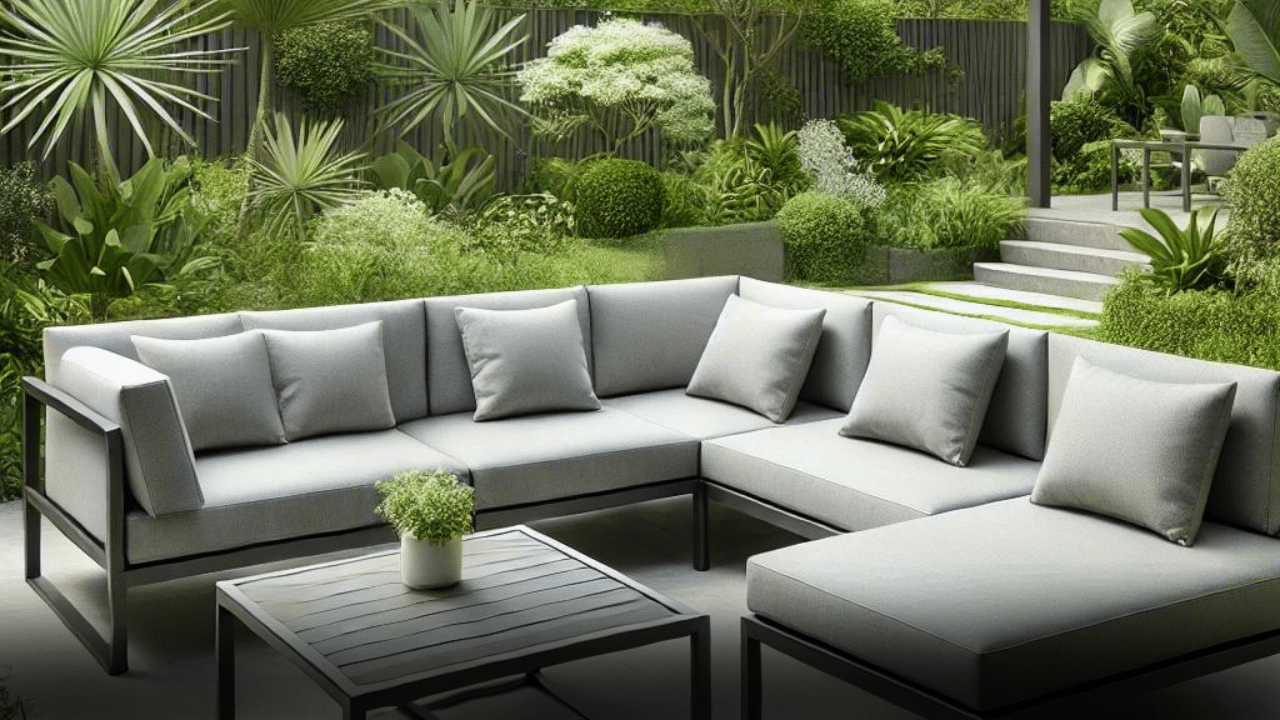
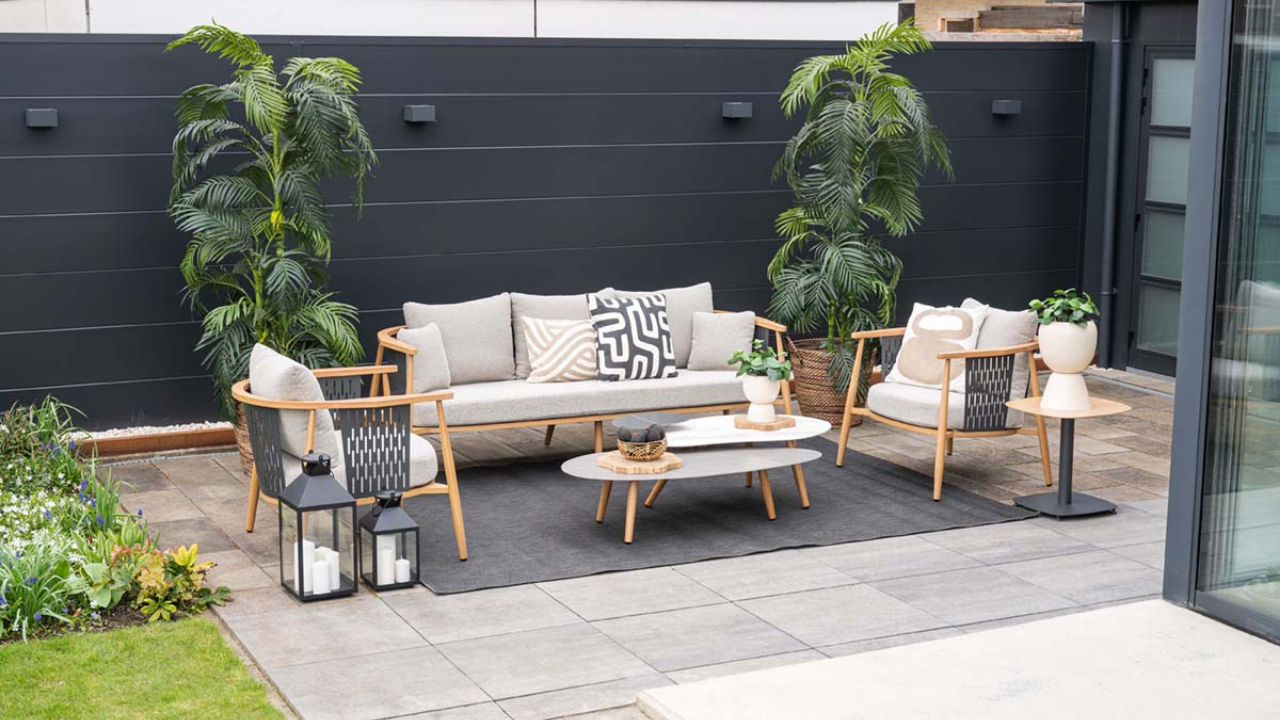
That's why this guideline: measure the outside dimensions of the table plus chairs, and choose a canopy that extends well beyond that on all sides. For a lounge set, measure the sofa with its cushions and the table in front of it. For a sunbed, measure the length of the bed, because you want your head and feet out of the sun too.
Arrange your chairs the way you actually sit in them, with the chairs pulled back slightly, and only then take your measurements. That's the area that needs to be in shade, not the tabletop.
Why the shade shifts
In the Netherlands, the sun is never directly overhead. The shadow of your parasol therefore always falls at an angle beside the parasol, and it moves from west to east over the course of the day. The lower the sun, the further the shadow moves away. In the morning, the late afternoon and in spring and autumn, the shade often falls a fair distance away from your table.
There are three ways to deal with that:
- A larger size: a bigger canopy keeps the table in shade for longer, even as the sun moves.
- Tilting: many parasols can be angled so the canopy leans towards the sun.
- Rotating and repositioning: with a cantilever parasol, the pole stands beside the seating area, so you can turn the canopy without moving the table.
For advice on where to position your parasol, considering sun, wind and the surface, read where should you place a parasol?
Size chart: from table to parasol
Use this table as a starting point. These are guidelines, not hard rules: a terrace that gets sun all day or where you tend to linger will generally call for the larger size.
| Table or seating area | People | Parasol guideline |
|---|---|---|
| Bistro or balcony table | 2 | Ø200 to Ø250 or 210 x 150 cm |
| Round or square table | 4 | Ø300 or 250 x 250 to 300 x 300 cm |
| Rectangular table | 6 | 300 x 300, 350 x 260 or Ø350 cm |
| Long table | 8 or more | 400 x 300 or Ø400 cm |
| Compact lounge set | 3 to 4 | Ø300 or 300 x 300 cm |
| Large corner lounge set | 5 or more | 350 x 260 to 400 x 300 cm |
| Sunbed | 1 | Ø250 or 250 x 250 cm, tiltable |
If your seating area falls between two sizes, choose the larger one if you have the space. For how much room a dining area needs, read how much space you need for a garden table.
Large corner sofa? Consider two parasols
An L-shaped lounge set is tricky to cover with a single canopy. Two smaller parasols, or one large cantilever parasol that you can rotate, often provide more shade where you actually sit.
Round, square or rectangular?
The shape of the canopy determines how the shade falls across your seating area. As a rule, follow the shape of your table.
| Shape | Suits | Note |
|---|---|---|
| Round | Round table, bistro set | Corners of your terrace stay in the sun |
| Square | Square table, lounge set | More shade than round at the same width |
| Rectangular | Long table, narrow terrace, balcony | Position the long side along the table |
A square 300 x 300 cm canopy gives more shade than a round Ø300 cm one, because the corners count too. A rectangular canopy is ideal if your terrace or balcony is narrow, or if you have a long dining table. Take a look at our round parasols, square parasols and rectangular parasols.
Centre-post or cantilever parasol?
The type of parasol also affects the size you need.
- Centre-post parasol: the pole sits in the middle, often through the hole in the table. The canopy hangs directly above the table, so the size needs to cover the seating area. Handy with a dining table that has a parasol hole, and on a balcony.
- Cantilever parasol: the pole stands beside the seating area and the canopy extends over it. No post in the way, which makes it ideal above a lounge set. Because many cantilever parasols can rotate and tilt, it's easier to follow the sun. Do allow space for the pole and base beside your seating area.
For a detailed comparison, read cantilever parasol vs centre-post parasol. Which base suits your parasol is covered in which parasol base do you need? Always check what the manufacturer of your parasol recommends.
Working out your size in 4 steps
Pull the chairs back as though someone is sitting in them. Then measure the outside dimensions of the table plus chairs, or of your lounge set with cushions.
Check how much room there is up to the wall, fence, railing, tree or roof edge. An open parasol needs to fit freely within that space, even when it's tilted.
Do you sit mainly at lunchtime, or in the evening sun? With low sun, the shade moves far away, and a large or tiltable parasol will serve you better.
Follow the shape of your table, choose centre-post or cantilever, and pick the size from the chart. If you're torn between two sizes, go for the larger one if it fits.
Choice test: which size do you need?
Answer four short questions and you'll immediately see which size range suits your spot.
Which parasol size do you need?
Which piece of furniture do you want to keep out of the sun?
- A bistro table or a balcony set
- A table for four or a small lounge sofa
- A table for six or a lounge set
- A long dining table or a large corner sofa
How many people are usually sitting outside on an ordinary summer day?
- Just the two of us
- Three or four
- Five or six
- Seven or more
How much free space is there around it, up to a wall, fence or railing?
- Hardly any, it's a balcony or a narrow terrace
- Enough to walk around it easily
- Plenty, with room for a pole beside the seating area
- Lots, a large terrace or an open garden
How long do you usually stay seated in one go?
- A cup of coffee or a quick drink
- Lunch or an hour of reading
- A long afternoon with family or friends
- From lunch until well after dinner
Compact: Ø200 to Ø250 or 210 x 150 cm. A small centre-post parasol or a rectangular model you can set along the railing. Choose one that tilts, so you can follow the sun without moving it.
Medium: Ø300 or 250 x 250 to 300 x 300 cm. Plenty of room for a table for four with the chairs. A centre-post parasol through the table works well, and a square canopy gives just a bit more shade.
Generous: 300 x 300, 350 x 260 or Ø350 cm. For a table for six or a lounge set. A cantilever parasol that can rotate and tilt keeps the whole seating area in shade for longer.
Large: 400 x 300 or Ø400 cm. For a long table or a large corner sofa. Consider two parasols too, and choose a base according to the manufacturer's advice.
Five parasols from small to large
To make the sizes more tangible, below are five parasols from our range, ranging from balcony to large dining table. Current prices can be found on the cards.
| Model | Canopy size | Suits |
|---|---|---|
| Lisboa (centre-post) | 210 x 150 cm | Balcony, bistro set |
| Riva (centre-post) | Ø300 cm | Table for four |
| Challenger T¹ (cantilever) | 300 x 300 cm | Table for four to six |
| Challenger T² (cantilever) | 350 x 260 cm | Table for six, lounge set |
| Challenger T¹ (cantilever) | 400 x 300 cm | Long table, large corner sofa |
Lisboa 210 x 150: rectangular for the balcony
The Lisboa is a middle-post parasol with a rectangular 210 x 150 cm canopy. It tilts, the height is adjustable, and thanks to its split pole it's easy to store. Set the narrow canopy along the railing or the wall so your balcony doesn't feel cramped.
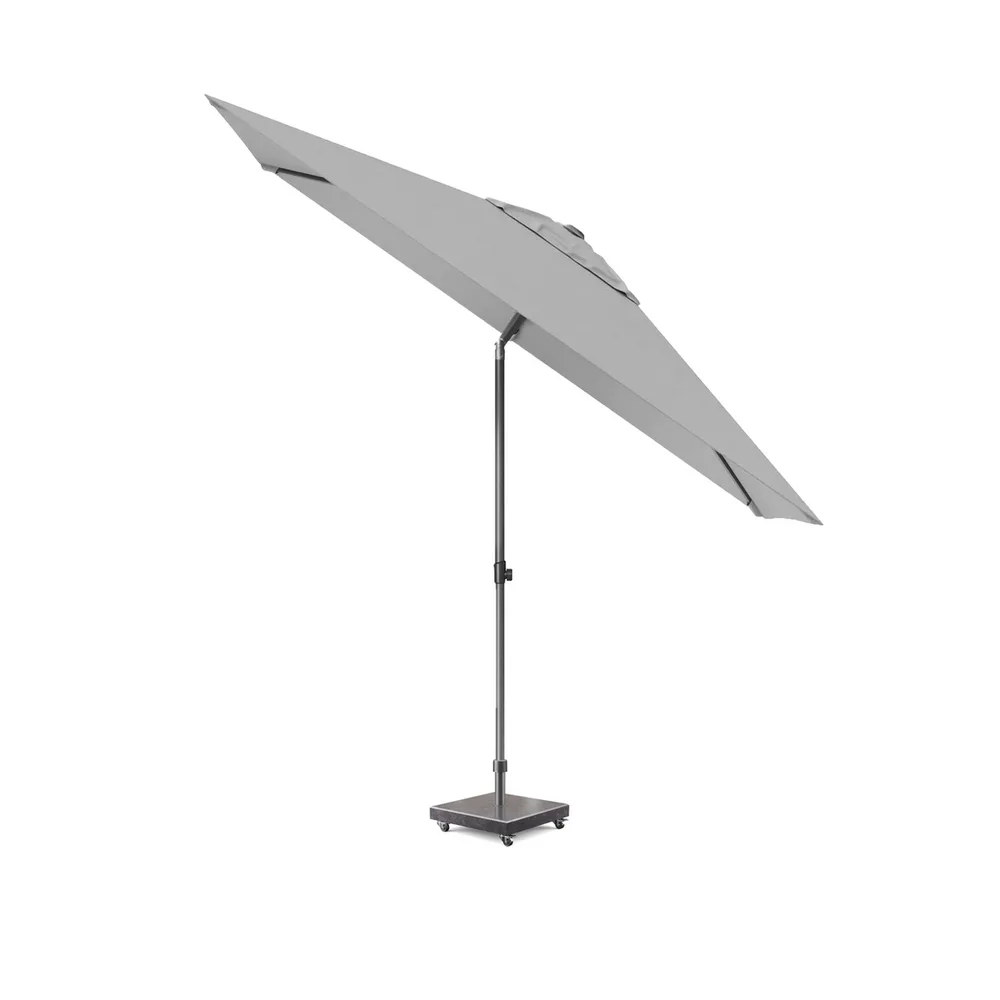
Please note: the parasol is supplied without a base. For more ideas for a small outdoor space, read tips for furnishing a balcony.
Riva Ø300: the classic size for four
A round Ø300 cm centre-post parasol is a popular size above a table for four. The Riva has an aluminium frame, a 220 gsm polyester canopy and a tilt function. Canopy tensioners keep the fabric taut.
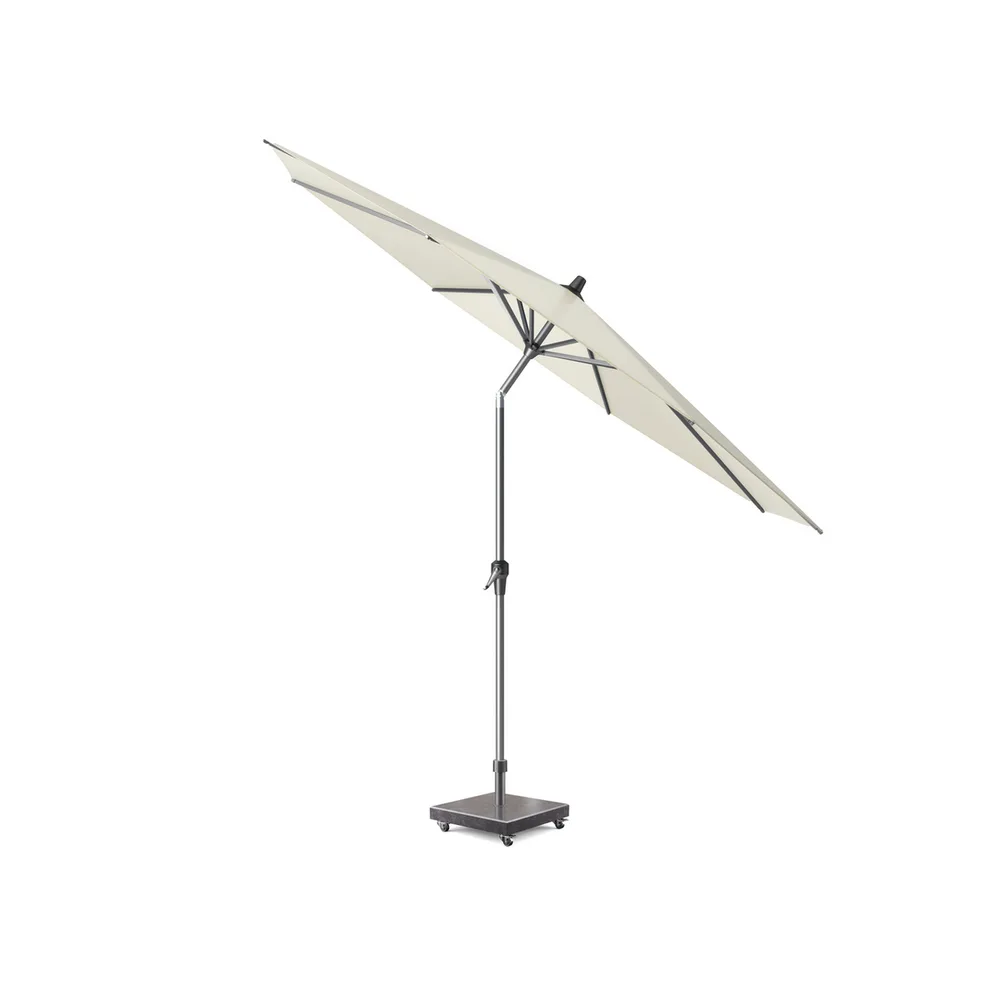
Riva parasol Ø300 ecru
Why: positioned through the table, the canopy sits directly above the seating area, and with the tilt function you can also block sun coming in from the side.
Challenger T¹ 300 x 300: square and rotatable
A square 300 x 300 cm canopy gives more shade than a round Ø300 cm one. The Challenger T¹ is a cantilever parasol that tilts backwards and rotates 360 degrees, with a 300 gsm polyester canopy. This way you can keep a table for four to six in shade without a post in the middle.
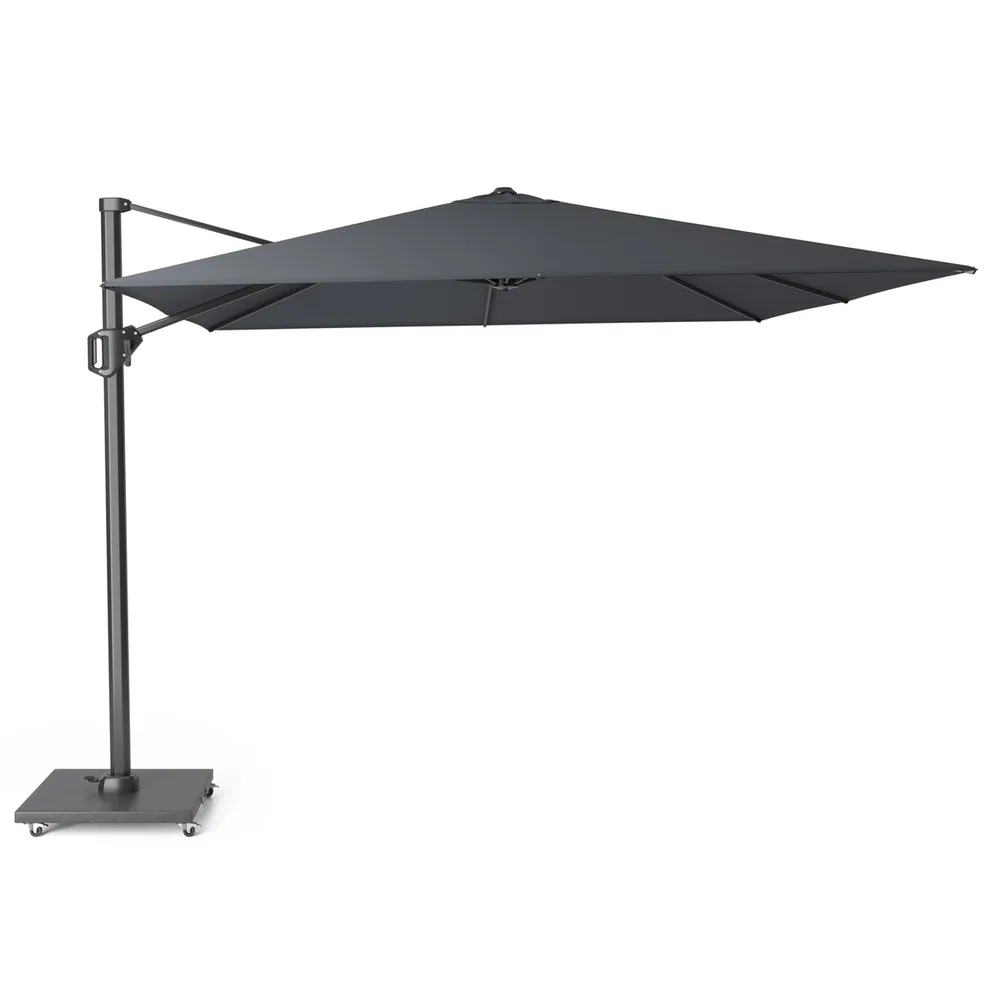
Challenger T¹ 300 x 300 anthracite
Challenger T² 350 x 260: rectangular for six
For a rectangular table for six, a rectangular canopy works best. The Challenger T² in 350 x 260 cm can tilt not only backwards but also sideways, and rotates 360 degrees. This keeps the long side of the table in shade, even as the sun moves.
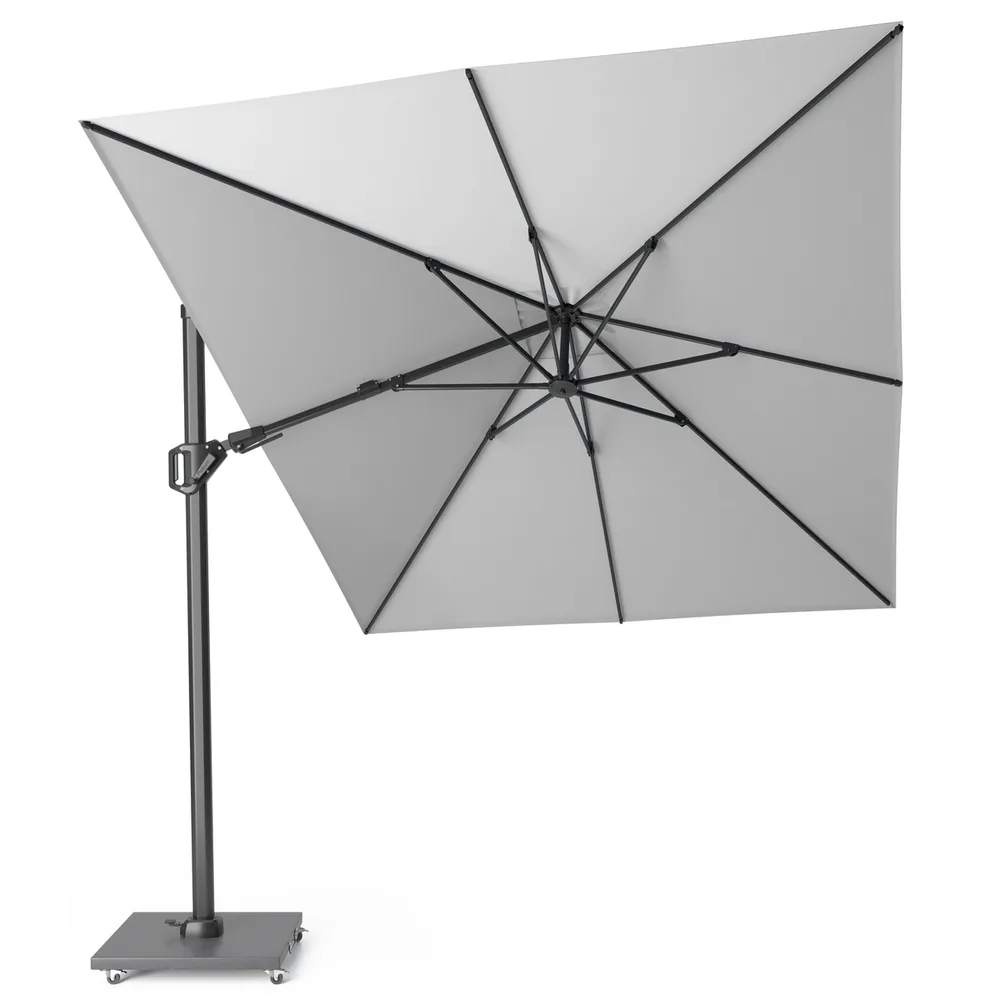
Challenger T² 350 x 260 light grey
Challenger T¹ 400 x 300: for the long table
For a long dining table or a large corner sofa, 400 x 300 cm is the generous choice. This Challenger T¹ has a 240 gsm Spuncrylic canopy in Faded Black, tilts backwards and has a 360-degree rotatable base. It's supplied without a base; Platinum recommends a 120 kg parasol base.
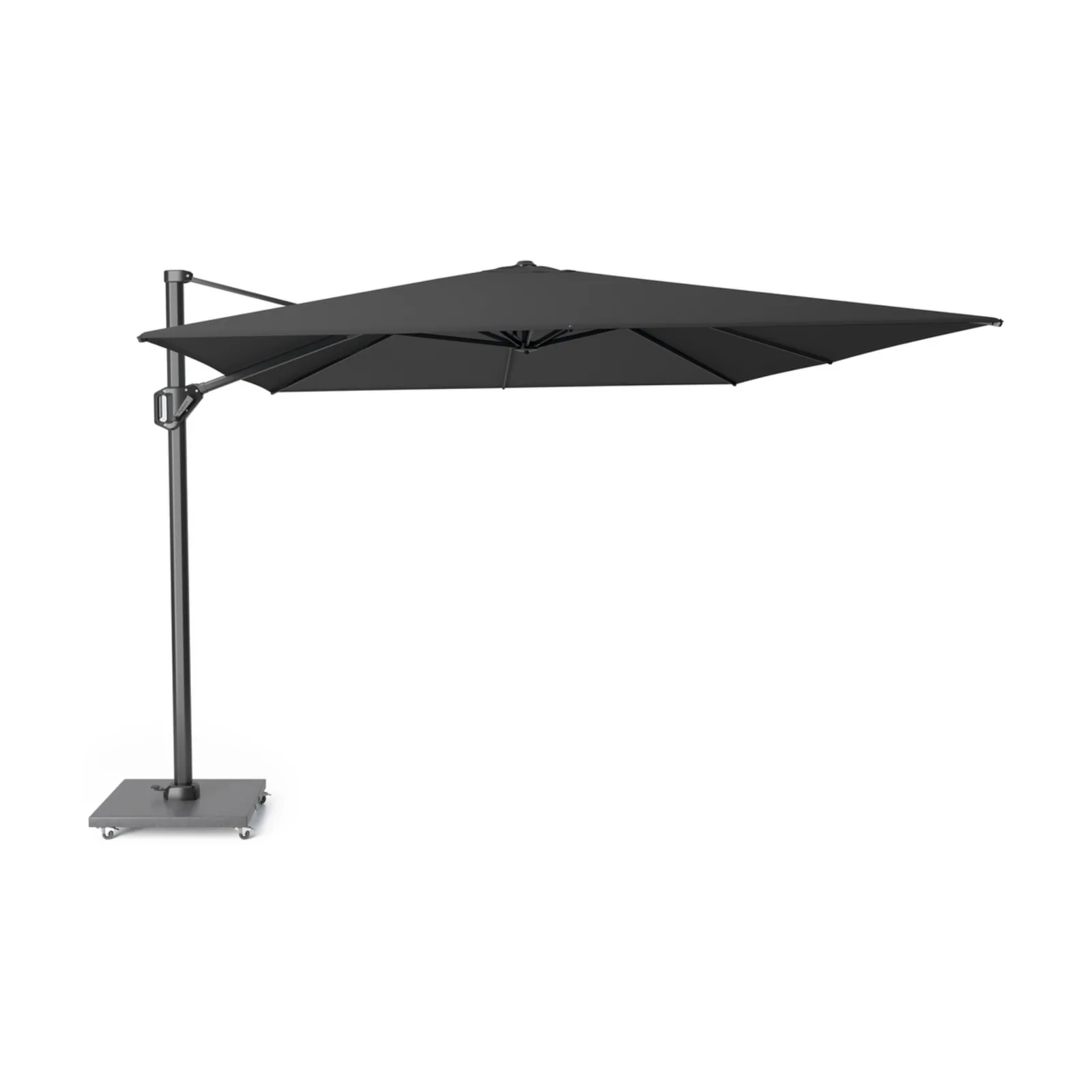
Challenger T¹ 400 x 300 Faded Black
Please note: a canopy four metres wide needs a lot of free space, including room for the pole beside the seating area. Measure that first.

How to choose the right size
- Measure table plus chairs, not just the tabletop
- Choose a canopy that extends well beyond the seating area on all sides
- Match the shape of the canopy to the shape of your table
- If you sit for long periods or in low sun, go larger or choose a tiltable model
- Check that the open parasol fits freely between wall, railing and trees
Also worth a look:
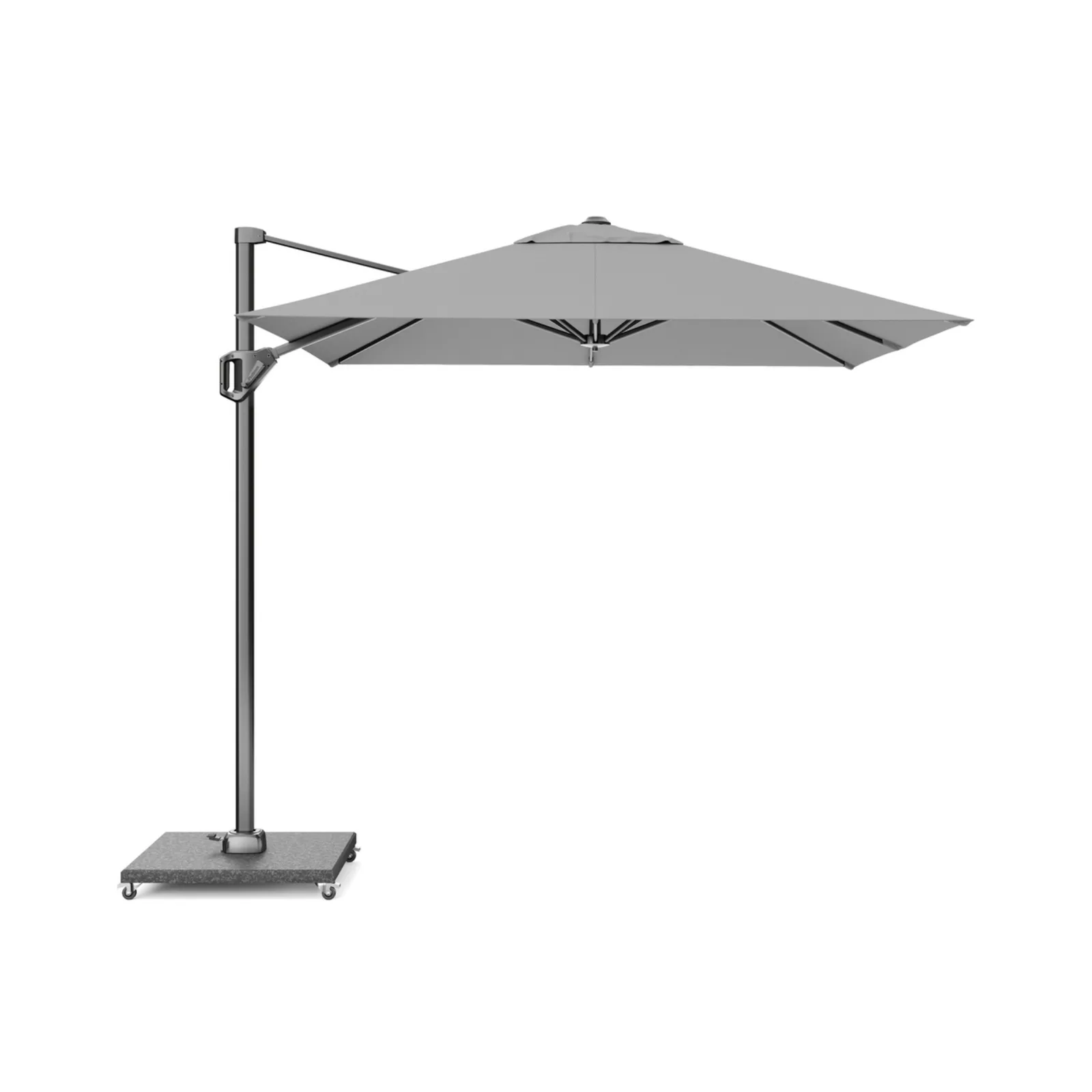
Voyager T¹ 250 x 250
View parasol →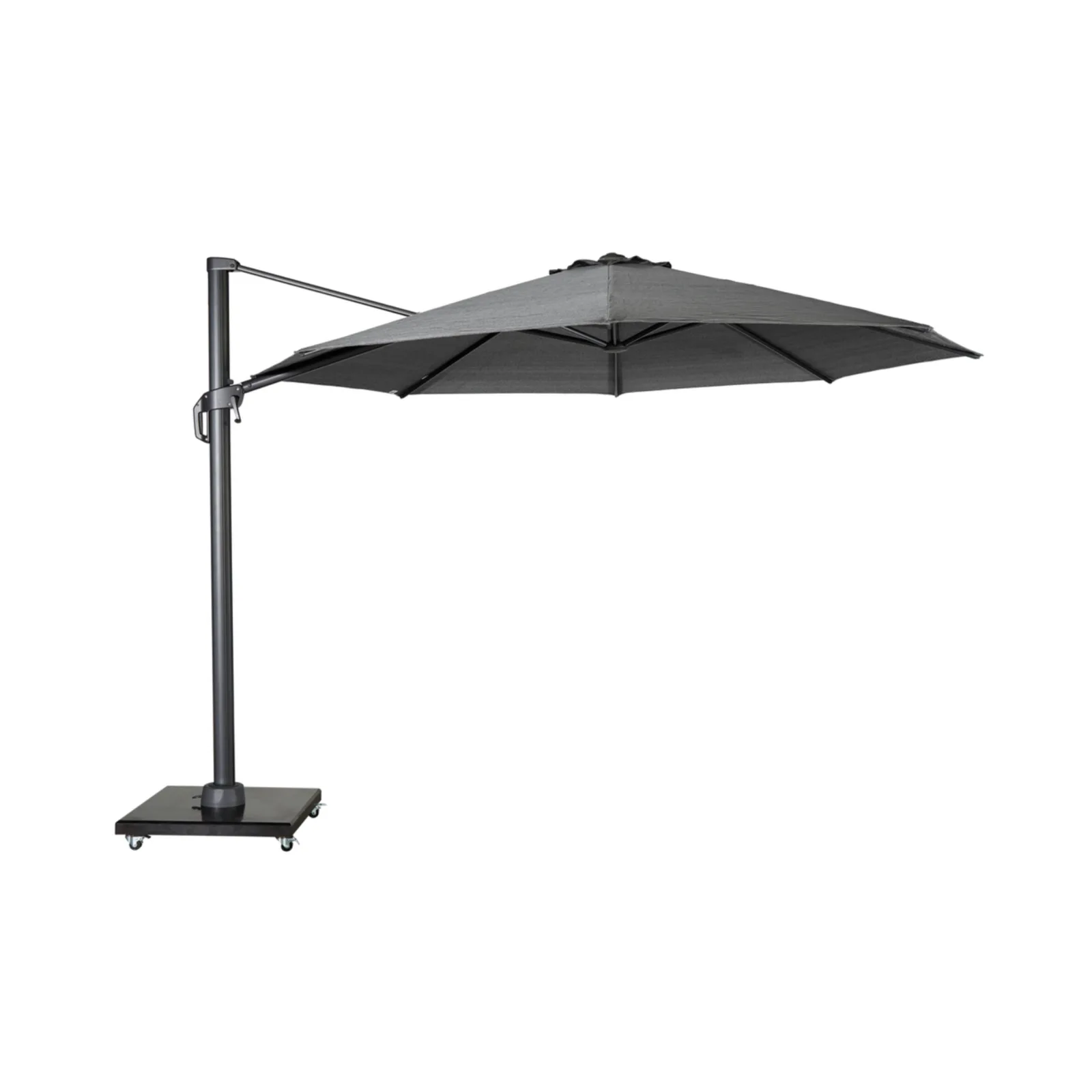
Nesling Coolfit Ø350
View parasol →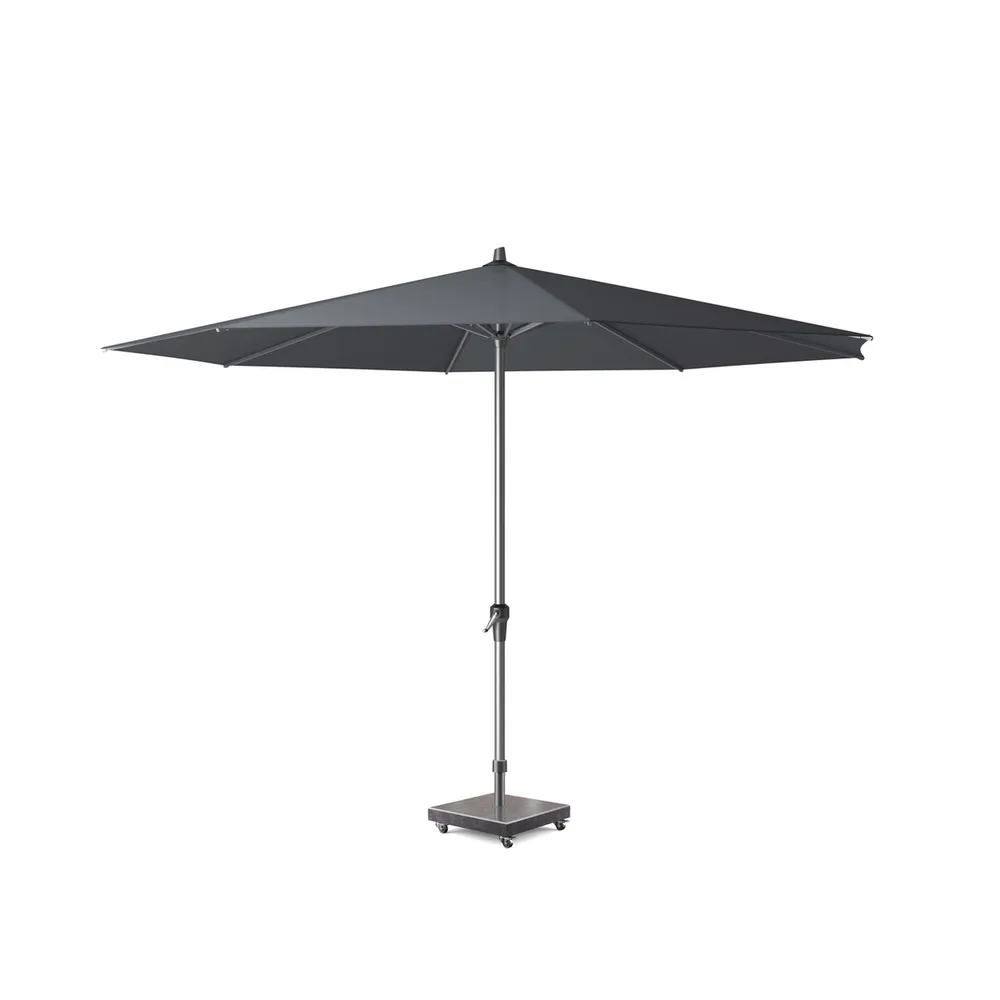
Riva Ø400 centre-post parasol
View parasol →The Riva Ø400 has no tilt function, so it's best placed where the sun hits your seating area straight from above. The Nesling Coolfit has an open HDPE canopy that lets wind and water through. Or browse all parasols and large parasols. If you want to compare models side by side, read the best parasols of 2026. Still unsure about your whole outdoor space? Then use our selection guide.
Common mistakes
Only measuring the tabletop
Chairs and the people sitting on them stick out beyond the table. Measure the whole seating area, or your guests will end up with their backs in the sun.
A round parasol above a long table
A round canopy leaves the ends of a long table in the sun. A rectangular canopy follows the shape of the table.
Forgetting the sun moves
At twelve o'clock you're perfectly covered, at five you're not. Choose a larger size or a parasol that tilts and rotates.
Too big for the spot
A canopy that hits the wall, the railing or a tree can't be opened or tilted properly. Measure the free space all around.
A large parasol on a light base
The bigger the canopy, the more wind it catches. Follow the manufacturer's advice and read which parasol handles wind best.
Before you order, run through this checklist:
- Measured the outside dimensions of table plus chairs
- Measured the free space up to walls, railings and trees
- Checked where the sun is when you're sitting outside
- Chosen the canopy shape to match the shape of your table
- Chosen between centre-post and cantilever
- Chosen the size from the size chart
- Chosen a suitable parasol base according to the manufacturer's advice
Frequently asked questions
How much bigger than the table should a parasol be?
Don't measure against the table alone, but against the table plus the chairs and the people sitting on them. These extend a good distance beyond the tabletop on every side. As a rule of thumb, choose a canopy that overhangs the chairs generously on all sides. If you're torn between two sizes, go for the larger one, as the shade shifts over the course of the day.
What size parasol do I need for a table for six?
For a rectangular table seating six, a rectangular parasol is often the best choice, for example 350 x 260 cm, as it follows the long shape of the table. A square parasol measuring 300 x 300 cm or a round one with a Ø350 cm diameter can also work. For a long table that you use often, 400 x 300 cm is the generous option.
Is a round or a square parasol better?
A round parasol suits a round table beautifully. At the same width, a square canopy gives more shade because the corners count too, and it fits neatly over a square table or lounge set. For a long table or a narrow terrace, a rectangular canopy is the most practical choice.
What size parasol suits a balcony?
On a balcony, space is usually the limiting factor. A compact pole parasol with a Ø200 or Ø250 cm diameter, or a rectangular model such as the Lisboa at 210 x 150 cm, often works better than a large round one. A rectangular canopy can be positioned along the railing. Always check that the parasol can open fully between the wall, the railing and, if applicable, the balcony above you.
Does a larger parasol need a heavier base?
Yes. A larger canopy catches more wind, and a cantilever parasol also hangs from one side, which adds further stress. For this reason, always follow the manufacturer's advice. For example, for the Challenger T¹ 400 x 300, Platinum recommends a base of 120 kg. You can read how to choose the right base in our article on parasol bases.