

From November it's dark by five o'clock, and you notice it in the garden. The path to the shed, the steps to the terrace and the driveway become slippery and hard to see, and in the evening you look out of the living room window at a black pane. The right lighting changes that: you walk safely to the front door, the garden is worth looking at in winter too, and the terrace stays a place to sit outside on a dry evening. In this guide you'll read how to light your garden during the dark months: where you need light, which sensors and timers are useful, whether solar lights work in winter, what frost and snow do to your lights, and how to light up the garden from inside the house.
Looking for general inspiration for garden lighting, all year round? You'll find it in garden lighting ideas: 10 ways to light up your garden. This article is about winter: short days, cold, damp and long evenings.
In brief: start with safety: light at the front door, the path, the steps and the driveway. Let the lights come on automatically with a dusk sensor, motion detector or timer. Solar lights run for shorter periods in winter, so use mains power or low voltage for important spots. Choose lights with an IP rating that suits the spot, light up a tree or shrub you can see from the house, and make the terrace cosy with warm light and a heat source.
Quiz: where does your garden need light in winter?
Every garden is different. Answer four questions to see where it's best to start. Then you'll read, topic by topic, how to tackle it. You'll find all the lights you come across on the garden lighting page.
Where do you start with winter lighting?
What bothers you most when it gets dark early?
- I can barely see the path or the steps
- I'm searching for the front door or the garden gate
- From the living room I look at a black window
- The terrace is a dark, empty spot in winter
Where is there power in the garden?
- There's already a cable or low-voltage system in the garden
- Only at the outside wall, next to the door
- There's an outdoor socket, but few cables in the garden
- Almost nowhere, only indoors
How do you want to control the light?
- It should come on automatically every evening along the path
- Only on when someone arrives
- With an app or schedule, together with other lights
- Just switch it on when I'm sitting outside
What do you find most important?
- Walking safely, even when it's icy
- Seeing who is at the door
- A nice view from the house
- Sitting outside cosily under a blanket
Start with path lighting. Bollards that direct the light downwards, on a dusk sensor or timer, make the path and steps safe without dazzling you.
Start with a wall light with a motion detector at the front door, the gate or the shed. The light comes on when you arrive and goes off again afterwards.
Start with light you can see from the house. A smart pedestal light or an uplight by a tree or shrub adds depth to the garden, on a schedule that suits winter evenings.
Start with the terrace. A wireless table lamp, a string light and a heat source turn the terrace into a place where you can still sit outside in winter.
Where do you need light in the garden in winter?
In summer you use garden lighting mainly for atmosphere. In winter the focus shifts: you walk to the shed, the wheelie bin or the bike shed in the dark, and you come home when it has been dark for a long time. So first list the functional spots, and only then the atmosphere:
| Spot | Why in winter | Which lighting | Control |
|---|---|---|---|
| Front door and garden gate | Looking for your keys, seeing who is ringing | Wall light | Motion detector with day-night sensor |
| Garden path | Wet leaves, black ice and loose paving | Bollards or pedestal lights | Dusk sensor or timer |
| Steps and stairs | You can't see a change in height in the dark | Low lights, directed downwards | Dusk sensor or timer |
| Driveway and bike shed | Getting out of the car and parking your bike in the dark | Wall light or floodlight | Motion detector |
| Terrace | Sitting outside for a while on a dry evening | String light, table lamp, mood lighting | Dimmer, timer or app |
| View from the living room | The garden stays visible instead of a black window | Uplight, spotlight, pedestal light | Timer or smart schedule |
This shows you at a glance where the priorities lie. Start with the places you walk and where it may be slippery; the atmosphere comes after that. The front garden counts too: a lit entrance is welcoming and makes the house less attractive to unwanted visitors. You'll find ideas for the front of your house in front garden ideas: 10 tips for a welcoming entrance.
How do you light a garden path and steps safely in the dark?
In winter there are wet leaves, moss and sometimes ice on the paving. Good light on the path stops you slipping or missing a step. Three rules of thumb:
- Point the light downwards: a bollard that casts light onto the ground shows you where to walk without shining in your eyes. A bright lamp at eye level dazzles you and actually makes the rest of the path darker.
- Spread the light: a few lights spaced along the path work better than one bright lamp at the end. Your eyes then don't have to keep adjusting.
- Mark changes in height: put a light beside a staircase or step that illuminates the treads, so you can see where the edge is.
You'll find bollards and pedestal lights under freestanding lighting. Ground spotlights in the path are also possible, but in winter they can disappear under leaves or snow. If you still want ground spotlights, first read buying a ground spotlight for the garden: what should you look for?.
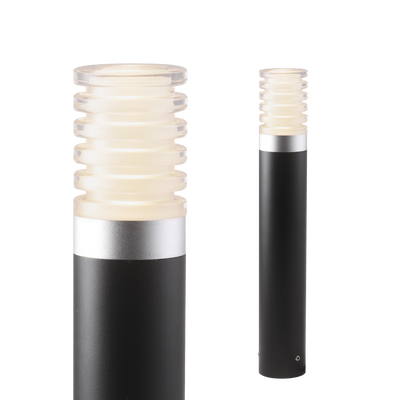
Lutec Gemini XF: bollard for along the path
An aluminium garden bollard of about 65 cm high, mains powered. According to the product information it is IP54, with integrated LED of 3,000 Kelvin, so warm white. It's tall enough to stick up above leaves and a layer of snow. You operate it with a switch, or fit a dusk sensor or timer to it.

Gemini XF garden bollard for path lighting
Clean the lights first
A glass cover full of dirt and cobwebs gives far less light. Wipe the covers clean in autumn and trim plants that have grown over the lights. That makes more difference than you'd think.
Outdoor light with a motion detector, dusk sensor or timer?
In winter you don't want to go outside at half past four every afternoon to switch the lights on. Fortunately, that can happen automatically. These are your options:
| Control | How it works | Useful for | Watch out for |
|---|---|---|---|
| Dusk sensor or day-night sensor | Light comes on when it gets dark | Paths, facades, mood lighting | Stays on all night, unless you add a timer |
| Motion detector | Light comes on when someone walks past, then goes off again | Front door, driveway, shed, bin | A moving branch or a cat can also trigger the light |
| Timer | Light switches on and off at set times | Mood lighting and views from the house | Adjust the times as the days get shorter or longer |
| Smart system with app | Schedule based on sunset, remote control | Several lights at once | Often needs a bridge or app |
At the front door a combination works best: a wall light with a motion detector and a day-night sensor, so the light only comes on when it's dark and someone approaches. You'll find wall lights with sensors under wall lighting, including from Steinel, Eglo and Lutec. If you want to control everything from one app, look at smart garden lighting and read smart garden lighting: Philips Hue and the alternatives.
Steinel L 1: wall light with motion detector
A black outdoor wall light with a built-in motion detector and day-night sensor. According to the product information it is IP44 and has an E27 fitting; the bulb is not included, so choose an LED bulb with warm white light. Handy at the front door, the back door or the shed.

Does solar garden lighting work in winter?
Solar lights are easy: no cables, no socket. But in winter they reach their limits. The days are short, the sun is low and it's often cloudy, while it's getting much darker for longer. The panel therefore charges the battery less, and the light runs for a shorter time or less brightly than in summer.
| Power source | In winter | Best place |
|---|---|---|
| Solar power | Shorter and weaker light, depending on the sun | Mood lighting in a sunny spot; lights with a motion sensor |
| Low voltage (12 or 24 V) | Constant light, safe to install in the garden | Paths, borders and views from the house |
| Mains power (230 V) | Constant light, also for brighter lamps | Facade, front door, driveway |
| Rechargeable battery | Light for as long as the battery lasts, then recharge | Table lamps on the terrace |
If you want to use solar in winter too, these tips help: place the panel where it gets as much sun as possible, facing south, wipe the panel clean now and then, and remove leaves and snow from it. When choosing solar, preferably pick a light with a motion sensor: it only comes on when someone passes and so saves the battery. For places where you need reliable light every evening, such as a staircase, choose mains power or low voltage instead. You can read more about choosing between the systems in buying garden lighting: what should you look for?.
Lucide Jackson: solar pedestal light with sensor
An aluminium pedestal light of about 50 cm high, powered by solar energy. According to the product information it is IP65, with a day-night sensor, a motion sensor and warm white light. A good choice for a sunny stretch of path where there's no cable.

Jackson solar pedestal light
Can garden lighting cope with frost, rain and snow?
Lights made for outdoor use can generally get through the winter. The weak point is usually not the light itself, but the connections, the cables and water that gets trapped somewhere. Pay attention to these points:
- IP rating: IP44 is protected against splashing water and is fine for a wall light under the eaves. IP65 is dust-tight and resistant to water jets, useful for lights standing freely in the garden. For ground spotlights, where water can collect, check the rating the manufacturer gives for that spot.
- Connections: couplings and junction boxes must be waterproof and preferably not sit in a hollow where water collects.
- Transformer: the transformer of a low-voltage system should hang dry, against the wall under a canopy or indoors.
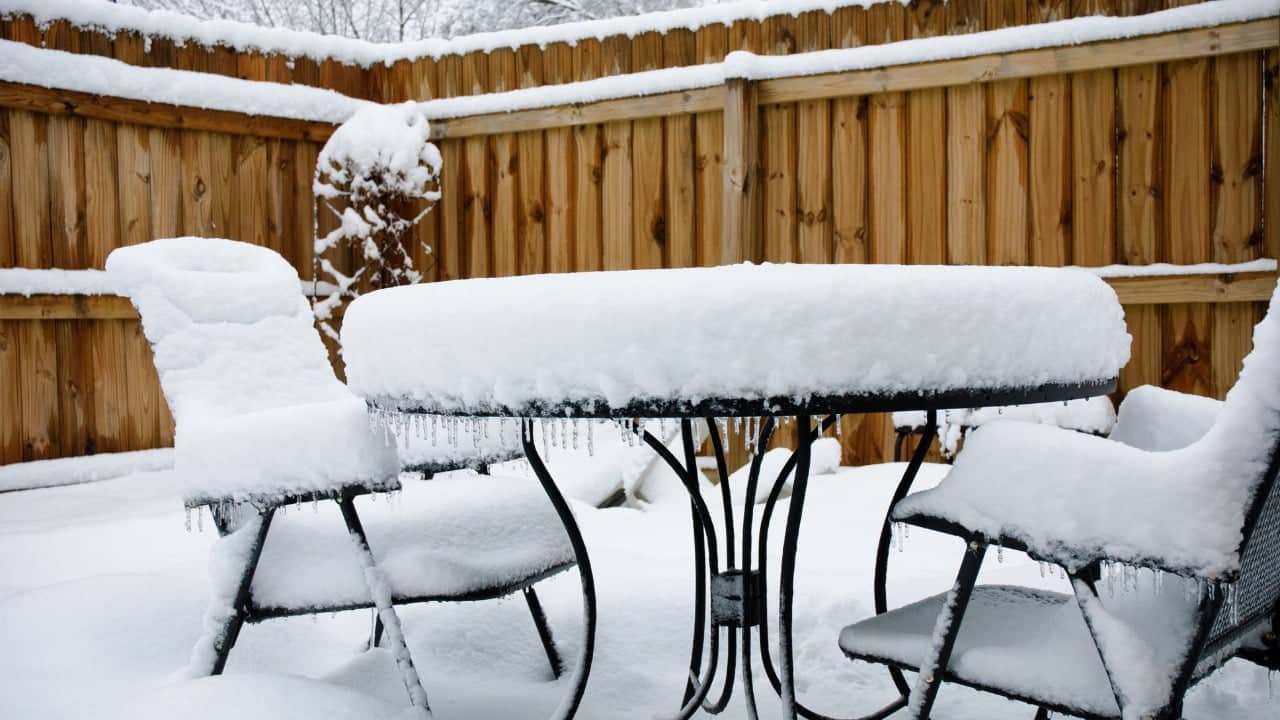
- Snow and leaves: ground spotlights and low lights get covered. Clear them so they keep giving light and don't get too hot or too wet.
Check after a storm
Wind can push bollards out of line and expose cables. After a storm, take a quick walk past your lights: push back a cable that has come loose, and replace a light with a cracked cover.
To learn how to install a low-voltage system neatly, with cables, connections and transformer, read installing garden lighting: Garden Lights 12V explained. And for the rest of the garden: getting garden furniture ready for winter explains how to protect your furniture, and frost-resistant planters shows which pots can handle winter outside.
How do you light the garden so you can see it from the house?
In winter you spend more time indoors than outdoors. So also look at the garden from the living room. A few well-placed lights give the garden depth and turn the window in the evening into a painting instead of a black mirror. Here's how to go about it:
- Choose one or two focal points: a tree, an evergreen shrub, an ornamental grass or a statue. A spotlight or uplight from below shows the shape.
- Light up the back of the garden: a point of light at the back makes the garden feel deeper. Without that light, the garden seems to stop at the window.
- Dim the light on the terrace: a brightly lit terrace right in front of the window dazzles you and turns the rest of the garden black.
- Evergreens work best: bare branches look lovely when lit, but an evergreen shrub gives a full picture all year round.
With a timer or a smart schedule, the light is on exactly during the hours you're looking at it. You can read more ways to create depth and atmosphere with light in creating atmosphere with garden lighting: 6 principles.
Philips Hue Calla: smart low pedestal light
A low aluminium pedestal light of about 25 cm, with white and coloured light. According to the product information it is IP65, dimmable and controlled via the Hue app. The light runs on low voltage; the product information shows what else you need to connect it. With a schedule in the app, it comes on automatically in winter when it gets dark.

Calla low pedestal light
Editor's tip: look at your garden on a winter evening from the sofa before you buy any lights. One light by that one tree you see from the living room often does more than ten little lights along the fence.
How do you make the terrace cosy in winter?
On a dry, clear winter evening it's lovely to sit outside with a blanket and something warm. Light and warmth make that possible. Combine three things:
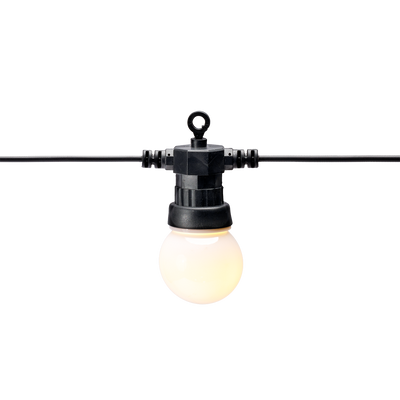
- Warm, dimmed light: a string light or a few table lamps with warm white light. To learn how to choose the right string light, read outdoor string lights: how to choose the right one.
- Wireless lights: a battery-powered table lamp you can place where you're sitting and take back inside when you're done. You'll find them under mood lighting.
- A heat source: a fire table gives light and atmosphere, a patio heater mainly gives warmth. Fire table or patio heater? explains what suits your terrace, and at terrace heating you can compare both.
More ideas for autumn, from blankets to seasonal decorations, can be found in 10 tips for a cosy autumn garden.
Konstsmide Scilla: wireless table lamp with dimmer
A table lamp with a glass cover and a rechargeable battery, with no cable on the table. According to the product information it is IP54, dimmable, with warm white light of 3,000 Kelvin, and a battery that lasts up to about nine hours. Charge it indoors and place it on the table outside when you're sitting out.

Scilla wireless table lamp
How much electricity does garden lighting use in winter?
In winter lights burn for much longer than in summer, so consumption goes up. With LED it's usually manageable, but it's worth working it out yourself. This is how: wattage multiplied by the number of hours of use gives the consumption in watt-hours. Divide by 1,000 for kilowatt-hours and multiply by your own electricity price.
| Example | Power | Hours of use per evening | Consumption per evening |
|---|---|---|---|
| One LED bollard | 10 W | 6 hours | 60 Wh (0.06 kWh) |
| Five LED bollards | 5 x 10 W | 6 hours | 300 Wh (0.3 kWh) |
| The same, with timer until 23.00 | 5 x 10 W | 4 hours | 200 Wh (0.2 kWh) |
| Wall light with motion detector | 10 W | Only when someone walks past | A fraction of that |
The figures in the table are a calculation example; the actual power is stated in the product information for your light. You can see straight away what helps: a timer that switches the lights off at night, and a motion detector in places where you don't need light all evening.
Five lights for winter compared
The lights from this guide at a glance. The details come from the product information; you'll see the current price and the shop on the cards.
| Light | Spot | Power | Control | IP |
|---|---|---|---|---|
| Lutec Gemini XF | Garden path | Mains power | Switch, optionally with timer | IP54 |
| Steinel L 1 | Front door, shed | Mains power | Motion detector and day-night sensor | IP44 |
| Lucide Jackson | Sunny path | Solar power | Day-night and motion sensor | IP65 |
| Philips Hue Calla | Border, view | Low voltage | App and schedule | IP65 |
| Konstsmide Scilla | Terrace table | Battery | On/off and dimmer | IP54 |
Also worth a look:

Eglo Rascino-E: wall light with sensor
View wall light →
Lutec Doblo: solar wall light with sensor
View wall light →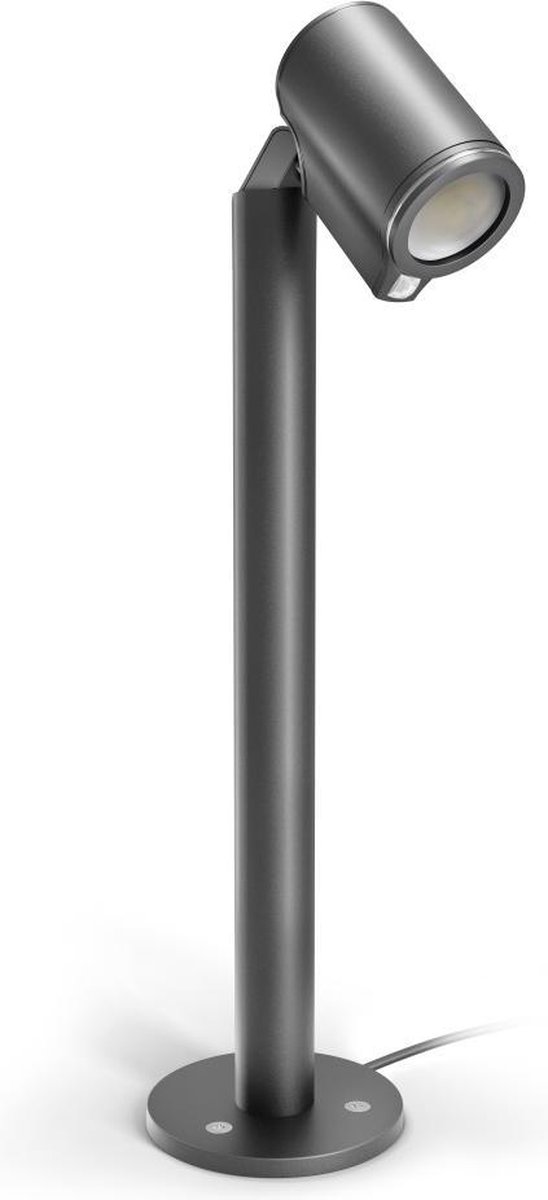
Steinel SpotWay: spotlight with motion detector
View spotlight →How to approach it
- Front door and driveway: wall light with motion detector and day-night sensor
- Path and steps: bollards that shine downwards, on a timer
- Solar: only in a sunny spot, preferably with a motion sensor
- View: light up one or two focal points
- Terrace: warm, dimmed light plus a heat source
Compare all the lights from Lutec, Steinel, Lucide, Philips Hue and Konstsmide at garden lighting, or start with a complete set.
What mistakes do people make with garden lighting in winter?
Click "Avoided" next to any pitfall you already avoid.
Relying on solar for the steps
In winter a solar light runs for a shorter time. For places where you need to be able to walk safely every evening, choose mains power or low voltage.
Bright lights at eye level
A bright light shining in your eyes makes the rest of the path darker. Point the light downwards.
Leaving lights on all night
A dusk sensor without a timer keeps the light on until morning. A timer or motion detector saves electricity.
The transformer in the wet corner
A transformer on the ground or out in the rain is asking for trouble. Hang it dry, under a canopy or indoors.
Forgetting ground spotlights under snow and leaves
Covered spotlights give no light and stay wet. Clear them regularly in autumn and winter.
Checklist: is your garden lighting ready for winter?
Go through these points and tick off what's done. Your browser remembers your ticks.
- Front door, path, steps and driveway have light
- The lights come on automatically with a dusk sensor, sensor or timer
- The timer times suit the short days
- Solar panels are in a sunny spot and are clean
- Covers are clean and plants have been trimmed back
- Connections and transformer are kept dry
- Cables are not exposed and bollards stand straight
- There is one focal point you can see from the house
- Warm, dimmable light is ready on the terrace
Frequently asked questions
Does solar garden lighting work in winter?
Yes, but for shorter periods and less brightly than in summer. In winter the days are short and the sun sits low, so the solar panel charges the battery less, while it is dark for longer. Place solar lights where they get as much sun as possible, keep the panel clean, and for spots where you really need light, choose a mains-powered or low-voltage lamp instead.
Can garden lighting withstand frost?
Garden lighting made for outdoor use can generally stay outside, even when it freezes. Do pay attention to the IP rating, to connections that must stay dry, and to ground spotlights where water can collect. Check the product information for the temperatures and locations the lamp is suitable for.
What time should garden lighting come on in winter?
You don't need to set this yourself if you use a dusk sensor or daylight sensor: it switches the light on when it gets dark. In winter that is much earlier than in summer. With a timer or a smart system you can also choose when the light goes off, for example when you go to bed.
What is the difference between a motion sensor and a dusk sensor?
A dusk sensor measures how much daylight there is and switches the lamp on when it gets dark. A motion sensor switches the lamp on when someone walks past and off again after a set time. Many outdoor lights have both: the motion sensor then only works when it is dark.
Which garden lighting is safest in snow and ice?
For a path or steps, lamps that direct light downwards are the most practical: you can see where you are walking without being dazzled. Bollard lights along the path stay above the snow, whereas ground spotlights disappear under a layer of snow. A lamp with a motion sensor by the front door means you can always see your keys and the doorstep.